ChatGPT Ads just hit $1bn run rate. Now comes the price test in India
Advertisers remain cautious about paying a premium until ChatGPT Ads proves its ROI
 by
by
Published: Sep 1, 2026 8:48 AM | 7 min read
 Follow Us

- OpenAI's ChatGPT Ads has achieved a $1 billion annualized revenue run rate within six months of testing, although it has not yet booked that revenue.
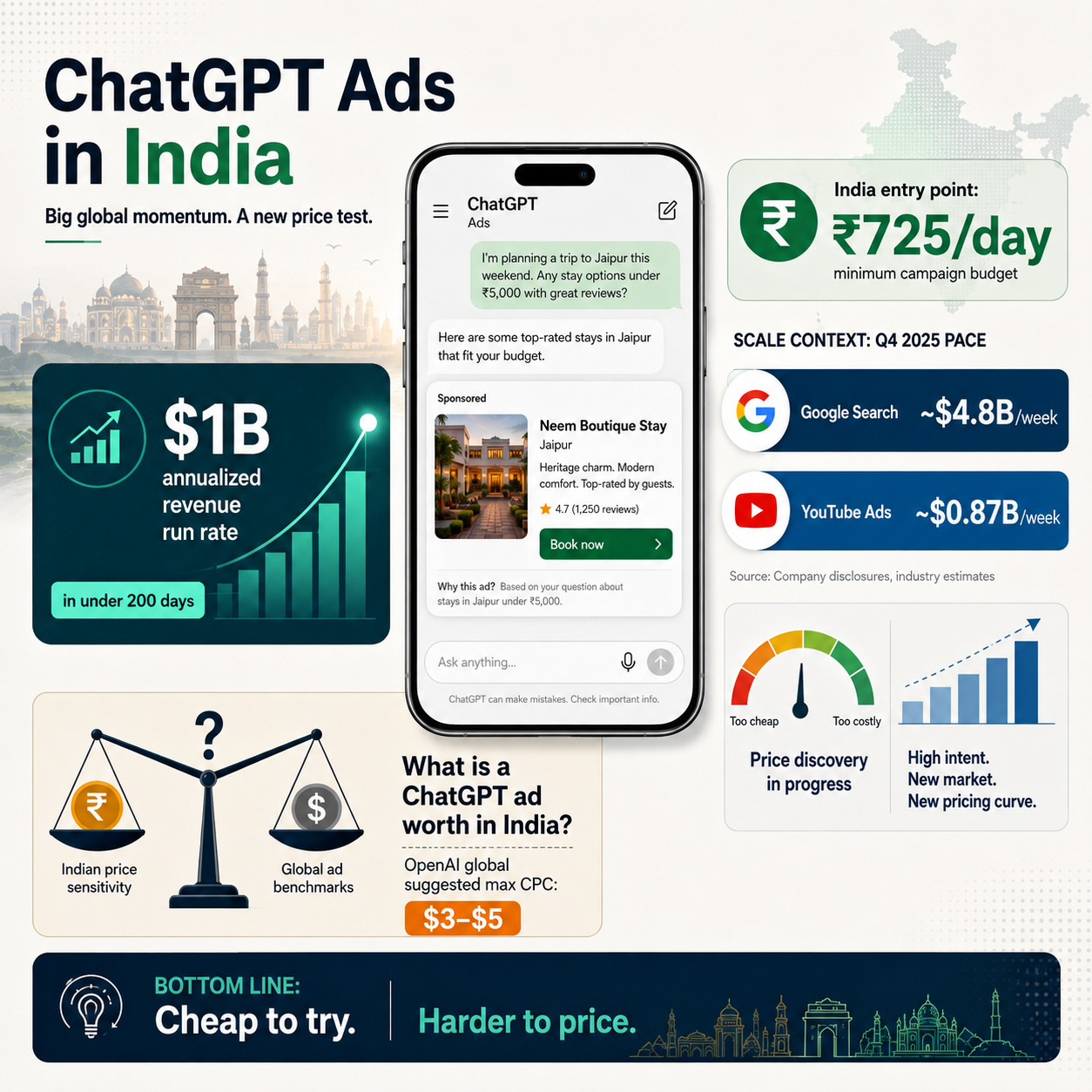
- The ad service has launched in India, targeting one of the largest digital advertising markets, with a minimum daily campaign budget set at ₹725 to encourage experimentation.
- Advertisers are cautious about the platform's pricing, which initially showed higher costs compared to competitors like Meta, and are waiting for performance data to determine if the investment is justified.
- The success of ChatGPT Ads in India will depend on its ability to demonstrate that higher costs can lead to better conversion rates and return on advertising spend compared to established platforms.
Less than 200 days. A $1-billion annualised revenue run rate. Tens of thousands of advertisers.
That is where OpenAI says ChatGPT Ads stands as of August 31, barely six months after it began testing advertising. To be clear, the company has not booked $1 billion in advertising revenue in that period; it says the business is now running at a pace that would generate $1 billion over a year if sustained.
Against Google, the original internet wunderkind, that remains tiny. In the fourth quarter of 2025, Google Search and other advertising generated $63.1 billion, while YouTube advertising brought in another $11.4 billion. At that pace, Search was generating roughly $4.8 billion a week, while YouTube was making around $870 million a week. Put another way, Google Search was generating $1 billion in about a day and a half; YouTube in a little over eight days. Even when operating at that level, a billion dollars isn't exactly chump change. But it's not not chump change either.
Read: Big Tech’s Q2 results: AI is moving from improving advertising to running it
All that being said, Google has spent more than two decades building that advertising machine. ChatGPT Ads has spent months.
And now, just as that nascent ad business crosses its first billion-dollar run-rate milestone, it has arrived in India. OpenAI launched self-serve access through Ads Manager across India alongside Europe, the Middle East and North Africa, taking a product that was still a US pilot earlier this year into one of digital advertising’s largest and most price-sensitive markets.
That makes the immediate Indian question less about whether advertisers are interested (tens of thousands globally already are) and more about what they will eventually be willing to pay.
OpenAI has set a minimum daily campaign budget of ₹725 in India, keeping the threshold for experimentation low. But the minimum spend says little about the eventual cost of the media itself. ChatGPT Ads supports CPM, CPC and conversion-optimised CPC buying, while OpenAI’s global guidance recommends advertisers begin CPC campaigns with maximum bids of $3-$5 per click.
For brand marketers, that gap between ease of entry and the possible price of an individual click is where the real test begins.
Akshat Chaudhry, Head of Marketing & Product at Titan Eye+, says ChatGPT’s advantage lies in the context surrounding intent: someone actively researching, comparing or deciding can offer a richer signal than a passive impression.
But, he cautions, “whether brands will pay a premium” will ultimately come down to whether the platform can demonstrate “incremental conversion and business outcomes.”
Viren Inaniyan, co-founder and CEO of Trucommerce.ai, makes an even sharper distinction: the ChatGPT user is not necessarily more valuable; the moment may be.
Search sees a keyword and social infers interest from behaviour. A conversation can reveal budget, use case, constraints and trade-offs, potentially making the consumer better qualified and shortening the path to purchase.
“The yardstick is incremental ROAS, not CPM,” Inaniyan says. He also points out that “ChatGPT ads launched at roughly three times Meta's CPM. That's appetite, not proven ROI.”
Early US pricing supports the broad contours of that comparison. Industry reportage put ChatGPT inventory at around $60 CPM during the initial pilot, while media buyers told the publication Meta CPMs typically came in below $20. Within weeks, however, ChatGPT pricing had begun compressing, with buyers reporting averages nearer $45 and some deals in the $25-$35 range.
That compression matters because it shows a new media product already going through price discovery.
And India is a particularly unforgiving place to discover that price.
Read: India gave ChatGPT users. Can it now give OpenAI ad revenue?
Public benchmarks vary sharply by category, objective and advertiser quality. But one 2026 dataset covering more than 100 Indian D2C brands and over ₹8 crore in managed ad spend puts median Google Search CPC at ₹18 and Meta CPM at ₹290.
Those figures are not directly comparable with OpenAI’s global $3-$5 recommended maximum CPC bid. A bid ceiling is not an average clearing price, and conversational intent may represent a very different commercial moment from either a social impression or a generic search query.
Jacob Joseph, VP – Data Science at CleverTap, argues that the premium only matters in relation to what happens after the click. “Cost per acquisition is CPC divided by conversion rate, so the two can offset each other. If a ChatGPT click costs 50% more but also converts 50% better, cost per acquisition stays flat, and the premium makes economic sense.”
If conversion fails to keep pace with the higher CPC, however, Joseph notes that even a seemingly reasonable media price can become expensive on a per-acquisition basis.
Still, the distance is large enough to make the premium question unavoidable.
Several advertisers approached by exchange4media held back from commenting, citing the lack of sufficient India campaign data to judge whether ChatGPT Ads can justify a premium.
OpenAI itself does not yet offer a mature answer. Ads are selected through a relevance-weighted, second-price auction, meaning bid is only one factor alongside relevance to the conversation and other contextual signals. Its reporting stack now includes impressions, clicks, spend, CTR, average CPC, average CPM and conversions, but the platform remains early in building the performance history advertisers take for granted elsewhere.
That produces an unusual situation for a platform already moving substantial money: the revenue has arrived before the benchmark has.
Nikhil Khatri, Vice President, Biddable Performance and E-Market at LS Digital, expects Indian advertisers to respond with experimentation rather than immediate budget migration.
“I expect brands to experiment first rather than immediately paying a premium,” he says. If conversational intent translates into better business outcomes, he adds, ChatGPT can eventually command more for the moments in which that intent is strongest.
That also means OpenAI is not merely competing with Meta or Google on headline CPMs and CPCs. It has to prove that a more expensive click, if it is more expensive, can be a better click: more qualified, more incremental or more likely to convert.
The argument may emerge first in high-consideration categories. Inaniyan points to autos, travel, electronics, education and B2B software, where users may spend several conversational turns spelling out requirements before making a decision.
Read: The AI knows why you saw the ad. What about the advertiser?
For Prabhvir Sahmey, CEO and co-founder of Stratpulse Labs, who says he has been testing the platform for the past three to four months, advertisers are also entering a steep learning curve as both buying mechanics and the wider AEO/GEO ecosystem evolve.
His pricing test is considerably simpler: “If the platform delivers the right or better ROI, price will be secondary.”
That may ultimately be the most useful way to read OpenAI’s first $1 billion advertising milestone.
Advertiser appetite is no longer hypothetical. Tens of thousands have already shown up, enough to take ChatGPT Ads to a billion-dollar annualised run rate in under 200 days.
What OpenAI has not yet demonstrated is the price at which they stay.
For India, ₹725 a day makes experimentation cheap. The harder task begins after the experiment: proving that conversational context can turn into enough incremental revenue to justify a premium over channels whose economics advertisers have spent years learning.
The money, in other words, has arrived before the benchmark has. India will now help decide what that benchmark is worth.
Read more news about Digital Media, Internet Advertising, Marketing News, Television Media, Radio Media
For more updates, be socially connected with us onInstagram, LinkedIn, Twitter, Facebook, YouTube & Google News