#e4mXplains: AI made the ad. Who owns it? India’s Copyright Office just weighed in
Legal voices say, in brand or agency workflows authorship may depend on prompting, iteration, selection and editing but the prompter cannot automatically be treated as the person who caused the work
 by
by
Published: Sep 4, 2026 9:10 AM | 6 min read
 Follow Us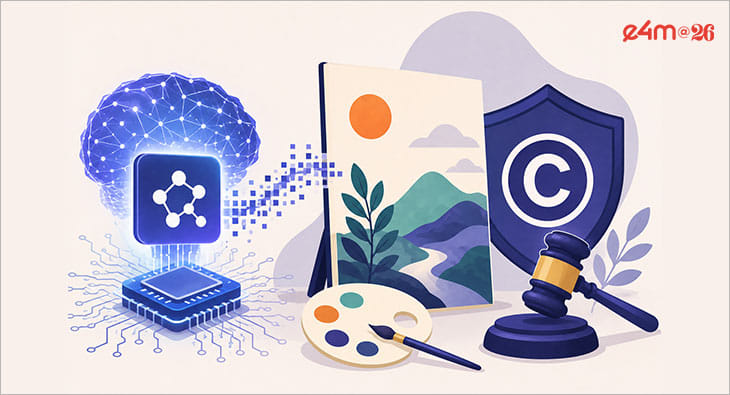

- India's Copyright Office ruled that AI cannot be recognized as an author of creative works, as demonstrated in the case of an artwork generated by the AI system DABUS, where the human who initiated the process was deemed the author.
- The ruling raises questions about authorship and ownership in creative processes involving AI, suggesting that determining who caused the work's creation may become increasingly complex.
- Legal experts indicate that the decision removes AI from the authorship equation but does not clarify which human contributors hold authorship rights, complicating the landscape for brand marketers and agencies.
- As AI-generated content becomes more prevalent, discussions around intellectual property rights and ownership are expected to intensify, with brands needing to clarify rights to use and defend AI-generated works.
Imagine for a moment, dear Reader, that you are a brand marketer. Which, given that you're reading exchange4media, isn't too burdensome an imagining. It's 2027, a balmy summer day in Cannes, and you're about to win an award for a fantastic campaign you commissioned for a leading Indian FMCG brand.
And as you step up to the podium, there is a pause. A kerfuffle, even.
Because it may be your campaign, but brand marketers are not monoliths. There was the brand team that wrote the brief and signed off on the work; the strategist who found the insight; the creative director who shaped the idea; the copywriter and art director who turned it into an ad; the production house, director and editors who made it; the media team that decided where it would live; and, somewhere in that increasingly complicated chain, perhaps an intern or junior creative who typed the prompt into ChatGPT that produced the first usable draft.
So, who made the ad?
You? Your agency? The creative team? The person who wrote the prompt? The person who kept rewriting the prompt until the machine produced something worth using?
Maybe Sam Altman should be walking up to the stage beside you.
Read more on the price test for ChatGPT ads in India
And forget the Lion for a moment. Who owns the thing? Who can license it, reproduce it, adapt it, or stop somebody else from copying it? When a machine contributes substantially to the final creative, where exactly does the machine end and the human author begin?
Why are you looking at Sam Altman again?
India's Copyright Office has just offered one answer. And, as answers involving artificial intelligence tend to do, it has created several more questions.
On August 31, the Registrar of Copyrights issued an order on A Recent Entrance to Paradise, an artwork generated by DABUS, an AI system created by Stephen Thaler. Thaler is an American computer scientist, AI researcher and founder of Imagination Engines, who has spent years pursuing test cases around the world seeking legal recognition for AI-created inventions and works, and declined the easier route of naming himself as author.
Thaler listed DABUS as author and himself as owner. The Office rejected that arrangement. Under Section 2(d)(vi) of the Copyright Act, the author of a computer-generated work is “the person who causes the work to be created”. DABUS, the Registrar held, is neither a natural nor juristic person recognised in law and cannot be entered as author.
But the artwork itself cleared India’s originality threshold. The fact that an algorithmic or computational process generated it did not, by itself, make the expression unoriginal.
In other words: the AI cannot be the author. An AI-generated work can still clear the originality test.
On these facts, the Office found Thaler to be the person who caused the work to be created. He had conceived and configured DABUS, supplied the inputs and initiated the process, even though DABUS autonomously generated the final artwork.
Thaler’s application was nevertheless rejected because he maintained that DABUS itself should be the author. When offered the chance to identify himself instead, he declined. The order leaves open a remedy based on correctly identified authorship and ownership.
For agencies and advertisers, the more useful question is what happens when human involvement is nowhere near as obvious.
Read more on - does the advertiser know who saw the ad
Ankit Sahni, counsel for Thaler and Partner at Ajay Sahni Associates, says the ruling removes one uncertainty but creates a more fact-intensive inquiry. In brand or agency workflows, authorship may depend on prompting, iteration, selection and editing.
“So the dispute may move from ‘is there copyright?’ to ‘who is the author and owner?’” he says.
That gets messy quickly.
Ronil Goger, Managing Partner at Blaze Legal, notes that the prompter cannot automatically be treated as the person who caused the work. A brand may set the brief, a creative director shape the concept, an employee iterate through ChatGPT or Midjourney, and an editor transform the output using Runway.
“The decision takes AI out of the authorship equation,” Goger says. “It does not tell us which human gets to occupy the space it leaves behind.”
Which is pretty much the problem with our imaginary Cannes campaign.
Reema Asrani, Head of Production at AiMighty Studio, says GenAI production is more collaborative than the mythology of a lone prompt wizard suggests.
“Prompting is part of that process, but it is not the entire creative act,” she says. Her team’s larger contribution, she adds, lies in the thinking, choices, selection and shaping of the final piece.
Read e4m deep dive on agencies going AI-native
That could make the creative trail of briefs, prompts, iterations, selections and edits increasingly important.
For brands, meanwhile, the practical question may be even less romantic than authorship.
Luke A Dewars, Co-Founder and CCO, Goodness of Digital and Design, makes much the same point more colourfully. He recalls a creative director looking at an AI-generated execution and saying, “Bhai, hum raat bhar yahi karte the. I just finished this in five minutes.”
For Dewars, that speed does not make the person typing the prompt the author. The brief, strategy, creative route and final communication are still shaped by people exercising creative judgment.
“GenAI is a powerful tool much like the typewriter, CorelDRAW or Illustrator were in their time,” he says. “The tool can produce the illusion, but the magician still decides what the audience should see.”
That could make the creative trail (briefs, prompts, iterations, selections and edits) increasingly important.
For brands, meanwhile, the practical question may be even less romantic than authorship.
Marketing leader Nikhil Kumar expects GenAI ownership to become a much bigger contracting and IP conversation as experimentation turns into scaled creative production.
“For brands, the question will increasingly move beyond ‘who created it?’ to ‘who owns the rights to use it, and can they actually defend those rights?’” he says. “As AI-generated creative scales, that clarity will become as important as the creative itself.”
exchange4media also reached out to senior brand-side marketers for their views on the ruling and its implications for AI-generated creative. They had not responded at the time of publication.
One caveat: this is a Registrar of Copyrights order, not a court judgment, and the Office expressly says it is not deciding every form of AI-assisted creation. Human involvement can vary materially from one work to another.
So no, Sam Altman probably does not get your Lion.
But before you collect it, your lawyers may want to know who wrote the brief, who shaped the idea, who kept the prompts, who made the final edits and, most importantly, what the contract says.
Dear Reader, keep the receipts.
Read more news about Digital Media, Internet Advertising, Marketing News, Television Media, Radio Media
For more updates, be socially connected with us onInstagram, LinkedIn, Twitter, Facebook, YouTube & Google News