CCI’s latest cartel ruling raises red flags for India's media agencies under probe
The media cartel probe has another complication that makes the TAI precedent particularly relevant: the existence of contemporaneous digital communications
 by
by
Published: Sep 4, 2026 9:17 AM | 8 min read
 Follow Us

- The Competition Commission of India (CCI) has found the Trustees’ Association of India (TAI) and three debenture trustees guilty of price-fixing and has ordered them to cease such conduct, highlighting that industry associations cannot shield companies from competition law violations.
- The CCI's ruling emphasizes the importance of examining the implementation of agreements, as it found evidence of TAI intervening to enforce a pricing floor among its members, which could set a precedent for ongoing investigations into media agencies accused of similar coordination.
- The investigation into India's advertising industry is scrutinizing potential collusion among media agencies, with evidence such as WhatsApp communications suggesting coordinated pricing and responses to clients, which could strengthen the case against them.
- The TAI case serves as a warning that industry practices must not cross into cartel behavior, as the CCI may hold individual executives accountable for anti-competitive conduct, and any findings could lead to reputational damage and significant legal repercussions for media agencies.
The Competition Commission of India’s latest cartel order against the Trustees’ Association of India (TAI) and three debenture trustees could prove far more uncomfortable for India’s media agencies than the relatively limited financial consequence of the case itself.
The reason is simple: the CCI has shown that an industry association cannot become a shield for competing companies that collectively decide how they will price their services.
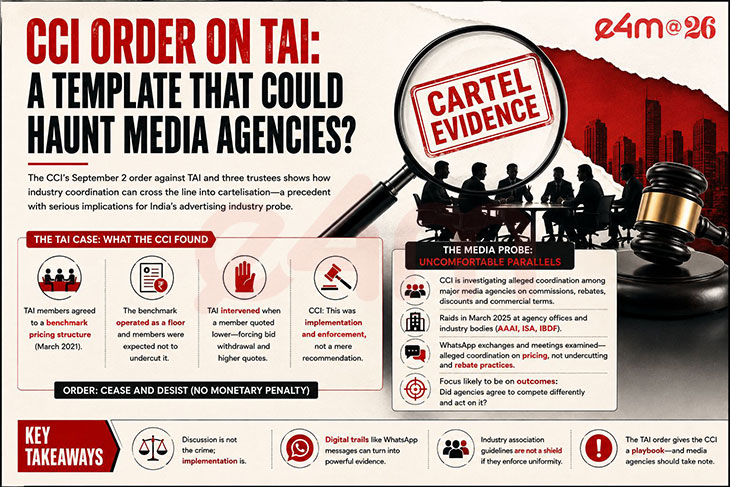
The regulator found TAI, IDBI Trusteeship Services, Axis Trustee Services and SBI CAP Trustee Company guilty of fixing benchmark fees, monitoring compliance and intervening when a trustee quoted below the agreed floor. It has ordered the parties to cease the conduct, although it did not impose monetary penalties after considering mitigating circumstances.
For media agencies already under investigation for alleged coordination on commissions, rebates, discounts and commercial terms, the order offers a potentially uncomfortable template of how the CCI could assess their conduct.
The September 2 CCI order shows what could turn an industry practice into cartel evidence.
Also Read: CCI agrees to add TLG India to media cartel investigation; Delhi HC disposes petition
AAAI under fire for alleged prominent role in media cartelisation case
Breaking the cartel myth: What CCI raids missed about media buying
The dangerous line: from discussion to enforcement
The TAI case is particularly relevant because the CCI did not stop at asking whether competing trustees had discussed pricing. It examined what happened after the discussion.
According to the order, TAI members agreed in March 2021 to a benchmark pricing structure for listed debt securities. The CCI found that the benchmark effectively operated as a floor and that the association sought to ensure that members did not undercut it.
The evidence became more damaging when the regulator found that TAI's intervention extended beyond setting the benchmark.
In one instance, MITCON had submitted a lower quotation for a HUDCO mandate. TAI allegedly intervened and the trustee withdrew its bid and submitted a higher one. The CCI treated this conduct as evidence that the benchmark was implemented and enforced rather than merely recommended.
That distinction could become central to the advertising probe.
A senior competition-law lawyer, speaking on condition of anonymity, said the order effectively provides a "road map" for how the regulator can distinguish legitimate industry coordination from cartelisation.
"The existence of an association guideline is not, by itself, the end of the analysis. The CCI will look at whether competitors actually surrendered independent commercial decision-making, whether the arrangement was implemented and whether there was any mechanism to discourage deviation."
That is precisely where the media agencies could face greater scrutiny.
The media case has several uncomfortable parallels
The CCI's investigation into India's advertising industry has examined alleged coordination between major media agencies.
The regulator raided agency offices and industry bodies including the Advertising Agencies Association of India (AAAI), Indian Society of Advertisers (ISA) and Indian Broadcasting and Digital Foundation (IBDF) in March 2025. The investigation was triggered by inputs under the CCI's leniency framework, with Dentsu subsequently to have made disclosures.
The investigators had examined WhatsApp exchanges and meetings involving senior agency executives, with the CCI alleging that competing agencies coordinated responses to clients and agreed on pricing, including not undercutting each other. The investigation documents also referred to discussions involving rebates and arrangements affecting agencies that did not comply.
That is where the TAI order becomes relevant.
The CCI is likely to be less interested in whether agencies sat in the same room than in whether they walked out of it having agreed to compete differently.
WhatsApp messages could be more damaging
The media cartel probe has another complication that makes the TAI precedent particularly relevant: the existence of contemporaneous digital communications.
The CCI's preliminary material examined a WhatsApp group involving senior executives from competing agencies. The agencies allegedly discussed pitches, client responses and commercial terms, while investigators preliminarily concluded that the conduct resulted in an "alignment of competing advertising agencies"
For a cartel investigation, that distinction matters.
A trade association document can be defended as an industry recommendation. A WhatsApp exchange in which competitors discuss what each will charge, how much discount each will offer or how they will respond to a particular client can potentially be interpreted as evidence of coordination.
Another competition lawyer representing a media agency said the CCI would likely examine the sequence of events.
"The real question will be whether the communications show independent businesses merely exchanging views, or whether they show an agreement followed by conduct consistent with that agreement. If the latter can be established, the defence that this was an industry practice becomes much weaker."
The ‘industry practice’ defence could come under pressure
This is perhaps the biggest lesson from the TAI order. The trustees argued that their pricing structure was linked to increased regulatory responsibilities and their engagement with SEBI. The CCI nevertheless concluded that regulatory oversight did not amount to authorisation for competing trustees to collectively fix prices.
That could have implications for the media industry's possible defence that common commercial practices emerged from discussions between agencies, advertisers, broadcasters and industry associations.
The question the CCI could ultimately ask is brutally simple:
Did the industry body require agencies to coordinate, or did agencies decide among themselves that they would coordinate?
If the latter is established, regulatory or industry-body involvement may not provide protection.
Enforcement could be the smoking gun
The most important part of the TAI order for media agencies may not be the benchmark itself. It is the evidence of monitoring and enforcement.
The CCI found that TAI sought to ensure compliance with the benchmark and intervened when a participant deviated.
The advertising investigation has similarly thrown up allegations that agencies and broadcasters sought to discourage or penalise players that did not comply with agreed commercial positions. CCI documents referred to alleged efforts to deny business to agencies that breached the arrangements.
If the CCI can establish that such conduct occurred, the parallel with the TAI case becomes considerably stronger.
According to experts, price fixing is one issue. Evidence that competitors collectively tried to discipline a deviation is much more powerful. It suggests that the arrangement was intended to alter market behaviour, not merely record an industry consensus.
For smaller media agencies, this could become especially significant.
If a smaller agency offered a client a more aggressive commercial proposition and larger agencies collectively attempted to prevent it from accessing inventory or clients, investigators could potentially view that as evidence of an attempt to preserve the cartel's pricing structure.
The smaller-agency angle could hurt
The media cartel investigation has already focused on alleged conduct involving agencies outside the largest networks. That makes the TAI-HUDCO episode particularly instructive.
In the financial-sector case, the CCI did not merely look at whether the three large trustees had agreed among themselves. It examined whether the benchmark was extended to non-members and whether a lower-priced competitor was pressured to align.
The media probe could similarly turn on whether agencies were trying to ensure that smaller or independent players did not undercut the commercial position of the larger agencies.
If investigators find such evidence, the case potentially moves beyond price coordination into a broader question of restricting competition.
The exposure is not necessarily limited to companies
Another reason agencies should pay close attention to the TAI order is the CCI's treatment of individual executives.
The regulator held certain individuals responsible under Section 48 where their participation and responsibility for the anti-competitive conduct were established.
That creates a second level of risk for media executives if the investigation ultimately establishes cartel conduct.
The issue would not simply be whether an agency's corporate entity participated. Investigators could examine who initiated conversations, who approved commercial positions, who communicated with competitors and who helped implement or enforce an arrangement.
For senior agency executives, that could make seemingly informal conversations considerably more consequential.
The financial penalty question
The TAI order may appear reassuring because the CCI did not impose monetary penalties. But media agencies should not assume the same outcome.
The CCI specifically cited mitigating circumstances in the TAI case, including the association's lack of income during the relevant period, instances where trustees charged below the benchmark and cooperation during the investigation.
The circumstances of a large advertising network could be very different if the regulator eventually establishes a cartel involving substantial revenues and a prolonged period of coordination.
More importantly, the financial penalty is only one part of the risk.
A cartel finding could bring reputational damage, litigation from affected clients, scrutiny of commercial contracts and potentially a fundamental reset of how agencies negotiate commissions, rebates and media buying arrangements.
The warning from CCI is broader than the trustee case
The TAI order therefore sends a message that India's advertising industry cannot afford to ignore. An industry association can provide the meeting room. It cannot provide immunity from competition law.
If agencies independently decide their prices, discounts and commercial strategies, competition remains intact.
If competitors collectively agree on those terms and then use an association, WhatsApp group, broadcaster relationship or another mechanism to make sure everyone follows them, the legal character of the conduct can change dramatically.
For media agencies already under investigation, that makes the next phase of the CCI probe critical.
The regulator will not only have to establish that conversations took place. It will need to establish the substance of any agreement, the participants, implementation and its effect on competition.
The question for the media industry is no longer simply whether agencies discussed pricing. It is whether anyone can prove that they agreed on a price — and then made sure everyone else played by the same rules.
Read more news about Internet Advertising India, Marketing News, PR and Corporate Communication News, Digital Media News, Television Media News
For more updates, be socially connected with us onInstagram, LinkedIn, Twitter, Facebook YouTube & Google News