Goafest 2026: Industry leaders call for advertising beyond tokenism
The session brought together voices from advertising, hospitality, media, real estate and sports to discuss the role of creative industries in shaping societal perceptions around women
 by
by
Published: May 21, 2026 5:46 PM | 5 min read
 Follow Us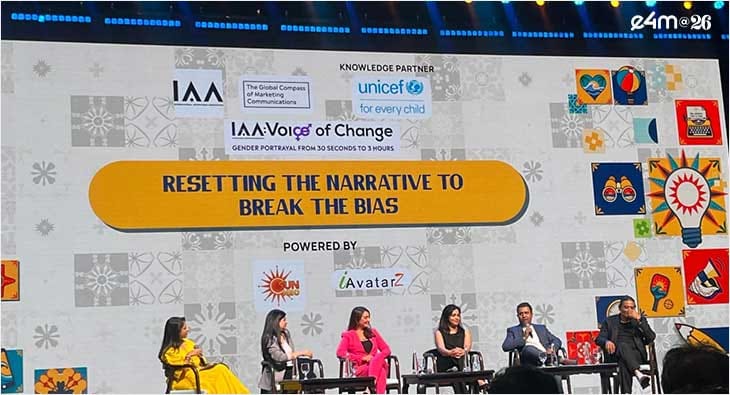

- Industry leaders at Goafest 2026 emphasized the need for marketers to move beyond symbolic representation and create culturally relevant narratives that challenge stereotypes and tokenism in advertising.
- The panel, featuring experts from various sectors, discussed the role of creative industries in shaping societal perceptions of women and the importance of "conscious creativity" in advertising.
- Speakers highlighted the necessity for diversity in decision-making processes to ensure that advertising reflects contemporary realities and challenges traditional gender roles.
- The discussion underscored that meaningful change in representation requires intentional action and a commitment to understanding evolving consumer dynamics, particularly regarding women's roles in various industries.
At a time when brands are increasingly being scrutinised for how they portray gender, culture and identity, industry leaders at Goafest 2026 called on marketers and advertisers to move beyond symbolic representation and build more conscious, culturally relevant narratives.
The session, titled ‘IAA Voice of Change: Resetting the Narrative to Break the Bias’, brought together voices from advertising, hospitality, media, real estate and sports to discuss the role of creative industries in shaping societal perceptions around women and representation.
The panel featured Amitesh Rao, Chief Executive Officer, South Asia Leo & VP – TAC; Preeti Jhangiani, Entrepreneur and Sports Leader; Prasun Kumar, Chief Marketing Officer & Business Head, MagicBricks; Riya Joseph, General Manager – Media, Britannia Industries Limited; and Veetika Deoras, Senior Vice President – Marketing and Brands, IHCL. The discussion was moderated by Megha Tata, Strategic Advisor & Independent Director.
Opening the discussion, Tata highlighted how the advertising and marketing ecosystem plays a critical role in shaping social narratives. Referring to the IAA Voice of Change initiative, she spoke about the industry’s efforts over the past few years to examine how women and men are represented in advertising and the impact such portrayals have on audiences, particularly children growing up consuming media and advertising.
The panelists collectively agreed that while conversations around representation have evolved over the years, the industry still has significant work to do in moving beyond stereotypes and tokenism.
Speaking about what “conscious creativity” means in today’s context, Deoras said brands and marketers need to evaluate whether their work is creating positive cultural impact while ensuring that it does not reinforce harmful narratives.
Deoras said, “As marketers and advertisers, we have this immense power and immense marketing dollars behind us, which drives visibility and influences behaviour. So, it’s important to look at it from both the perspectives of whether we are able to make a positive impact and whether we are ensuring that there is no negative impact.”
Jhangiani argued that advertising needs to reflect the realities of contemporary women rather than limiting them to traditional caregiving roles.
“For me, conscious marketing should be depicting the reality. Women are so much more than supportive characters. They are business leaders, professionals, entrepreneurs and decision-makers, and advertising needs to reflect that,” Jhangiani said.
Joseph stressed the importance of cultural relevance and diversity within brainstorming and decision-making rooms, noting that representation behind the scenes often shapes the narratives seen in campaigns.
Joseph noted, “Are we culturally relevant? Are we still sticking to age-old thinking about how families should be? It happens at the brainstorming level itself. Do we have diversity in the room? That’s where culturally relevant advertising begins."
Adding to the discussion, Kumar said the most effective creative work often emerges when brands position themselves at what he described as the “bleeding edge of culture”, rather than merely reflecting prevailing social norms.
“The most differentiated work is the work that sits at the bleeding edge of culture. Advertising is not just reflecting culture, it is shaping culture while also building businesses,” Kumar said.
Rao described conscious creativity as an exercise in honesty and warned that biases in advertising extend beyond gender alone.
“Conscious creativity is all about honesty. It’s about being honest to your goal, your category and your objective, and not letting artificial biases shape the work,” Rao said.
The discussion also explored how representation varies across industries traditionally perceived as male-dominated.
Speaking from the hospitality sector’s perspective, Deoras pointed to evolving workforce realities and changing portrayals within hospitality advertising. Referring to IHCL’s ‘She’s the Taj’ campaign and its recent extension, ‘She Remains the Taj’, she said brands have a responsibility to create visibility for women in unconventional roles.
Deoras added, “It’s important to keep doing that because the visibility we are able to garner through our efforts is a huge responsibility on us to make sure it has the right societal impact."
Kumar challenged the perception of real estate as a male-led category, citing consumer behaviour data from MagicBricks. According to him, women now constitute a significant portion of home-search and home-loan audiences.
“On my platform, we have about 35% of the traffic at this point of time which is women,” Kumar said, adding that women are increasingly initiating home searches and playing a larger role in purchase decisions.
Joseph shared how Britannia has attempted to shift representation through campaigns that challenge conventional portrayals of women and men within family settings. She cited examples including campaigns for Marie biscuits and digital films that showcased emotionally expressive fathers.
Joseph argued, “We are making progress in that as well. Have we done enough? No. But I think that’s also a very societal, cultural thing."
Jhangiani also highlighted that society is far more receptive to changing narratives than advertisers often assume. Drawing from her experience building Pro Panja League, she said audiences across smaller towns and non-metro markets are increasingly embracing new ideas around women, ambition and power.
“We were very sure that we wanted to change this narrative of having a separate male and separate female kind of sport," she said.
She added that brands and audiences have responded positively to such representation, citing campaigns featuring female athletes in physically demanding sports.
Throughout the session, panelists repeatedly returned to the idea that representation cannot remain performative or tokenistic. Several speakers stressed the need for greater diversity within brainstorming and decision-making rooms themselves, arguing that inclusive creative output is difficult to achieve without inclusive participation behind the scenes.
As the session drew to a close, the panelists offered brief takeaways for the industry, emphasising that meaningful change requires intentional action, updated consumer understanding and a willingness to challenge legacy thinking.
The conversation reflected a broader shift currently underway across advertising and marketing, where brands are increasingly expected not just to sell products, but also to participate responsibly in shaping culture and public imagination.
Read more news about (internet advertising India, internet advertising, advertising India, digital advertising India, media advertising India)
For more updates, be socially connected with us onInstagram, LinkedIn, Twitter, Facebook Youtube & Whatsapp
