Cannes Voices: Anisha Iyer on judging media creativity in the age of fragmented attention
As CEO of OMD India and a Cannes Lions 2026 Media juror, Anisha Iyer believes the strongest media ideas are deceptively simple, and that complexity is often mistaken for craft
 by
by
Published: Jun 4, 2026 9:08 AM | 10 min read
 Follow Us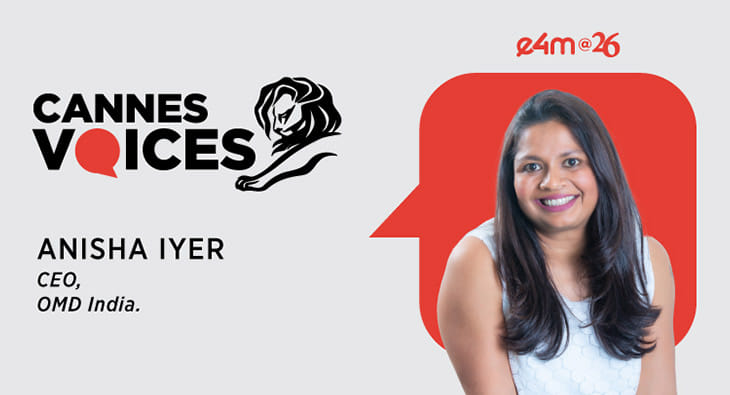

- Digital advertising in India is projected to grow by 14% in 2024, potentially making up 64% of an $18.5 billion ad market by 2026, while users spend over six hours daily online across multiple platforms.
- Anisha Iyer, CEO of OMD India, emphasizes the need for media planning to focus on significance rather than just scale, advocating for campaigns that resonate with human truths and cultural relevance.
- The effectiveness of advertising is increasingly evaluated through outcome-oriented metrics, requiring campaigns to demonstrate measurable impact on behavior and brand perception.
- Iyer anticipates that the 2026 Cannes Lions Media jury will prioritize creativity that emerges from constraints, simplicity, and purpose-driven ideas with tangible human consequences, reflecting India's unique media landscape.
The numbers that define Indian media today are, depending on how you read them, either an extraordinary opportunity or an extraordinary problem. Digital ad spend in India grew by 14% in 2024 and is projected to account for approximately 64% of an eighteen-and-a-half-billion-dollar total ad market by 2026, according to estimates aggregating WARC, the Pitch Madison Advertising Report 2026, and WPP's TYNY projections. At the same time, a Redseer analysis published in April this year found that users in the country now spend an average of over six hours daily online, spread across more than thirty applications and multiple devices. Reach has become structurally easier.
Relevance has become structurally harder. The gap between the two is the central problem of media planning today, and it is the one the Cannes Lions Media jury (one of the festival's oldest and most contested categories) will attempt to resolve in the jury room this June.
Few people in the Indian market are better placed to navigate that gap than Anisha Iyer. As CEO of OMD India, a role she has held since January 2022, Iyer leads the Indian operation of the world's largest media agency network by billings: OMD Worldwide reported global billings of $25.9 billion in 2024, an 8% year-on-year increase, and was simultaneously ranked the best-performing global media network overall by RECMA for the eighth consecutive edition. Within India, she inherited an agency that needed repositioning and delivered one that, by 2024, had been named South Asia Agency of the Year, India Media Agency of the Year (gold), and Digital Innovation Agency of the Year (silver), all at the Campaign Asia Agency of the Year awards. Her client roster includes Nivea India, Tata Motors, Mercedes-Benz, McDonald's India, Lupin, and Sugar Cosmetics, among others.
Iyer came to the India role from a trajectory that is unusual in the Indian market: more than two decades in media, digital, and technology, built across Mindshare, Madhouse, and GroupM, followed by a deliberate APAC rotation through OMD Malaysia as Managing Director and OMG Thailand as Chief Product Officer before landing at OMD India's helm.
That rotation gave her a perspective on media markets at different stages of digital maturity (markets where the consumer journey is more legible, the measurement infrastructure is more developed, and the inventory ecosystem is more consolidated) which she has since applied to the Indian context, where none of those things is uniformly true. It is also a perspective that has earned her recognition beyond client results: Campaign Asia's 40 Under 40 in 2023, Impact Magazine's 50 Most Influential Women in three consecutive editions, and BW Marketing World's Most Influential Women in 2024.
This June, she takes that perspective into the Cannes Lions International Festival of Creativity 2026, running from 22 to 26 June, where she will serve as a member of the Media Awarding Jury: one of fourteen Indian jurors across the festival's categories this year.
The significance question
The Media Lions category has, for most of its existence, rewarded scale: the audacity of a media idea expressed across the widest possible surface area, with the most impressions, the most platforms, the most touchpoints. That framework has not disappeared, but Iyer argues that a more demanding criterion has moved alongside it: one that she frames, with characteristic directness, as significance.
"Breakthrough media thinking is no longer about scale alone; significance counts," she says. "Work that truly stands apart is rooted in sharp human truth or insight and expressed through an idea so compelling that media becomes part of the experience, not just the delivery system. The difference between innovation and excess often comes down to intent. Innovation simplifies, sharpens, and elevates the idea. Excess tends to confuse sophistication with effectiveness. Just because technology, data, or platforms can do more, does not mean the work should. The strongest ideas use these tools with precision and purpose — in ways that feel seamless, culturally relevant, and impossible to separate from the core idea itself."
The distinction between media as a delivery system and media as an experience has been made before, but rarely with this degree of editorial precision. It identifies a failure mode that the fragmented attention economy has, if anything, intensified: the tendency to treat media planning as an optimisation exercise, in which the goal is to distribute a message across the maximum available surface area with the minimum available waste. The result is work that is technically efficient and experientially inert. What Iyer is describing is rarer, harder to evaluate on a spreadsheet, and significantly more durable as a cultural artefact.
"What elevates work at an awarding level is its ability to shape culture while delivering business impact," she adds. "They do not feel like isolated campaigns but rather operate as connected ecosystems that influence behaviour across the funnel and build long-term brand value. And perhaps most importantly, truly exceptional media thinking is deceptively simple. In an industry that often overcomplicates itself, the ideas with the greatest impact are usually the ones that are the clearest, boldest, and hardest to ignore."
The shifting standard of effectiveness
The conversation about how effectiveness is measured in media has been reshaping itself over the past several years, accelerated by the industry's broader reckoning with the limits of impression-based metrics and the rise of outcome-oriented planning. Iyer's account of that shift is grounded and specific, and it maps closely onto what the data bears out. India's ad market grew by just 9% in 2024 (the slowest rate since 2017 and, notably, the first time in recent memory that Indian ad spend growth lagged the global average) at a moment when the proliferation of platforms and formats has made measuring the actual return on that spend more contested than ever.
"A few years ago, the industry would have been more willing to appreciate and reward intent," she says. "Today, there is far less room for intent without evidence. Did the work shift behaviour? Did it build brand preference? Did it create measurable commercial impact? The scrutiny is sharper, the benchmarks are higher, and effectiveness is being measured through a far more outcome-oriented lens."
The pressure toward outcome-orientation is, in part, a consequence of the same fragmentation that defines the attention economy: when media budgets are distributed across thirty-plus touchpoints, clients require more rigorous justification for each allocation, and the tolerance for campaigns that built awareness without demonstrable downstream impact has narrowed. But Iyer resists the implication that outcome-orientation has simplified the effectiveness conversation. She argues it has complicated it.
"Effectiveness itself has become more nuanced," she says. "Increasingly, brands are being evaluated not just by the business impact they create, but by the human impact they leave behind. If a campaign is not directly driving commercial outcomes, then it needs to meaningfully shift perception, spark conversation, or influence culture tangibly. There is a heightened sense of purpose shaping how effectiveness is judged today."
Alongside impact, she names a third criterion that she considers increasingly decisive at the awarding level: authenticity of fit. "True cut-through does not come from innovation for its own sake or from plug-and-play ideas designed for a medium," she says. "Impactful work is deeply native to the brand's DNA. The idea has to feel inherently crafted for that brand, its values, and resonate with the audience it serves. That is increasingly the benchmark today — not just whether the work was noticed, but whether it was unmistakably ownable."
What makes a campaign Lion-worthy
The Media Lions category, at its best, has always produced work that makes other media practitioners uncomfortable in a productive way; work that makes visible what is possible when the brief is written around an idea rather than around a media schedule. The gap between that standard and an efficient campaign is, in Iyer's framing, qualitative rather than quantitative.
"Lion-worthy work does something far rarer — it makes the industry stop, sit up, and rethink what is possible from a creativity standpoint," she says. "Often, the most powerful ideas are rooted in a deeply human insight that feels immediately intuitive, even when the execution behind it is complex or sophisticated. That clarity of thought is what gives great work its staying power."
The clarity/complexity distinction is worth dwelling on. Some of the most celebrated media campaigns of recent years have been architecturally intricate (layered across platforms, driven by real-time data triggers, optimised at every juncture) while feeling, to the end consumer, like the most natural thing in the world. The craft in those campaigns lies precisely in the concealment of their sophistication. Iyer's second criterion moves the conversation from architecture to belonging.
"What elevates a campaign today is the ability to create genuine business impact through an idea that is bespoke to the brand," she says. "The strongest work is not built for the medium first; it is built for the brand, its audience, and the specific tension it is trying to solve. That is what gives it depth, distinction, and commercial relevance. Culture is the other key defining factor — influencing work that is not simply placed within culture but rather dictated by it. When creativity, cultural intuition, and business impact converge seamlessly, that is when a campaign moves towards becoming truly Lion-worthy."
What she expects to dominate the conversation
Asked to project what kind of media creativity will define the 2026 jury room conversation, Iyer's answer moves across three distinct registers, each of which illuminates a different dimension of where the category is heading.
The first is purpose with consequence. "There is a noticeable appetite for ideas that make people feel something real," she says, "whether that is around mental health, inclusion, empathy, or broader societal tensions — purpose with tangible human consequences." This is a meaningful refinement of the awards landscape's long-running engagement with purpose-driven work. The shift she is naming is from purpose as brand positioning to purpose as verifiable intervention; work that can demonstrate a causal relationship between the media idea and a human outcome.
The second is the rehabilitation of simplicity as an act of creative courage. "There is a renewed appreciation for simplicity," she says. "Some of the most powerful work today is built on a deeply observed human insight expressed with extraordinary clarity. In many ways, simplicity is the new sophistication. What makes this exciting is how the industry is pairing that simplicity with a relentless pursuit of excellence — whether through sharper craft, vernacular storytelling, smarter use of platforms, evolving formats, or AI being used to enhance creativity rather than dominate it." In a media landscape that has spent years accumulating complexity as a proxy for rigour, this is a more radical argument than it sounds.
The third is what she calls creativity emerging from constraint, a phenomenon that the Indian market, with its structural diversity, is arguably producing more of than any other. "Some of the most original ideas today stem from challenging environments — from navigating adversity, tighter realities, or cultural complexities," she says. "There is often a certain resilience and challenger energy in that work, which gives it a disproportionate cut-through. Creativity tends to become far more inventive when there is a hard boundary wall to push against."
This last observation is the most directly relevant to India's position in the global media conversation. The constraints that define the Indian media environment are, in Iyer's framing, not a disadvantage but a forcing function for a kind of creative problem-solving that more comfortable markets cannot replicate. The challenger energy she describes is not incidental to Indian media thinking. It is structural. And if the Media jury this year rewards work that found elegant, culturally resonant ideas inside genuine constraint, India is well-placed to produce it, and, in Anisha Iyer, well-placed to make the case for it.
Read more news about Cannes Lions Festival, Advertising, Marketing, Digital Media, PR & Corporate Communication News
For more updates, be socially connected with us onInstagram, LinkedIn, Twitter, Facebook YouTube , WhatsApp & Google News