Goafest: Prasoon Joshi, Nikhil Sharma & Rajiv Kumar debate India’s growth reset
At Goafest 2026, the industry veterans agreed on one thing: India's story has been well-told. The strategy hasn't
 by
by
Published: May 20, 2026 6:16 PM | 4 min read
 Follow Us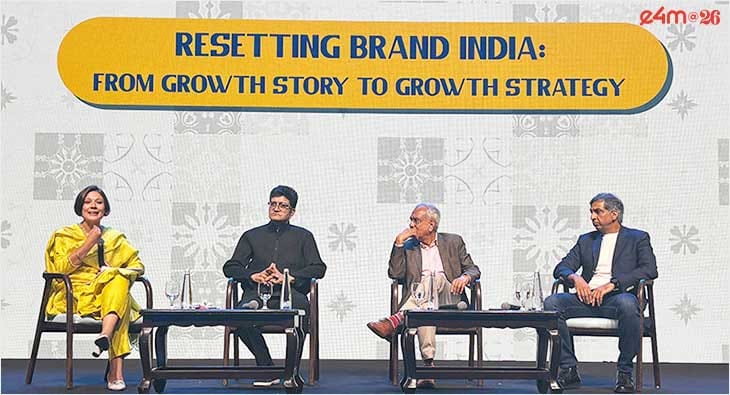

- The opening panel of Goafest 2026 featured prominent figures Prasoon Joshi, Nikhil Sharma, and Dr. Rajiv Kumar discussing India's growth narrative and strategy, moderated by NDTV's Padmaja Joshi.
- Prasoon Joshi highlighted the need for Brand India to evolve beyond selling its exotic image and embrace a more strategic confidence, particularly through storytelling in the entertainment industry.
- Nikhil Sharma emphasized the importance of fostering pride in Indian products across various consumer segments, noting the challenge of translating premium consumer sentiment into broader market transformation.
- Dr. Rajiv Kumar called for a stronger collaboration between industry and think tanks, advocating for the integration of indigenous knowledge systems into modern sectors to support India's evolving identity and growth strategy.
The first panel of Goafest 2026's opening day carried an unusual weight. Padma Shri Prasoon Joshi, Nikhil Sharma, and Dr Rajiv Kumar, three men who collectively straddle the country's creative, commercial, and policy universes, sat down with NDTV’s Managing Editor Padmaja Joshi for a conversation that, at its core, asked a deceptively simple question: India has a growth story. Does it have a growth strategy?
Prasoon Joshi, Chairman of Omnicom Advertising India and Prasar Bharati, quickly diagnosed where Brand India has historically found its footing and its limits. "We have sold the exotic part of India," he said, "which is chaotic and, in a sense, cerebral. The cows, the thick moustaches, the crowded roads — we have been selling it with great style, great pride. As an art form, we have been selling that." The problem, he suggested, is that art awards and cultural cachet are not the same thing as strategic confidence. But something is shifting inside India that may change the equation entirely.
He pointed to the country's entertainment industry as a leading indicator. "There was a time when escape cinema used to be the biggest seller," he said. "Today, people are looking for real stories, biopics, films grounded in truth. What it tells you is that there is now a confidence in us to face these things." That willingness to look reality in the eye, to accept what has been done and what remains to be done, is, for Joshi, the psychological foundation on which any real reset must be built.
For Nikhil Sharma, Managing Director of Perfetti Van Melle India, the question of Brand India has a practical dimension that sits somewhere between aspiration and arithmetic. "Progress is in the right direction," he said, noting a visible shift in Indian consumers' pride in homegrown products. "There are lots of people paying top dollar for Indian." But the challenge of extending that pride across categories, and especially at scale, is not simple. "We are a mass company, at the bottom of the pyramid, so to speak — for us, that challenge is even greater." His observation was a useful corrective to the risk of conflating the premium, urban consumer's embrace of Indian craftsmanship with a broader, bottom-up transformation of market sentiment. The two are connected, but not yet the same thing.
Dr Rajiv Kumar, Chairman of the Paheli India Foundation and former Vice Chairman of NITI Aayog, offered a structural reading of what needs to change. He argued that the generational shift already underway with India's Gen Z, a cohort less reflexively deferential to Western ideas and more willing to find solutions domestically, must be actively encouraged rather than taken for granted. More urgently, he flagged the near-total absence of a working relationship between industry and think tanks as a structural failure. "In other countries, the two are thinking and working together to generate new ideas," he said. "Here, the distance between the lab and the land is only growing." He also made a pointed case for recovering India's own knowledge systems, like Ayurveda, traditional pedagogical models, and indigenous product categories, and connecting them to sunrise sectors, rather than allowing them to remain sidelined by a default preference for imported frameworks.
The conversation repeatedly returned to the question of collective purpose. Joshi, who was in characteristically expansive form, reached for a striking metaphor: a Solomon Islands tradition in which a tree is not cut down but cursed, until the accumulated weight of those curses fells it. "India has seen a lot, suffered a lot," he said. "If we are at an inflection point, this is not the time to curse the tree so much that it falls. This is the time to water it — together. Private, corporate, media, all of us." His prescription for the reset was correspondingly ambitious: more diverse think tanks, cross-sector coalitions pulling in the same direction, and a frank acknowledgement that the intellectual frameworks that brought India to this point may not be sufficient to carry it forward. "What got us here will not get us any further," he said plainly. "We will have to reinvent the way we look at everything."
What emerged from the stage at Goafest was less a roadmap than a reckoning: a sense, shared across three very different vantage points, that the confidence India now carries in its entertainment, its fashion, and its emerging consumer categories must find its way into policy, R&D, institutional design, and the stories brands choose to tell about themselves. The invisible reset, as Padmaja Joshi observed in closing, is the most critical: a confidence in self, and a belief that what exists here is genuinely worth building on.
Read more news about (internet advertising India, internet advertising, advertising India, digital advertising India, media advertising India)
For more updates, be socially connected with us onInstagram, LinkedIn, Twitter, Facebook Youtube & Whatsapp
