From the Croisette to the jury room: Gurbaksh Singh on what digital craft must earn back
As Gurbaksh Singh joins the Digital Craft jury at Cannes Lions 2026, the Dentsu Creative CCO & CIO calls out a category in danger of confusing polish with purpose
 by
by
Published: Jun 2, 2026 8:53 AM | 9 min read
 Follow Us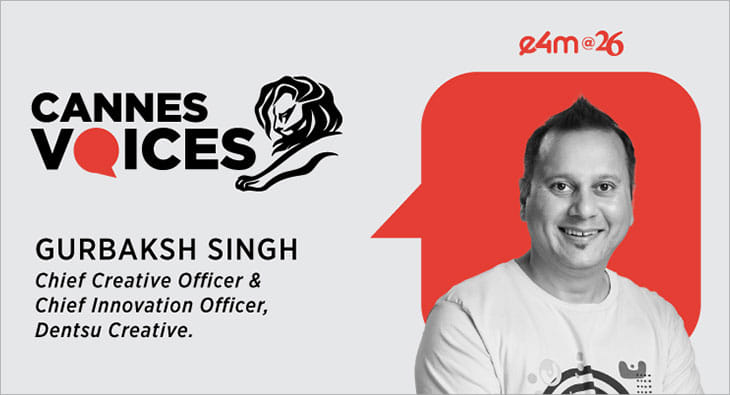

- Gurbaksh Singh, Chief Creative Officer at Dentsu Creative India, will serve on the Digital Craft Awarding Jury at the Cannes Lions International Festival of Creativity 2026, marking his return to the festival after Dentsu Webchutney won Agency of the Year in 2022.
- Singh emphasizes that exceptional digital craft should prioritize emotional and cultural relevance over mere technical excellence, arguing that technology should be seamless and invisible in the user experience.
- He highlights the challenge of originality in the age of generative AI, asserting that true creativity stems from personal and culturally relevant perspectives, despite the universal availability of creation tools.
- Singh calls for innovation that addresses real emotional or cultural issues, distinguishing between beautiful execution and impactful work that resonates with audiences long after their initial experience.
There is a particular kind of silence that descends on the Palais des Festivals in the moments before a major Lions category is announced, the kind that carries the weight of every late night, every revision, every argument about whether the technology was serving the idea or smothering it.
Gurbaksh Singh knows that silence intimately. He was in it, in 2022, when Dentsu Webchutney, the agency he had spent years helping build into one of India's most formidable creative-technology outfits, walked away as Agency of the Year, the first Indian agency ever to do so, on the back of The Unfiltered History Tour, a guerrilla AR campaign that had digitally hacked the British Museum without ever setting foot inside it.
This year, Singh is back at Cannes, but in a different seat. As a member of the Digital Craft Awarding Jury at the Cannes Lions International Festival of Creativity 2026, scheduled to run from 22 to 26 June on the French Riviera, he will be on the other side of the table, deciding which work deserves to be called the best in its field. The appointment makes him one of fourteen Indian jurors at this year's festival, a number that, not long ago, would have seemed improbable, and one of only two Indians in the craft and design disciplines.
As Chief Creative Officer and Chief Innovation Officer at Dentsu Creative India, Singh has spent the better part of two decades at the intersection of creativity and technology. His career traces the arc of Indian digital advertising itself: from the early, scrappy days of Dentsu Webchutney, where he built one of the subcontinent's first creative technology labs from scratch, to leading the Dentsu Aegis Network Innovation Lab, to now steering Dentsu Lab, a dedicated innovation platform with physical spaces in Mumbai, Bengaluru, and Gurgaon, focused on AI, AR/VR, product design, and data-led experiences. Along the way, his work has collected metals from Cannes Lions, The One Show, D&AD, Spikes Asia, Adfest, and the Webbys.
His most decorated project, The Unfiltered History Tour, built for Vice Media, used Instagram's augmented reality filters (rendered with LiDAR technology by creative partner Pixel Party) to smuggle an alternative tour of the British Museum's disputed artefacts directly into the hands of visitors, who accessed it on British Museum WiFi. Kalpit Dwivedi, founder of Pixel Party, called working with Singh "very thrilling and inspiring" and described him as "a hardcore creative advertising technologist."
The campaign took home a Titanium Lion, three Grand Prix, a Gold, four Silvers, and three Bronzes, making it the most awarded campaign in Cannes Lions 2022 history and handing India its first-ever Agency of the Year.
When we spoke to Singh ahead of his jury stint, it was clear that the experience of building something that extraordinary has not made him any easier to impress. If anything, it has made him harder to fool.
When technology disappears
The Digital Craft jury at Cannes has always occupied a complicated position in the awards ecosystem. It sits at the junction of creative ambition and technical execution, and the debate about which should take precedence never quite gets resolved. Singh's own view is unambiguous: technical excellence is no longer a differentiator. It is the entry ticket.
"Exceptional digital craft is when technology disappears, and experience takes over," he says. "Technical excellence is now the baseline, not the differentiator. What truly stands out is work where every interaction, transition, behaviour, and system design serves a larger emotional or cultural purpose. The best digital craft feels simple in experience, yet incredibly thoughtful underneath."
This framing matters because it repositions the conversation entirely. In a category that has historically rewarded visible technical ambition (the bespoke rendering engine, the novel API integration, the never-before-attempted interface) Singh is arguing that the highest form of craft is, paradoxically, the kind you cannot see. Work that earns its complexity by concealing it.
The Unfiltered History Tour was itself a demonstration of that principle. What the visitor experienced was a seamless, emotionally charged parallel narrative about colonialism and cultural theft. What they did not see was the LiDAR mapping, the filter engineering, the eighteen months of development, the six iterations of the case film. The seams were invisible. That, Singh would argue, is what craft actually looks like.
The originality problem
If invisibility of effort is one axis of great digital craft, originality is another, and it is under pressure in ways that were not imaginable even three years ago. The widespread availability of generative AI tools has created a genuine epistemological problem for awards juries: if the instruments of creation are universal, what, exactly, is being judged?
Singh does not think this is the catastrophe some are making it out to be, but he is not complacent either. "AI is democratising creativity in exciting ways, but it's also challenging the industry to redefine originality," he says. "For me, originality today comes from how creators use technology to express something deeply personal, culturally relevant, or emotionally unexpected. The tools may become universal, but the perspectives behind them never will. That's where truly distinctive digital craft still emerges."
This is a position that holds up under scrutiny, but it also places a significant burden of proof on the work itself. If any agency in any market can now access the same AI tools, the distinguishing factor becomes the brief, the cultural insight, the human editorial decision about what to make and why. India, with its complexity of languages, communities, and unresolved histories, has long argued that it possesses a native advantage in the cultural specificity that global platforms cannot easily replicate. The argument is gaining traction. The Cannes jury line-up is perhaps the clearest institutional acknowledgement of that shift.
The efficiency trap
There is a broader critique embedded in Singh's worldview, one that the industry would do well to take seriously. Digital product design has, over the past decade, been overwhelmingly shaped by the logic of conversion: reduce friction, increase throughput, optimise for the next click. The result is a digital landscape that is, in many respects, extraordinarily functional and almost entirely unmemorable. Singh calls this out directly.
"We're optimising experiences so heavily for usability, speed, and efficiency that sometimes we forget to make people feel something," he says. "The most memorable digital experiences are rarely just functional — they create wonder, empathy, or delight. Craft should not only reduce friction; it should create connection. The challenge for creatives today is balancing utility with humanity."
This is not an abstract concern. Research from Kantar's BrandZ studies consistently shows that emotional salience (the degree to which a brand creates a meaningful, different, and salient impression) is among the strongest predictors of long-term brand value growth. Brands that win on emotional connection consistently outperform those that compete purely on functional superiority. Yet the gravitational pull of performance marketing and growth hacking continues to draw investment away from the kind of craft that creates those emotional impressions. The jury room, in this context, is not just an awards body; it is one of the few places where the industry formally argues about what it should value.
Beautiful versus unforgettable
The distinction Singh draws between beautiful execution and award-winning work is one of the more useful frameworks for understanding what separates the Lions shortlist from the Lions winners. Both are technically accomplished. Both look impressive on a deck. Only one stays with you.
"Beautiful execution can impress you in the moment, but award-winning work stays with you long after you've seen it," he says. "The difference is usually meaning and impact. Great digital work uses craft to elevate the core idea, not distract from it. At the highest level, we look for work where technology, storytelling, design, and cultural relevance become inseparable."
The inseparability Singh describes is the hardest thing to achieve and the easiest thing to fake. Work where the technology is a gimmick dressed up as an idea is recognisable to any experienced juror within minutes. Work where the technology and the idea have genuinely grown together is rarer and proportionally more valuable. The Unfiltered History Tour was of the latter kind: the AR filter was not a delivery mechanism for an idea that could have been executed differently. It was the idea. Remove the augmented reality, and you have a podcast. Add it back, and you have something that 15,000 visitors to the British Museum used, on British Museum WiFi, to hear a version of history that the institution had never sanctioned.
What he is watching for
Asked what kind of work he hopes rises above the noise at this year's festival, Singh is precise about what he is not hoping for. Not AI for the sake of AI. Not immersive tech as spectacle. Not digital innovation that exists to be photographed and shared rather than used and felt.
"I'm hoping to see innovation that feels genuinely meaningful again," he says. "Not just AI for the sake of AI, or immersive tech used as spectacle, but ideas that solve real emotional, social, or cultural problems in unexpected ways. The work that excites me most is when digital innovation creates accessibility, participation, empathy, or entirely new forms of interaction that genuinely could not exist before."
That last phrase is doing significant work. It is a high bar, and a deliberately set one. It rules out the majority of digital work submitted to Cannes in any given year: the responsive websites, the personalised push notifications, the AI-generated content at scale. What it leaves is a small, uncomfortable category of work that requires the particular configuration of technology, culture, and creative intelligence that exists right now, and would have been impossible or meaningless in any other moment. The Unfiltered History Tour was of that category in 2022. Singh will be looking for its equivalent in 2026.
Dentsu Lab, the innovation infrastructure Singh now leads across three cities, was built to produce exactly that kind of work. The Lab's current focus areas include public safety applications using drone technology, wearable devices that push back against algorithmic bias, and emotional tech designed to bridge remote human connection. These are not advertising briefs in any conventional sense. They are, however, the raw material for the kind of work that wins a Titanium Lion. Not because they are technically impressive, but because they are genuinely necessary.
As Singh takes his seat on the Digital Craft jury this June, the industry will be watching not just for India's performance in the medals table, but for the signal his presence sends about what the category has decided to value. If his own body of work is any guide, the signal will be clear: craft is not a surface. It is a system of choices, each one in service of an idea that could not exist any other way. That has always been the standard. It has rarely been harder to meet.
Read more news about Cannes Lions Festival, Advertising, Marketing, Digital Media, PR & Corporate Communication News
For more updates, be socially connected with us onInstagram, LinkedIn, Twitter, Facebook YouTube , WhatsApp & Google News