Every piece of communication has a job. Do it
Priya Choudhary, Director, Business Solutions & Insights, Google India, speaks with Shripad Kulkarni on the non-linear consumer reshaping rules, why every comm. must earn its place with a clear job
 by
by
Published: May 14, 2026 9:07 AM | 8 min read
 Follow Us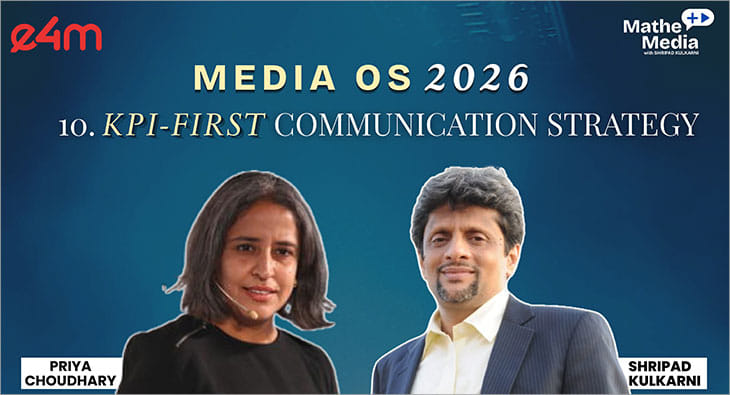

- Priya Choudhary discusses the shift from traditional media consumption to a more complex "4S behaviour," where consumers are simultaneously streaming, scrolling, searching, and shopping across multiple screens, changing the dynamics of media planning.
- The rise of Connected TV has transformed the living room into a point of sale, with short-form video content gaining traction on larger screens, leading to significant engagement and measurable outcomes for advertisers.
- The media landscape in India is evolving, with 95% of YouTube content being regional, prompting advertisers to increasingly engage with diverse micro and nano influencers across various languages and regions.
- Choudhary emphasizes the need for advertisers to focus on driving impact, making content shoppable, and leveraging AI to enhance personalization, marking a shift in how brands interact with audiences in the digital age.
OLDEN DAYS, THE BRIEF WROTE ITSELF
One broadcast. One platform. One direction. A pre-decided schedule, and most people showing up for it. The media plan had a logic — and it was elegant in its simplicity. You knew the screen. You knew the time. You knew the audience. The brief wrote itself.
That world is over.
What has replaced it, Priya Choudhary explains, is something far more complex and far more alive. She calls it 4S behaviour — a phrase that captures, better than any chart or data point, what it actually feels like to be a consumer right now.
“We were used to a single broadcast from a single platform, one to many. And it was a pre-decided schedule on which most people used to watch television. Now what we are calling the 4S behaviour. The consumer is streaming, scrolling, searching and shopping at the same time. And that is happening across different formats. They are on mobile screen; they are on connected TV. Consumers are also moving seamlessly from one to the other.”
— Priya Choudhary, Google
Four simultaneous actions. Two screens, often at the same time. Moving between them without friction, without thought. The old idea of a media plan — reach this person, on this platform, at this time — has quietly become a category error.
And layered on top of that shift is a deeper change in what people expect from the content they consume. Not just broadcast. Not just on-demand. Content they can act on. Content they can talk back to.
“I would like to have a personalised content feed for myself, or I would like to have content on which I can take action. In the YouTube world you have creators who you trust. In our data almost 88% of people say that they trust the creators on the YouTube platform, they trust the content. You want to be spoken to not from one way but from places where you can interact and have a two-way conversation with creators.”
88% trust. That is not a small number. It is the distance between broadcasting at someone and speaking with them.
THE LIVING ROOM IS NOW A POINT OF SALE
If forest behaviour is the diagnosis, Connected TV is the screen where its consequences are most visible — and most commercially interesting.
For Google, it is the fastest growing surface. And what is happening on that surface is surprising even to those who saw it coming. Shorts — the short-form video format widely assumed to be a mobile phenomenon — have moved to the big screen. People are watching them on connected TVs. And they are taking action on them.
“Connected TV is actually our fastest growing service. YouTube is the largest platform on streaming at the moment. A brand did an ad in which they utilised the QR code and they saw amazing results — 3.6 times the uplift that they would have seen on a normal creator. People are watching Shorts on connected TV and that's the short form video that has completely transcended what we thought is going to be a mobile phenomenon to connected TV.”
3.6 times. On a living room screen. The family TV has become a point of sale.
And with that shift, the vocabulary of video planning has had to change. Priya describes how Google now talks to advertisers — not in currencies, but in outcomes.
“When we speak to our advertisers, now we speak about outcomes, and we talk about the AI formats that are going to reach that outcome. If you want reach, we talk about video reach campaigns. If you are indexing on views, we say view campaigns. We are very fast moving from these currencies to an outcome-based currency. Our advertisers are moving as well.”
95% OF THE INTERNET SPEAKS REGIONAL
There is a version of India that media planners have long operated with: largely Hindi, largely metro, largely linear. That version is incomplete — and the gap is widening.
“YouTube content is 95% regional. It's in Hindi language and it's there in multiple southern languages and multiple Indian languages, actually. Television penetration in southern markets has always been strong. YouTube penetration is also very high in these markets. They are very evolved media markets.”
The creators who have emerged from this reality are not smaller than their Hindi counterparts. They are simply from somewhere else — and their audiences are just as large, just as loyal, and just as commercially valuable.
“There is somebody called Sidhu Vlogs who creates content in Tamil language. Every single video of his gets 3 million views, which is comparable to any Hindi creator. There are regional nano micro influencers who are coming up and are even stronger in the region that they belong to. Just in terms of views and reach, they are as strong as Hindi creators.”
And the advertisers have started to follow. Not in the tentative, trial-budget way of a few years ago. In volume.
“Even the large advertisers — and you will be surprised — they are coming with asks of 10,000 and 15,000 micro nano beauty influencers in a specific region. So, they are looking for trends at that point in time and what can they do from beauty perspective, from apparel perspective. This market is very very deep, and we are just getting started.”
Ten thousand influencers in a single region. Not a test. An ask. The depth is real. And by Priya's reckoning, it has barely been discovered.
KILL THE BRAND VS. PERFORMANCE DEBATE. ASK ONE QUESTION.
The industry has spent years arguing about brand versus performance. Two camps, two budgets, two sets of metrics, often two separate agencies. Priya's position on this debate is simple and final.
“In fact, we have started to stay away from performance and brand marketing as terminologies. We believe every piece of communication has a job to do and creating the best piece of communication to do the job and the best way to disseminate it is the only thing that matters.”
Every piece of communication has a job. Not a category. Not a budget line. A job. And the only question worth asking is whether it does that job well — and how best to get it in front of the right person.
That job, in practice, begins with a single question: what is the KPI?
“When we speak to our advertisers, the only thing they are interested in is what is the KPI that they want to drive. We go back to the table, and we design campaigns which are able to deliver to that KPI. It's not about YouTube or Google search or our other platforms. It's about how do you deliver singularly to that KPI.”
Platform is downstream of KPI. Format is downstream of KPI. Even AI — the word on every brief right now — is downstream of KPI. And AI, Priya argues, is simply what makes the delivery of that KPI faster, more precise, more scalable than it has ever been.
“Editing has become easy, dubbing has become easy, translation has become easy at the press of a button. AI has actually given what we were doing, superpowers — that is the way I look at it. We were always an AI first company and generative AI has given us superpowers. We were always rooted in AI and now we have even more tools to be able to drive this revolution forward.”
WHAT HAPPENS NEXT — AND WHAT YOU MUST DO NOW
The signals are already in. Three things Google is asking advertisers to act on now — drive impact with creators, make everything shoppable, supercharge with AI — are not a seasonal brief. They are the permanent operating conditions of the next chapter of Indian media.
“One, ensure that you are driving impact — present on all the high impact properties and driving impact with creators. The second is make everything shoppable. How will you present everything that is shoppable with the right creatives and the right measurement in place so that you are able to track it. The third thing we are saying is supercharge your creators with AI — ensuring that your feeds are in place, you're pulling in the right feeds in product studios so that you are able to have personalisation at scale.”
Personalisation at scale. Impact with creators. Everything shoppable. These are not features being rolled out. They are the architecture of how video will be planned — and bought — from here forward.
The contract between brands and audiences has been rewritten. Priya Choudhary's job, as she describes it, is not to sell platforms. It is to help advertisers understand what that new contract requires of them — and then build the capability to meet it. The brands that do this now are not ahead of the curve. They are simply on the right side of it.
Priya Choudhary is a contributor to the Media OS 2026 Report, examining how Indian advertising is being rebuilt from the ground up. This piece has been curated by Shripad Kulkarni based on the conversation for the MatheMedia Podcast Series.
Read more news about Marketing News, Advertising News, PR and Corporate Communication News, Digital News, People Movement News
For more updates, be socially connected with us onInstagram, LinkedIn, Twitter, Facebook, YouTube & Google News