Attention: The Report Nobody Can Look Away From
This intelligence report by Rediffusion Consumer Lab provides a deep dive into the ‘Attention Economy’
 by
by
Published: Apr 8, 2026 9:46 AM | 23 min read
 Follow Us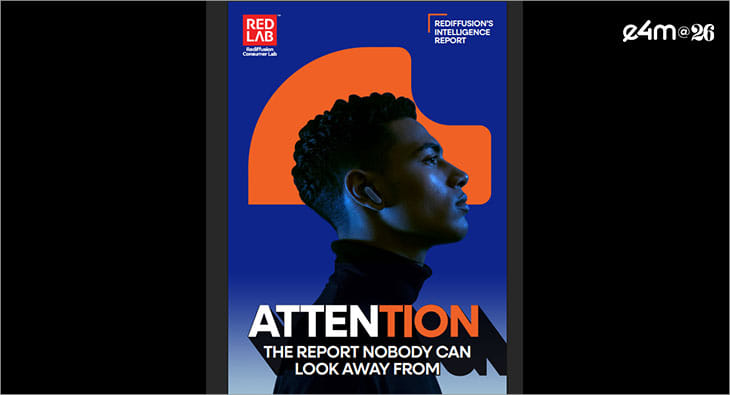

THE ECONOMY YOU NEVER SIGNED UP FOR
What information consumes is rather obvious: it consumes the attention of its recipients. Hence, a wealth of information creates a poverty of attention - Herbert A. Simon, Nobel Laureate, 1971
A Nobel Prize-winning economist named Herbert Simon said it first, and said it well. In 1971, he wrote the defining statement of our digital age — before the internet existed. He understood something the rest of the world is still catching up to: attention is the bottleneck of human existence. We can produce infinite content, infinite products, infinite messages — but we cannot produce more time to pay attention to them.
Thomas H. Davenport and John C. Beck, in their landmark 2001 Harvard Business School book, defined it precisely: “Attention is focused mental engagement on a particular item of information. Items come into our awareness, we attend to a particular item, and then we decide whether to act.” That single moment of choosing to attend is what every brand, every platform, and every publisher is racing to capture.
Michael Goldhaber predicted the shape of the internet economy in 1997. His crucial insight: attention is a zero-sum game. When one thing earns it, everything else loses it. By 1999, Georg Franck went further — arguing that “income in attention ranks above financial success” for advertising-driven media. The attention economy also generates what economists call ‘negative externalities’ — costs borne by society at large: social media addiction, fake news amplification, surveillance capitalism (the harvesting and selling of personal data), and the marginalisation of minority voices. The UN Economist Network has formally recognised the attention economy as a source of measurable social harm.
We are now living in what researchers describe as the most complex attentional environment in human history. There are more screens, more sources, more voices, more ads, and more notifications than at any point in our evolutionary story, and our brains are running the same hardware they were 10,000 years ago
A WEALTH OF INFORMATION CREATES A POVERTY OF ATTENTION
The more we have to pay attention to, the less we truly attend to anything. This is not a flaw in us. This is the mathematics of scarcity. And the entities that understand this scarcity and engineer for it will define the next century of commerce, culture, and power.
YOUR BRAIN IS THE BETA VERSION
Your brain didn’t evolve for the world it now lives in. But the algorithms that harvest your attention, evolved for exactly this brain.
Here is a fact that should rattle every marketer, every parent, and every person who has looked up from their phone to find an hour has passed: social media platforms are engineered using the same psychological mechanisms as slot machines. This is not an accusation. It is the architecture, documented in peer-reviewed research and admitted by the people who built it.
Dr. Gloria Mark, Chancellor’s Professor of Informatics at UC Irvine, has studied human attention longitudinally since 2004, longer than almost any other researcher in this field. Speaking on the APA’s flagship podcast Speaking of Psychology, she reported findings that should alarm every leader, every teacher, and every parent: “Around 2012, we found it to be 75 seconds, and in the last six years, we found it to average about 47 seconds.” To put that in context: when her research began in 2004, the average was two and a half minutes. In two decades, we’ve lost more than two-thirds of our on-screen attention span. And the trajectory is not flattening.
At the core of the collapse is dopamine, the brain’s reward and motivation chemical. This is called a variable reward schedule, first described by B.F. Skinner in the 1930s. Uncertain rewards are far more compelling than predictable ones. Slot machines pay out randomly, and that’s precisely why people can’t stop pulling the lever. Pull-to-refresh is a slot machine. You never know if you’ll get something good. And so you keep pulling
Technology is not neutral. The race for attention always ends at the bottom of the brainstem — in outrage, in emotion, in the lizard brain. Because that’s the only way to win - Tristan Harris, former Google Design Ethicist, TED 2017
THE PUPPET MASTER OF SILICON VALLEY
Imagine a control room. Thousands of designers, psychologists, and engineers are turning dials — dials that adjust how a billion people feel, think, and behave. That room exists. It’s every major tech company’s product office.
Tristan Harris coined the term ‘human downgrading’ — the interconnected system of addiction, distraction, isolation, and polarisation that weakens human capacity on a civilisational scale. His central argument: there is a hidden goal driving every piece of technology we build – the race for your attention. Those minutes are the product. Those minutes are sold to advertisers.
Tim Wu, a legal scholar and author of The Attention Merchants, formalised the concept of ‘attention theft’ — arguing that ads imposed on captive audiences without compensation constitute a form of theft. Demanding the most valuable thing a person has (their time and focus) while paying them nothing in return. This concept has since entered policy circles, with researchers proposing ‘interrupt rights’ and ‘attention bonds’ as market mechanisms to make the cost of demanding attention more honest.
Kevin Kelly, co-founder of Wired, identified eight intangibles that in the attention economy are worth more than the content itself. Understanding these is a masterclass in what brands must provide to earn genuine attention.
KEVIN KELLY’S 8 INTANGIBLES OF THE ATTENTION ECONOMY
IMMEDIACY
Priority access and instant delivery. People will pay for what arrives before the crowd.
PERSONALISATION
Tailored just for you. Generic is free; specific is priceless.
INTERPRETATION
Support, context, and guidance. Raw information is abundant; meaning is scarce.
AUTHENTICITY
The real thing, verified. In an age of deepfakes and AI, genuine provenance commands a premium.
ACCESSIBILITY
Wherever, whenever, effortlessly. Friction is the enemy of attention.
EMBODIMENT
The physical experience. Live events and real objects — what screens cannot replicate.
PATRONAGE
Paying simply because it feels good to support something meaningful.
FINDABILITY
Being discovered in a world of millions. When everything is available, being found is the competitive advantage.
Called ‘the closest thing Silicon Valley has to a conscience’ by The Atlantic, Harris coined the term ‘human downgrading’ and inspired The Social Dilemma. He continues to brief governments and heads of state on the systemic risks of unregulated attention architecture.
DOCUMENTED DESIGN PATTERNS THAT EXPLOIT HUMAN PSYCHOLOGY
INFINITE SCROLL
Removes natural stopping points
VARIABLE REWARDS
Unpredictable likes and notifications
STREAKS & COUNTERS
Loss aversion engineered as a product feature
AUTOPLAY The next hit before you decide you want it
PUSH NOTIFICATIONS
Interrupting your thoughts on demand
SOCIAL PROOF
Public likes count as anxiety triggers
FOMO DESIGN
Stories that disappear. Live notifications. Countdown clocks.
HYPER-PERSONALISATION
The algorithm that knows you better than you do
AD FATIGUE ENGINEERING
Serving ads just below the threshold that triggers irritation
BRAIN ROT, TIKTOK & THE MEMORY EXPERIMENTS
When Oxford names your problem the Word of the Year, you have a civilisational crisis.
The coinage of ‘brain rot’ as the defining word of 2024 is not a casual cultural observation. It is the mainstream vocabulary catching up to a scientific reality that researchers have been documenting for years. In a controlled experiment at Ludwig Maximilian University of Munich, 60 participants were tested on prospective memory, the ability to remember to carry out an intended action after an interruption. Participants were given a task, then interrupted with either TikTok, Twitter, or YouTube, and then asked to return to their original goal.
TikTok was the decisive destroyer. After using TikTok, participants’ performance cratered so severely that they were only slightly better than random guessing. Twitter and YouTube showed no measurable impact. When researchers investigated why, controlling for social media addiction, absent-minded phone use, and general boredom, none of those factors explained the effect. The culprit was the format itself: rapid-fire short-form video combined with constant, frictionless task-switching. A completely independent research team replicated the results in a study published in February 2025. Two labs. Same result
Short-form video, as a format, systematically impairs your brain’s ability to hold onto intentions. And the habit, once formed, extends beyond the app. Dr. Gloria Mark’s research provides the cognitive mechanism: every time we switch tasks, and short-form video is a machine for maximising task-switches, we incur a ‘switch cost’. In a TikTok session, a user might switch contexts hundreds of times. The cumulative switch cost is enormous.
The generational dimension is the most troubling. Researchers note that 1.4 million children under 13, below TikTok’s own age restriction, are active on the platform. These children’s prefrontal cortex is still developing; their capacity for sustained attention, delayed gratification, and executive function is literally being shaped in real time. The short-form epidemic is not just altering the attention of adults who have already developed those capacities. It is shaping the brains of children who have not.
FOCUS DIDN’T LEAVE. IT WAS STOLEN.
The landmark research of Johann Hari and why the crisis is not your fault.
You are not lazy. You are not weak. You have not failed at focus. You are living in a system that is pouring acid on your attention every day and then blaming you for the burns.
Johann Hari, author of Stolen Focus, spent three years interviewing over 200 of the world’s leading scientists. His conclusion was stark and counterintuitive: the global attention crisis is not a personal failing. It is a structural crime. The average American office worker now focuses on a single task for just three minutes before being interrupted. College students average just 65 seconds. Even Fortune 500 CEOs get only 28 minutes of uninterrupted focus per day. This is not a generation of weak-willed people. This is an engineered collapse.
DAY TRADING EYEBALLS — THE NEW BRAND GOSPEL
Gary Vaynerchuk’s 2024 book, ‘Day Trading Attention’, reframes marketing for an era where attention is no longer assumed — it is won or lost every single second. His thesis: go where attention is high and competition is low. He calls this ‘underpriced attention.’ TikTok in 2019 was the canonical example. Brands that showed up early built massive audiences at almost zero cost. Those who waited paid exponentially more for exponentially less.
Vaynerchuk also identifies the ‘TikTokification of social media’, the structural shift from follower-based algorithms to interest-based algorithms. A small brand with extraordinary content can now outperform a giant brand with a massive media budget. The playing field is tilted toward the creative and the agile, away from the rich and the complacent.
2.5 SECONDS TO MIDNIGHT THE AD INDUSTRY’S CRISIS
An ad that was ‘viewed’ is not an ad that was seen. And an ad that was seen is not an ad that was remembered. The gap between these three states is where billions of dollars disappear every year.
For decades, the advertising industry operated on a comforting lie: that a ‘viewable impression’ is the same as attention. It is not. Research from Amplified Intelligence delivers the uncomfortable verdict: approximately 85% of online ads do not pass the 2.5-second attention-memory threshold. The majority of digital advertising budgets are being spent on impressions that vanish before they can have any effect.
The most ambitious response to this crisis has come from Amazon Ads and Dentsu, who commissioned Lumen Research to conduct a landmark joint study: over 1,000 ads from 76 brands, analysed across Amazon Freevee, Twitch, and Amazon Music. Amazon Freevee generated 3x the attention of linear TV norms. Amazon Music and Twitch generated 2.6x and 2x, respectively. The key mechanism: premium content that audiences already love creates an attentional halo around the ads within it. Context is attention. The environment in which your ad appears is as important as the ad itself
The research also illuminated the role of frequency. There is a frequency sweet spot for every medium. Before it, attention is building. After it, ad fatigue sets in, where excessive exposure leads to reduced engagement and active avoidance. Understanding this curve is the new media planning.
THE COST OF ONE SECOND
The advertising industry has spent decades arguing about reach, frequency, and creative quality. It has largely avoided the one conversation that makes CFOs uncomfortable: what is the precise financial cost of attention that never actually arrives?
An ad that was ‘viewed’ is not an ad that was seen. And an ad that was seen is not an ad that was remembered. The gap between these three states is where billions of dollars disappear every year.
Imagine a brand — call it Brand X — runs a digital video campaign in India. The media plan looks impressive: 50 million impressions, a CPM of `180, a total media spend of `90 lakhs. The campaign runs. The dashboard turns green. Viewability scores come back at 72%, above the industry benchmark. The marketing team presents a slide that says ‘36 million people saw our ad.” The CEO nods. The agency gets a case study.
Here is what the dashboard did not show. Of those 50 million impressions, approximately 85% — 42.5 million — did not cross the 2.5-second active attention threshold required to begin encoding brand memory. They were technically viewable. They were not actually viewed. Of the remaining 7.5 million impressions that did cross the threshold, only those with strong, immediately recognisable brand assets — logo, colour, character, character, and sonic identity — had any chance of converting attention into recall. Without clear distinctive assets in the first frame, 29 research by VCCP and Amplified Intelligence suggests even those 7.5 million impressions lose roughly 60% of their potential effectiveness.
So from `90 lakhs of media spend, the number of impressions doing real, memory-encoding work is somewhere in the range of 3 million. The effective CPM — the cost per impression that actually worked is not `180. It is closer to `3,000. This is not a hypothetical.
This is the current operating reality of digital advertising, measured by eye-tracking technology, EEG data, and brand lift studies conducted by the most rigorous attention researchers in the world. The gap between the number on the media plan and the number doing actual cognitive work is, in most campaigns, enormous and almost entirely invisible to standard measurement tools.
THE WORLD’S MOST CONTESTED ATTENTION MARKET
Everything you’ve read was about a global crisis. This is about where the crisis is most intense, most complex, and most consequential. With 750 million smartphone users, the world’s largest base of first-generation internet users, the highest average daily social media consumption in Asia, and a media landscape that is simultaneously ancient and radically new — India represents the single most contested attention market on earth. Every global platform is fighting for Indian eyeballs. Every Indian brand is fighting for the same finite pool of human focus. And the rules of the game are different here.
THE NUMBERS, FIRST
India has the highest average daily social media usage in Asia, at approximately 2 hours and 36 minutes per day, above the global average and above China, Japan, and South Korea. The average Indian smartphone user unlocks their phone 52 times per day. WhatsApp commands over 500 million active Indian users and is not a social media app but an infrastructure, the primary communication channel for a significant portion of the country. YouTube reaches over 467 million Indian users monthly, making India YouTube’s single largest market in the world by user count.
THE IPL — THE WORLD’S GREATEST ATTENTION EVENT
The IPL is the single largest attention event in the annual global advertising calendar. For approximately 60 days every year, hundreds of millions of Indians synchronise their attention around one property, simultaneously, emotionally, and communally. No Super Bowl, no World Cup, no Olympics generates the concentration of voluntary, high-quality attention that the IPL does in India, at the scale it does. Brands that understand this are buying not just eyeballs but emotional states — the excitement, the tribalism, the shared moment — that are the rarest and most valuable contexts in the entire attention economy.
THE BHARAT DIMENSION
The attention economy, as described by Western researchers, assumes a context that does not fully apply to the majority of Indian internet users, particularly those entering digital life for the first time through a JioCinema or a shared smartphone in a small town in Uttar Pradesh, Bihar, or Rajasthan. For these users, the digital experience is not a layer on top of an existing media diet. It is the media diet, arrived at fully formed, algorithm first, with no preceding era of newspapers, cable television, or desktop internet to provide context or comparison. These users are not cynical. They are not ad-fatigued in the way that a 35-year-old Mumbai professional is. They are, in many cases, genuinely open to brands that speak to them in their language, in their context, and according to their values. The attention is there. It is waiting to be earned. The question is whether Indian brands and the agencies that serve them are willing to do the work required to earn it.
JIOCINEMA AND THE STREAMING ATTENTION WAR
The launch of JioCinema as a free streaming platform — carrying IPL, international sports, and an expanding library of premium content — represents one of the most dramatic attention economy events in Indian media history. By removing the paywall from premium content and monetising it through advertising, Reliance created the world’s largest free-to-air premium streaming audience essentially overnight. Research consistently shows that audiences watching premium content they have actively chosen generate higher-quality attention for surrounding advertising than passive or incidental consumption. JioCinema has created an enormous inventory of this premium attentional context. Brands that understand the streaming attention research and apply it to the Indian streaming landscape will find themselves with an enormous first-mover advantage. The brands that show up with creative excellence, strong, distinctive assets, and genuine contextual relevance will find streaming India to be the most rewarding attentional environment in the history of Indian advertising.
THE LANGUAGE OF ATTENTION
One of the most significant and least-discussed dimensions of the Indian attention economy is language. India has 22 officially recognised languages and hundreds of dialects. The majority of first-generation internet users consume content primarily in their mother tongue — Hindi, Tamil, Telugu, Kannada, Bengali, Marathi, and Gujarati. The brands and creators who are winning genuine attention in India’s tier-2 and tier-3 markets are doing so in the language of their audience, not translated, not dubbed, but genuinely conceived in that language, with cultural references, humour, and emotional registers that belong to that world. This is Kevin Kelly’s ‘personalisation’ intangible applied at the civilisational scale. Generic is free. Specificity is priceless.
WHAT BRANDS MUST DO RIGHT NOW
Attention is not bought. It is built, one story, one moment, one genuine connection at a time. The brands that understand this will define the next decade.
- KNOW YOUR ASSETS Distinctive brand assets, colours, characters, sonic branding, and visual identity are the attention multipliers. Dr. Karen Nelson Field’s research shows well-branded ads are 2.5x more effective than poorly branded ones. Audit your assets. Activate them consistently. Without them, even 10 seconds of viewability is money evaporating.
- HOOK IN THE FIRST FRAME Whether it’s a video, a headline, or an email subject line, the opening must earn the next second. Lead with tension, a bold claim, or genuine curiosity. In a world where TikTok has trained audiences to evaluate content in milliseconds, saying ‘we’ll get to the point in a moment’ is not a strategy. It is a death sentence.
- TRADE IMPRESSIONS FOR TRUST The best brands treat creators as independent creative directors who craft audience-first content. Kevin Kelly’s ‘authenticity’ intangible applies directly: genuine creator voices cannot be faked, and audiences can feel the difference. Authenticity is the new algorithm.
- GO WHERE IT’S CHEAP Underpriced attention is always somewhere. Gaming, podcasting, community platforms, live streaming, premium streaming, wherever the audience is real and the brands are absent, there is an opportunity. Amazon’s streaming data proves this: environments audiences love produce 2–3x the attention of environments they merely tolerate.
- MANAGE FREQUENCY LIKE A DRUG Ad fatigue is real, measurable, and costly. Dentsu’s research identifies medium-specific frequency sweet spots. One extra impression in the right moment builds brand choice. One too many trains your audience to look away. Know the difference.
- BE WORTH THE BRAIN’S TIME Nobody wants to watch advertising. They want to be entertained, moved, surprised, or informed. The bar is not ‘did we run an ad?’ The bar is ‘would someone choose to watch this?’
The winner of the attention economy is not the brand with the biggest budget or the most screens. It’s the brand with the most relevance, the most honesty, and the best story.
RECLAIMING THE HUMAN MIND
Because the goal was never just to win the war for attention — it was to be worthy of it.
If we only think about attention as a resource to be captured, we’ve already lost the larger point. The deeper question isn’t, ‘how do we get more of it?’— it’s ‘what are we doing with it?’
The Center for Humane Technology, co-founded by Tristan Harris and Aza Raskin, advocates for ‘time well spent’ technology, systems designed around the deepest human values rather than engagement metrics. The UN Economist Network has formally recognised the need for policy responses to the attention economy’s negative externalities.
Dr. Gloria Mark’s research is explicit on neuroplasticity: the brain’s capacity to rewire itself is not only the source of the problem. It is the source of the solution. A 2025 clinical trial at McGill University found significant improvements in attention among adults who participated in challenging cognitive exercises. Another study found that simply blocking mobile internet improved sustained attention, equivalent to reversing a decade of cognitive ageing. The brain can heal. But it needs the conditions to do so. As consumers grow more conscious of attention manipulation, brands that operate with transparency and respect that earn attention rather than steal it, will build deeper loyalty than any algorithm can generate. In a world saturated with manipulation, dignity is a competitive advantage.
WHAT AI DOES TO THE ATTENTION ECONOMY NEXT
Every crisis described in this report was created by human beings working with human-speed tools. What comes next will be created by machines working at a speed humans cannot imagine, cannot match, and cannot fully govern.
Here is the situation as it stands. In 2022, the entirety of human-written text available on the internet was estimated at approximately 300 billion pages. Generative AI systems trained on that corpus can now produce an equivalent volume of text — articles, scripts, captions, campaigns, and novels — in a matter of weeks. The content supply, which was already vastly exceeding the attention available to consume it, is about to become essentially infinite.
Infinite supply. Finite attention. The economics of the situation are not difficult to understand. They are difficult to survive. There is no AI that can generate more hours in the day. There is no algorithm that can create more human attention. The scarcity that Herbert Simon identified in 1971 is about to become the defining crisis of the mid-21st century in a way that makes today’s attention economy look, in retrospect, like a gentle warning.
THE AI ATTENTION PARADOX
The same technology that is flooding the world with content is also the most powerful tool ever created for personalising it. AI-driven recommendation systems are already extraordinarily effective at predicting what any individual user will attend to next, and serving it to them before they consciously know they want it. As generative AI becomes more sophisticated, the logical next step is already being taken by several platforms: using a user’s attention model to generate content specifically optimised for that user’s attention patterns in real time. No content has been selected from the library of human-made videos. Content created, on demand, for you, engineered from the ground up to hold your specific attention as long as possible.
If the slot machine was the first generation of variable reward systems and the personalised algorithm was the second, this is the third — and it is orders of magnitude more precise. Tristan Harris described the current system as a race to the bottom of the brainstem. The AI-generated personalised content system is the same race, with a faster car and no speed limit.
WHAT HAPPENS TO HUMAN CREATIVITY
The advertising industry’s first response to generative AI has been a question of craft: will AI replace copywriters, art directors, and strategists? The more important question is: what happens to the value of human creativity when the supply of creative output becomes infinite? The answer, counterintuitively, is that genuinely human creativity becomes more valuable, not less. Kevin Kelly’s ‘authenticity’ intangible — the demand for the real thing, verified — applies with particular force in an era when most content is AI-generated. The handmade object in a world of mass production commands a premium. The genuine emotion in a campaign conceived by a person with actual experience of the human condition lands differently than content optimised by a machine.
THE AI ADVERTISER — FRIEND OR THREAT
AI-powered media buying already operates at speeds and scales that no human media planner can match. The problem is that most AI media buying systems are currently optimising for the wrong things — click-through rates, video completion rates, viewability scores, and the same proxy metrics that have misled the industry for two decades. An AI optimising for a bad metric makes the same mistakes faster, at greater scale, with greater confidence, and with less human oversight to catch the errors.
The future of AI in advertising depends entirely on the signal it receives to optimise for. If that signal is genuine attention — measured with the rigour that Dentsu, Amplified Intelligence, and the IAB are now developing, AI could become the most powerful tool for earning human attention that the industry has ever had. If that signal remains impressions, clicks, and completion rates, AI will accelerate the existing dysfunction to a degree that makes the current crisis look mild.
THE THREE FUTURES
In the first future, regulation arrives. Governments, learning from GDPR on data privacy — impose design standards on digital platforms. AI-generated content is labelled. Algorithmic amplification of outrage is structurally limited. Brands that have built genuine creative excellence are rewarded. The extractors are penalised. This is the hopeful future.
In the second future, the flood wins. AI-generated content overwhelms every platform. Attention continues to fragment. Advertising effectiveness collapses to the point where the current model, which serves enough impressions that some percentage of people buy something, becomes economically unviable. A new model, yet unformed, must emerge from the wreckage. This is the chaotic future.
In the third future — and this is the one that creative agencies should be building toward, human creativity becomes the scarcest and most valuable input in the entire content supply chain. AI handles volume, speed, personalisation, and distribution. Human creative intelligence handles meaning, emotion, cultural resonance, and the kind of genuine surprise that no language model can generate because it has not lived a human life.
Read more news about Industry Briefing, Internet Advertising, Marketing, PR & Corporate Communication, Television Media
For more updates, be socially connected with us onInstagram, LinkedIn, Twitter, Facebook YouTube & Google News