Why video is reshaping media investment, measurement and market power
With digital driving over 100% of growth, for marketers video now delivers both scale and performance, a combination that was earlier split across television for awareness and search for conversion
 by
by
Published: Mar 26, 2026 9:13 AM | 8 min read
 Follow Us

India’s advertising industry is undergoing a structural reset where the shift is no longer just from traditional to digital, but from broadcasters to platforms. As digital crosses 60% of the advertising market and contributes over 100% of industry growth, five channels—search, social, video, display and ecommerce advertising—are redefining how brands reach, influence and convert consumers. Yet within this evolving mix, one format is increasingly anchoring the transition - video.
The emerging playbook is no longer built around reach alone but around how effectively brands can capture attention, intent and transactions across interconnected platforms. The story is not just about digital scale. It is about how video is becoming the central layer through which this new advertising infrastructure operates, shaping both consumer behaviour and media economics.
The Pitch–Madison Advertising Report 2026 echoes this shift's magnitude. While core digital advertising grew from ₹45,292 crore in 2024 to ₹53,342 crore in 2025, the traditional media declined marginally during the same period. Under the expanded definition that includes ecommerce and MSME spending, digital reached ₹93,156 crore in 2025, taking its share to 60% of total advertising. Crucially, digital contributed over 100% of the industry’s growth, offsetting declines in traditional channels.
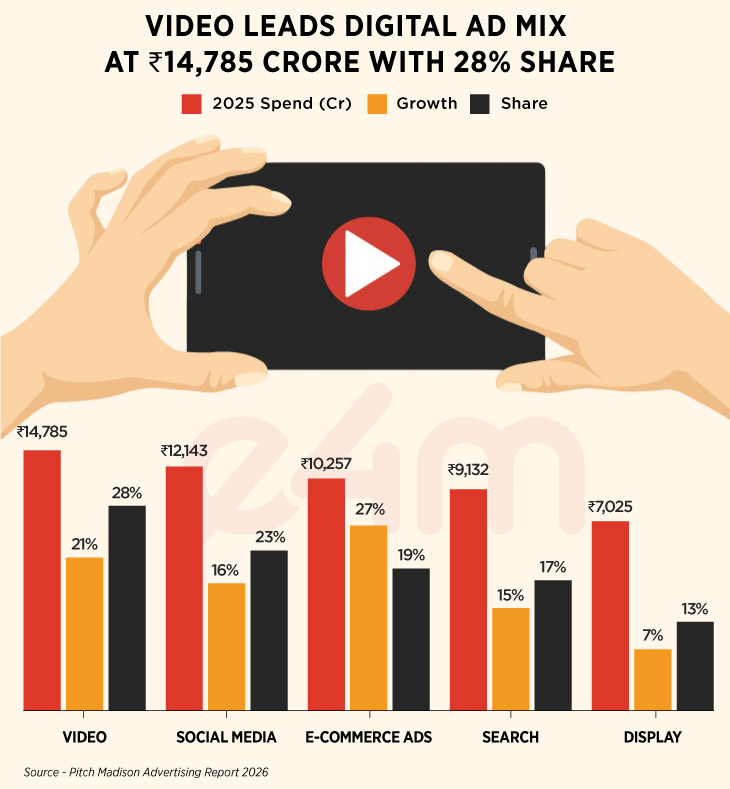
But within this growth, the composition of digital itself is changing.
As the PMAR highlighted, video has emerged as the largest digital format at ₹14,785 crore accounting for 28% of digital ad spend and growing at 21%. Alongside ecommerce advertising, which grew 27%, video is not just expanding but driving the direction of advertising strategy itself. Together, video and ecommerce contributed nearly 59% of digital growth, with performance-linked formats now making up close to 70% of digital advertising.
The rise of video as the new centre of gravity
The increasing dominance of video is closely tied to how consumers spend time. Platforms built around video consumption, from short-form feeds to long-form streaming, are now at the centre of digital behaviour.
Brijesh Bharadwaj, Co-Founder of Segwise.ai, an AI creative analytics platform says, “Share of video ads will continue to go up, as long as people are spending more time on apps which are natively video. If you think about where people spend time, they are on YouTube, Instagram, and even on formats like stories across platforms. Consumption wise, video is the highest. People spend more time watching videos on their phone than anything else.”
He adds that this behavioural shift is directly influencing advertising decisions. “Ads will follow wherever the human is spending time. If humans are spending more time on apps that serve video, ads will also follow video.”
This alignment between consumption and advertising is now being reinforced by platform economics. Video platforms are not only capturing attention but are also becoming increasingly monetisable. The steady rise in platform revenues, particularly for video-driven ecosystems, reflects how advertising dollars are consolidating around high-attention environments.
For marketers, this makes video a dual-purpose medium. It delivers both scale and performance, a combination that was earlier split across television for awareness and search for conversion.
From formats to full-funnel infrastructure
The broader transformation is visible in how the five dominant digital channels are being deployed. Search continues to capture high-intent demand. Social platforms drive engagement and discovery. Display enables retargeting. Ecommerce closes the loop at the point of transaction. But video increasingly sits across all these layers, acting as the connective tissue of the digital funnel.
Rajiv Dingra, Founder and CEO of ReBid, explains, “The largest incremental budgets today are flowing into video, ecommerce advertising, and social commerce formats, while search remains the most stable intent-capture channel.” He notes that short-form video ecosystems are attracting brand investments because they combine reach with improving performance signals.
This shift is being driven by a change in decision metrics. Advertisers are moving away from measuring success through impressions and toward evaluating incremental sales, cost per acquisition, and return on ad spend. Video, once seen primarily as a branding tool, is now being evaluated through the same performance lens.
Vishal Shrivastava, Head of Business Strategy at AnyMind Group India, adds that “social and online video together command over 50% of digital spends, but the most strategic growth is currently seen in ecommerce and retail media, which act as the ultimate conversion engines.” He explains that brands are increasingly using integrated data strategies that combine first-party, second-party and third-party signals to link video exposure directly to transactional outcomes.
This convergence is effectively collapsing the traditional funnel. Awareness, consideration and conversion are no longer separate stages but part of a continuous, data-driven loop.
Advertising economics shift from media to data
The rise of video is also central to a deeper shift in advertising economics. The industry is moving from a model where value was derived from media ownership to one where it is defined by data ownership and integration.
Dingra notes, “The biggest shift is that advertising economics are moving from media ownership to data ownership.” Digital platforms offer deterministic targeting, real-time optimisation and closed-loop attribution, allowing advertisers to connect exposure to outcomes.
What makes video particularly powerful in this context is its ability to operate across multiple layers of the ecosystem. It is consumed within platforms that also control discovery, engagement and increasingly, commerce signals. This vertical integration gives platforms a structural advantage.
Shrivastava describes this as a move toward unified data environments where platforms act as a clearinghouse for different data types. “Economic leverage is held by those who can seamlessly blend first-party, second-party and third-party signals into a single actionable profile,” he says.
This creates an intelligence gap between platforms and traditional media. Platforms use behavioural data and machine learning to predict consumer intent, refining targeting and optimisation over time. Video, being the most consumed format, becomes a critical input in this data loop.
Sectoral shift and the D2C acceleration
The rise of video is also being shaped by sector-specific behaviour. Categories such as FMCG, D2C, fintech and consumer electronics are restructuring their media mix to align with digital-first strategies.
Bharadwaj points out that D2C brands are at the forefront of this shift. “All the top D2C brands are spending heavily on marketing, and most of that spend is going into platforms like Meta and Google, with video being the dominant format,” he says. He adds that as production costs decline and AI enables faster content creation, the volume of video advertising is increasing significantly.
This has implications for competition. As Bharadwaj notes, “The number of advertisers who can produce video ads is increasing, which means competition for attention is going up, and prices will go up.” The democratisation of content production is lowering entry barriers while intensifying competition for consumer attention.
Russhabh Thakkar, Founder and CEO of Frodoh, reinforces this trend. “Incremental budgets are clearly flowing into commerce media, short-form video, and search,” he says. He adds that for many FMCG and D2C brands, a significant share of digital budgets is now allocated to retail media, while video continues to dominate top-of-funnel investment.
Growth with volatility and emerging risks
Despite strong growth, the digital advertising market is also showing signs of volatility. According to the Pitch–Madison Advertising Report, digital ad spend grew sharply in early 2025, with 50% growth in Q1, followed by a decline of 18% in Q4, partly due to regulatory changes affecting key categories.
This highlights a new reality. As advertising becomes more concentrated within platform ecosystems, it also becomes more sensitive to policy shifts, platform dynamics and category-specific disruptions.
At the same time, the concentration of power within a few platforms raises questions about market structure. Thakkar notes, “Platforms are no longer just media owners, they are infrastructure. They control reach, data, measurement and transaction.” He adds that this gives platforms pricing power, particularly as they move closer to conversion.
The future is video-led and data-connected
Looking ahead, the trajectory appears clear. Digital will continue to grow, but the focus will shift from scale to efficiency, optimisation and integration. Retail media, connected TV and AI-driven targeting are expected to drive the next phase of growth.
Within this, video is likely to remain the central format.
Bharadwaj emphasises that the gap between advertisers who adopt AI and those who do not will widen significantly. As content production becomes more scalable, the ability to generate, test and optimise video creatives at speed will become a key competitive advantage.
At a broader level, the future of advertising will be defined by the ability to connect data across platforms and orchestrate the consumer journey in real time. Dingra notes that “the next phase of advertising will be defined by who controls the data layer that sits above the platforms and orchestrates media investment across them.”
This suggests that the real competition is not between channels but between ecosystems that can integrate attention, intent and transaction signals.
A market rewritten
India’s advertising market is not just becoming digital. It is becoming platform-led, data-driven and increasingly video-centric.
The shift from broadcasters to platforms marks a fundamental change in how value is created. Video, once a medium of storytelling, is now at the centre of a system that connects content, commerce and data.
As brands navigate this new landscape, the question is no longer whether video will grow. It is how the industry will adapt to a future where video is not just a format, but the foundation of advertising itself.
Read more news about Digital Media, Internet Advertising, Marketing News, Television Media, Radio Media
For more updates, be socially connected with us onInstagram, LinkedIn, Twitter, Facebook, YouTube & Google News