'AI can scale reach, but humans still own attention'
At the e4m Pitch CMO Summit 2026, brand leaders unpacked what it truly means to capture and keep consumer attention in a world reshaped by artificial intelligence
 by
by
Published: Mar 17, 2026 3:17 PM | 12 min read
 Follow Us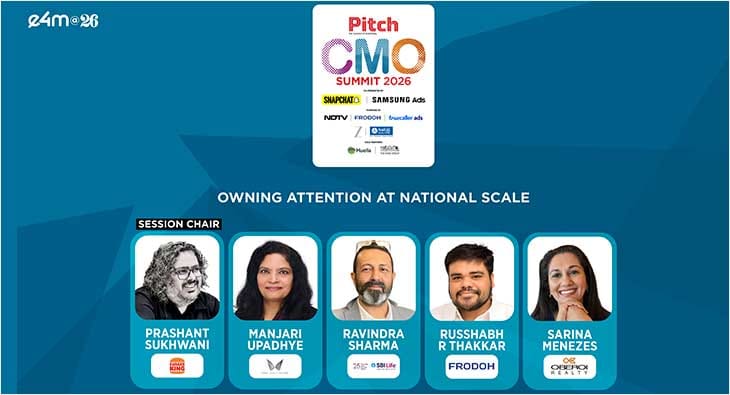

At the e4m Pitch CMO Summit 2026, the panel discussion titled "Owning Attention at National Scale" brought together senior marketers to examine how their categories are navigating an increasingly fragmented, AI-influenced consumer landscape.
Moderated by Prashant Sukhwani, VP Marketing, India, Burger King, the session featured Manjari Upadhaye, Chief Marketing Officer – Auto, Mahindra & Mahindra; Ravindra Sharma, Chief of Brand, Corporate Communication & CSR, SBI Life; Russhabh R Thakkar, Founder & CEO, Frodoh; and Sarina Menezes, SVP & Head – Marketing & Corporate Communication, Oberoi Realty.
Sukhwani opened the discussion by asking what does the AI-native consumer actually mean for each of these categories?
Upadhaye offered a grounded view from the automotive world. "The AI-native consumer is looking for all their research in one place. ChatGPT is their new best friend," she said, noting that today's car buyer is comparing models through AI-driven searches and asking deeply personal questions like whether a car is suitable for an elderly parent, for instance.
Yet for all the convenience this offers, she pointed out that the same consumer is often overwhelmed by the sheer volume of options and ends up relying on a trusted friend or a showroom visit to make the final call.
Sharma, representing SBI Life, pushed back gently on the term itself. "AI-native in my understanding, is where an organisation's foundation starts with AI. So do we have AI-native consumers? In my opinion, that is a big question mark, because AI itself is at a very nascent stage," he said.
He drew an analogy to a child and how one cannot yet define the personality or thinking of something still forming. His view was that consumers are currently using AI as a research tool, not living within it natively.
Thakkar brought a different lens altogether. As a founder whose clients are marketers themselves, he observed that even in a fully digital product environment, decisions ultimately remain human. "Culture and decisions are largely human-based. So for us, the consumer is absolutely native, but decisions are still taken by humans themselves," he said.
Talking about the human element amidst rapid technological advancements, Prashant Sukhwani, Vice President – Marketing, Burger King India, said, “Whilst AI and technology allow me to personalise offers, understand consumer journeys through first-party data, predict demand and optimise media, at the end of the day, if my crew member is not speaking to you nicely, you’re not coming back.”
For Menezes, the question had to be situated within the dramatic growth of India's luxury market, which, she noted, a recent industry report projects will be worth $12.4 billion by 2028, up from $7.4 billion in 2016–17. The luxury consumer, she explained, is well-travelled, exposed to the finest global standards, and arrives at a brand having already done extensive research.
"We always say as a brand that this is the largest cheque a customer will write in his life and hand it over to a brand like ours. And he wants to hand his cheque to a credible brand," she said. AI, in this context, is helping that consumer understand and validate the brand long before any direct interaction.
The conversation then moved to how discovery and the physical experience of a product are being reconciled in an AI-assisted world, particularly for Mahindra, where the test drive remains central.
Upadhaye explained that the journey for Mahindra now begins at the discovery stage itself, and that hyper-personalisation is where AI is making the most meaningful difference. "A person sitting in Kolkata experiences a very different traffic situation from someone in Leh, and AI is helping expose the customer to why a Mahindra car works just as well in one city versus another," she said.
But she was candid about the pitfalls too. Hyper-localisation for its own sake, e.g. placing a Taj Mahal behind a car for an Agra audience and Red Fort for a Delhi one, does not necessarily build connection. "Consumers want more than that. They want to know how a Mahindra Thar is more apt for them in their particular city," she said.
Where AI has genuinely transformed the funnel is in simplifying the path from interest to booking. Leveraging WhatsApp and generative AI, Mahindra has made it possible for a consumer who discovers a car on Instagram to book a test drive, down to the time slot, entirely through a chat interface. "We have seen some of our customers even committing to a payment on WhatsApp. The journey is completely seamless," she said.
That said, she was clear that the physical world remains irreplaceable. Insurance, registration, the relationship with a sales consultant are all human touchpoints that close the deal. "AI equals efficiency, but humans equal sensory experience and final closure. So many customers know the sales consultant by name, the service people by name. It's a journey of eight to ten years with a car," she added.
For SBI Life, the challenge Sukhwani raised was one of trust and cultural resonance. How does a brand in a commoditised category move beyond visibility to actually shifting behaviour?
Sharma traced the brand's evolution over the past few years from a tactical to a deeply emotional positioning. SBI Life's current platform — Apne Liya, Apno Ke Liye — was, he explained, rooted in a sharp cultural observation that the social norm of self-sacrifice, of a parent never doing anything for themselves, has shifted over the last decade. "The culture is no longer that you must sacrifice everything for your children or parents. It is now a balance. You can fulfill your own passions and also do it for your loved ones," he said. The brand exists at precisely that intersection.
This cultural grounding also extends to SBI Life's social initiatives. One campaign is focused on driving breast cancer awareness and reducing deaths from the disease; another tackles child helmet safety, a cause that is often overlooked. "Everyone is talking about helmets, but they are not talking about the child riding on the bike. If you look at accident fatality ratios, that is one of the highest," he said. For him, trust is built not just through communication but through acting on it and making audiences feel that it is genuinely acceptable, as the tagline suggests, to live both for oneself and for those one loves.
Thakkar spoke to what is happening at the intersection of technology, regional audiences, and the changing nature of media consumption. His argument was that while AI is making creative production more efficient and cheaper, the consequence is that content becomes infinite and infinite content produces scarcity of attention. The opportunity lies in tapping into audiences beyond the metro bubble. "You may be looking for a metro user, but you may find the same profile in a tier-two or tier-three market for an equivalent CPM," he said, pointing to the gap between India's roughly 500–600 million smartphone users and the estimated 60 million who are actually making purchases.
He also made the case for connected TV as a medium that has quietly transformed viewing from passive to active. "We are all forgiving towards ads on TV in some ways because we've grown up watching that. But ads have now turned viewing completely active," he said. And unlike the old linear prime time of seven to eleven, connected TV audiences are engaging deep into the night, a behavioural shift that, in his view, signals genuine and invested attention.
The luxury end of the spectrum, as Menezes explained, operates by an entirely different logic. AI-qualified leads may be the buzzword elsewhere, but for Oberoi Realty, the emphasis remains on the quality of the relationship, not the volume of the pipeline.
"Welcome to the world of luxury. It's very quiet," she said, drawing a deliberate contrast with the noise and hype elsewhere in the market. Her target consumer has already achieved financial and social status, and is looking for something quieter and more considered. The idea that someone might buy a home entirely online struck her as inconceivable. "I can't see, for the love of anything, anyone buying a home online. You want to actually experience what the home feels like," she said, adding that a recent internal study found the average conversion time is between 30 and 60 days. It is an indicator of brand strength and consumer confidence.
The tools like chatbots, WhatsApp, AI-driven lead profiling are there but what matters most in this category is human connection. "He doesn't want to talk to a chatbot. He wants to pick up the phone and talk to somebody who understands not his need, but his aspiration," she said. The purchase is a whole-family event, often involving the extended family and the patriarch. Every touchpoint in that journey must be seamless and calm.
Thakkar interjected with an observation that resonated across categories: Mercedes had recently reported that 43% of its buyers last year were millennials or Gen Z. "How you are present where their perception and aspiration gets built is very important," he said.
The panel then turned to one of the most contested questions in marketing today, i.e. is human-made content becoming the new luxury standard?
Sharma said, "For me, it is reality. Humans are the ones who create. AI only assists them. AI will work on the data provided by humans, but a human will create from experience, imagination, and motivation," he said. His distinction was that AI can write a heartbroken letter, but AI can never experience a heartbreak.
Thakkar extended the thought with a prediction. "In a few years, there will be campaigns with the tagline '100% human made', just like organic food. AI will give you information, but advertising that is truly heartfelt and culturally rooted will always be conceived by humans," he said.
Upadhaye agreed, and added that consumers are becoming sharper at telling the difference. "Human beings are far more perceptive than AI ever can be or will be. We can tell whether this is a real agent or an AI agent. We have trained ourselves to become smart," she said. For her, human-made content is a necessity. "There is no way a burger looks appetising if it is AI-made versus something shot by someone who put their heart and soul into it."
Menezes framed it as a question of brand differentiation. "In a world of sameness, how is AI going to tell my unique story - one that is being conceptualised and crafted in our design studios?" she asked. The architect's narrative, the concept behind a project, the soul of the brand cannot be outsourced to an algorithm. "AI can help me reach. The reach will be effective and quicker and far more enhanced. But the storytelling and the heart of the brand lie in the hands of humans," she said.
The final thread of the discussion was perhaps the most universal challenge that in a world of doomscrolling, where a consumer processes hundreds of reels in under two hours, how do brands claim even two seconds of genuine attention?
For Sharma, the answer lies in emotional quotient. "If the emotional delivery and the narrative are there for the audience I've made it for, they will pause. They will try to feel it, try to understand it, try to share it," he said. He pointed to SBI Life's recent campaign featuring Rishabh Pant and Ravindra Jadeja not as cricketers, but as characters called Jolly and Polly, giving advice to audiences in a conversational way. The approach generated strong ripple effects precisely because it showed them in an unexpected avatar. "If you are able to create the EQ, you will make them stop," he said.
Thakkar agreed on emotional resonance but brought in a structural point as well. The micro-drama format, i.e. setup, tension, instant dopamine release, is gaining ground for a reason. "Why is CTV screen time peaking from 10pm to 3am on a Friday? Because you want to watch one more episode, and then one more," he said, arguing that the same principle applies to brand content.
Menezes offered a counterintuitive observation that attention spans may be short, but depth still wins when the intent is genuine. She cited the example of a four-hour podcast that nonetheless touched millions of views. "If your content has depth, has a great story to tell, and is aesthetically shot and presented, it catches the attention of the viewer who has the intent to buy what you are presenting," she said. For Oberoi Realty, roughly 80% of her time is spent on designing, storytelling, and creating content for the brand and its projects.
Upadhaye brought the discussion to a close. Aesthetic quality, she said, is now table stakes. It is what Gen Z expects as a baseline. What actually makes someone stop is connection. "The 60-second ads of yesterday, if you remember Cadbury Dairy Milk or Bournvita, were all about human connection, something that a human soul yearns for. Even if it's aspirational, if you are connecting with humans in that way, they will take notice," she said. No amount of high-level aesthetics, on its own, will do the job.
Bringing in a category-specific perspective from QSR, where consumer decisions are often instantaneous, Sukhwani further highlighted how discovery itself is increasingly being shaped by algorithms. “We are being discovered through algorithms which are feeding you the best hangout spots… these are people making decisions faster because information is now very easily available, it’s at the tip of your fingers. These consumers want everything hyper-personalized… this is who I am, this is where I am, this is what I’m doing—and hence give me communication accordingly.”
Read more news about Marketing News, Advertising News, PR and Corporate Communication News, Digital News, People Movement News
For more updates, be socially connected with us onInstagram, LinkedIn, Twitter, Facebook, YouTube & Google News