AI will become one of the biggest enablers for leaders in the coming decade
Shalini Rao, Chief Marketing Officer of BIAL, discusses how value will depend on intelligent AI use, Gen Z’s impact on workplaces, the need for leaders to stay agile, adapt to change and more
 by
by
Published: Mar 17, 2026 9:34 AM | 4 min read
 Follow Us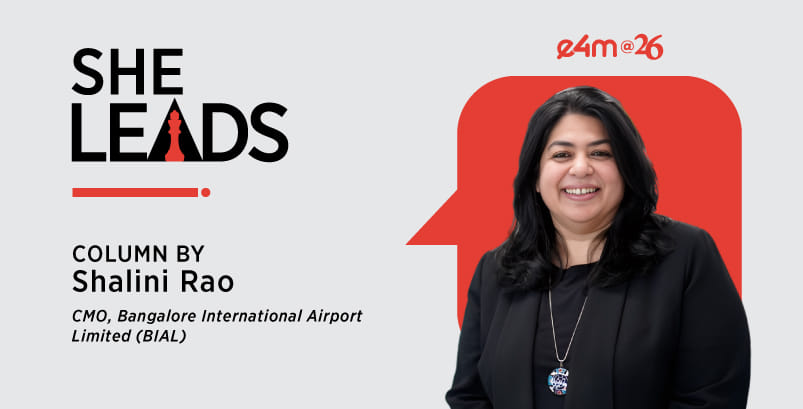

Leadership is entering one of its most defining decades. Organisations today operate in an environment that is more interconnected, technology-driven and dynamic than ever before. While change is accelerating across industries, it is also creating new opportunities for leaders to shape organisations, cultures and communities with clarity and purpose.
For women leaders, this moment represents a meaningful shift. As more women step into leadership roles across sectors, the conversation is steadily moving beyond representation. The focus is increasingly on the leadership mindsets and capabilities that will define the next phase of organisational growth. Success today is not about fitting into traditional leadership models alone. It is about expanding them. Women leaders are bringing broader perspectives to decision-making, combining strategic clarity with empathy, resilience and long-term thinking. As workplaces continue to evolve, these qualities will play an important role in shaping leadership over the next decade.
Three powerful forces are likely to influence this evolution: the rise of artificial intelligence, the influence of a new generation entering the workforce, and a shift in the skills required to lead in an increasingly fluid environment.
AI as the Next Enabler of Leadership
Artificial Intelligence will become one of the biggest enablers for leaders in the coming decade. However, like most powerful capabilities, its value will depend on how intelligently it is used. The ability to work effectively with AI is fast becoming a core skillset every professional must possess. Technology today can support analysis, insights and productivity at a scale that was once unimaginable. In many ways, AI is beginning to homogenise access to information and capability, helping level the field between individuals and teams.
Yet, even as AI accelerates speed and efficiency, leadership must remain anchored in human thinking. Leaders must ensure that their cognitive strengths remain intact. Technology can support decisions, but it cannot replace judgement, context, or perspective. The leaders who will stand out in the AI era will be those who use technology as an enabler while preserving creativity, clarity of thought and original thinking.
How Gen Z Will Redefine Leadership and Work
Gen Z professionals are bringing fearlessness and experimentation into workplaces. They are more willing to challenge traditional ways of working and redefine what great work looks like. Their openness to questioning established systems is encouraging organisations to rethink long-standing assumptions about productivity and culture.
At the same time, this generation is bringing new conversations into the workplace. Discussions around personal wellbeing, balance and self-care are becoming far more visible within professional environments. These perspectives are gradually influencing how organisations design work cultures and leadership environments.
New generation is therefore likely to bring greater balance to leadership cultures, with a stronger focus on individual wellbeing and boundaries. Over time, this generation will reshape leadership by redefining work culture, challenging traditional hierarchies and introducing new expectations around flexibility and purpose. For organisations, the opportunity lies in embracing these shifts while continuing to nurture accountability and leadership responsibility.
The Skills That Will Define Leadership in the Next Decade
When technological acceleration and generational change converge, one reality becomes clear. The workplace of the future will be far more fluid than the one we know today.
Structures, roles, and expectations will continue evolving, requiring leaders to remain comfortable navigating constant change. In this environment, resilience will become one of the most critical leadership traits. Leaders will need the ability to weather challenges without losing direction.
Cognitive strength and emotional intelligence will also become increasingly important. As AI becomes more embedded in the workplace, human judgement, empathy and perspective will differentiate effective leaders.
Agility and quick decision-making will define leadership effectiveness. Decision cycles are becoming shorter, and leaders must be able to think on their feet and respond confidently to emerging situations.
Adaptability and momentum will therefore be essential. There will be little room for what can be described as cruise control leadership. The leaders who succeed will be those who maintain direction while continuously adapting to change.
Leadership as a Journey of Constant Motion
Perhaps the most important shift is philosophical. Leadership today is less about reaching a destination and more about sustaining momentum. Careers and organisations are becoming increasingly dynamic. Instead of fixed structures, professional journeys now resemble ships docking briefly before moving on again. Movement, learning and reinvention are becoming defining characteristics of modern leadership.
A useful analogy is that of a river. A river is constantly moving, adapting to changing landscapes while maintaining its direction and flow. Leadership in the coming decade will require a similar mindset. Leaders must remain agile, continue learning and sustain forward momentum even as environments evolve.
Those who shape the future will not simply respond to change. They will move with it, and in doing so, help shape its course.
Read more news about Marketing News, Advertising News, PR and Corporate Communication News, Digital News, People Movement News
For more updates, be socially connected with us onInstagram, LinkedIn, Twitter, Facebook, YouTube & Google News