The New Billboard Playbook: Built for social media
From interactive billboards to experiential activations, brands are designing campaigns that people photograph, share and turn into content, extending their reach far beyond the street
 by
by
Published: Jul 9, 2026 9:15 AM | 8 min read
 Follow Us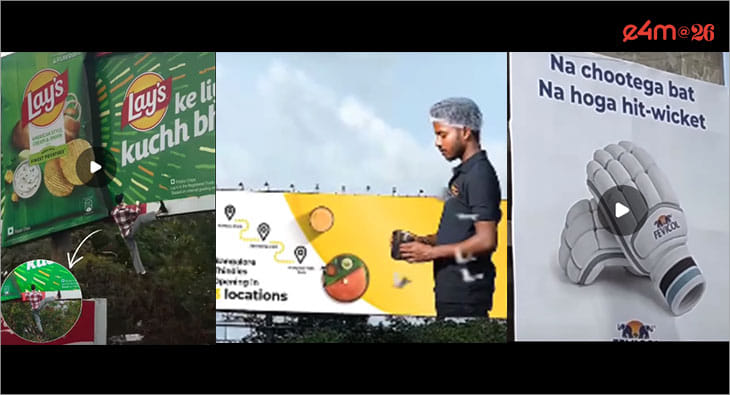

- Indian marketers are shifting from the traditional advertising mantra "Jo dikhta hai, woh bikta hai" to "Jo content banta hai, woh bikta hai," emphasizing the importance of creating engaging content that encourages social media sharing.
- Outdoor advertising campaigns are increasingly designed to spark conversations and generate user-created content, with success measured by social media engagement rather than just physical visibility.
- Examples of innovative campaigns include Zepto's humorous wedding attire ads, Bengaluru Thindies' 3D billboard, and Fevicol's timely response to a cricket moment, all of which leveraged cultural relevance and social media to amplify their reach.
- Marketers are encouraged to focus on creating shareable content rather than chasing virality, recognizing that effective outdoor advertising now serves as a catalyst for digital distribution and community engagement.
"Jo dikhta hai, woh bikta hai" has long been Indian advertising's favourite mantra. Today, marketers are increasingly replacing it with "Jo content banta hai, woh bikta hai" or, in other words, "What becomes content is what sells".
In this social media era, simply being visible is no longer enough. Whether it is a billboard, a metro announcement or an experiential activation, every consumer touchpoint is now expected to spark conversations, generate user-created content and travel far beyond its physical location.
For marketers, this represents a fundamental shift in how out-of-home (OOH) advertising is being designed and measured. Instead of judging a billboard by the number of people who drive past it, brands are increasingly asking a different question: will people stop, pull out their phones and post it on social media? If the answer is yes, the campaign can multiply its reach far beyond its physical location through earned media and user-generated content.
As Chandan Mendiratta, Chief Brand Officer at Zepto, puts it marketers also need to rethink where campaign ideas originate. "Everything today is content, from a television commercial and a billboard to the conversations taking place beneath a brand's Instagram post. Your comment section gives you a massive, massive insight. It's essentially a dialogue you're having with your customer," he said.
This thinking led to one of Zepto's most talked-about outdoor campaigns.
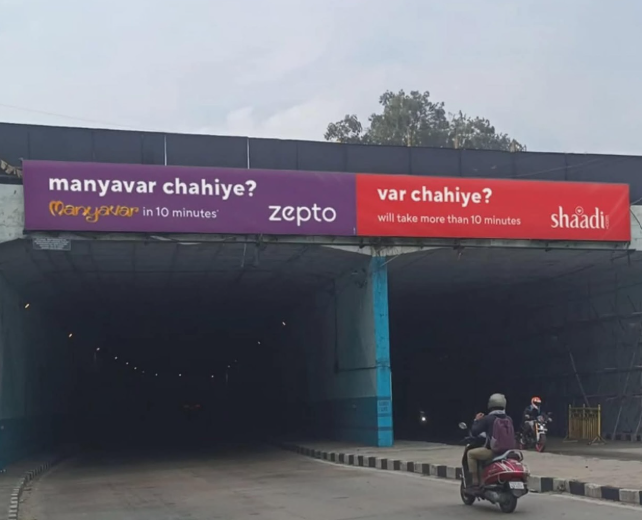
The company had partnered with Manyavar for a campaign in which three wedding guests forgot to buy festive kurtas and ordered them on Zepto in 10 minutes. Soon after the campaign was released, users began joking in the comment section that if Zepto could deliver wedding attire so quickly, it should also deliver a groom. Instead of ignoring the jokes, the marketing team recognised a recurring pattern.
Within days, Zepto transformed the online banter into an outdoor campaign featuring two adjacent billboards. One read, "Manyavar chahiye? Manyavar kurtas in 10 minutes on Zepto." The neighbouring billboard completed the joke: "Var chahiye? This will take more than 10 minutes. Shaadi.com."
The campaign quickly spread across LinkedIn, Instagram and X, illustrating how consumer conversations can evolve into creative ideas that generate significantly more attention than traditional advertising.
According to Mendiratta, that is exactly how marketers should think about outdoor advertising today.
"I could have sold something on the outdoor, but the idea is to make some content so that somebody can take a picture, and it has much wider reach," he said. He noted that had the billboard remained just another hoarding inside a Bengaluru underpass, only commuters passing through the location would have seen it. Instead, photographs of the campaign travelled across social media and reached audiences well beyond India.
The approach reflects a broader transformation taking place across the OOH industry. Increasingly, brands are creating installations designed as social media moments first and billboards second.
Bengaluru-based restaurant chain Bengaluru Thindies adopted a similar strategy while announcing three new outlets. Instead of using a conventional digital screen, the brand installed a 3D anamorphic billboard featuring a man pouring traditional South Indian filter coffee. The illusion made it appear as though the man was stepping out of the screen to offer a steaming cup to passersby. Videos of the installation were widely shared across social media, extending the campaign's reach well beyond the physical billboard and helping the restaurant generate conversations around its launch.
View this post on Instagram
Centerfruit's "Metro Mein Laplap" campaign demonstrated that even public infrastructure can become shareable content. Rather than relying on conventional metro branding, the brand temporarily transformed routine Delhi Metro public service announcements into playful audio messages built around its "Kaisi Jeebh Laplapayee" platform. The unexpected format prompted commuters to record the announcements and post them online, while creators produced reaction videos, memes and commentary that significantly amplified the campaign without direct media investment.
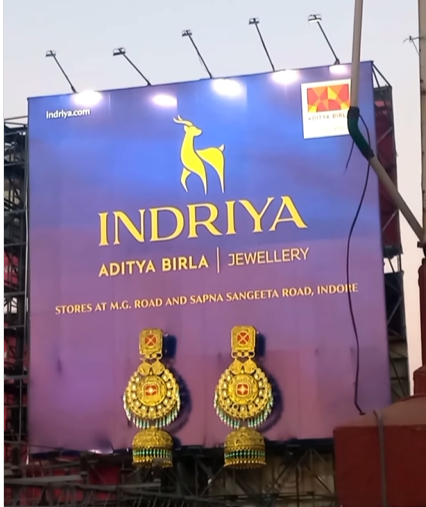
Jewellery brand Indriya by Aditya Birla Jewellery also leaned into spectacle by installing massive 15 to 20-foot gold jhumkas that physically extended from billboards in cities such as Indore and Vijayawada. The oversized installations blurred the line between outdoor advertising and public art, quickly becoming photo opportunities that spread widely across social media.
These campaigns point to a larger evolution in experiential advertising. The objective is no longer limited to creating awareness at a particular location. Instead, the physical activation serves as the starting point for digital distribution, where consumers become the media channel by posting photographs, videos and reactions across platforms.
Ironically, despite creating campaigns that frequently dominate online conversations, Mendiratta believes marketers have become too obsessed with chasing one metric.
Asked to name the most overrated word in Indian marketing, his answer was simple: "Virality."
His argument is that virality cannot be engineered directly. What brands can control is creating ideas that people naturally want to talk about, photograph and share. In that sense, successful outdoor advertising today is no longer just about being seen. It is about becoming content.
Fevicol offered another example of how brands are increasingly designing outdoor campaigns around real-time cultural moments. During the IPL, Gujarat Titans opener Sai Sudharsan was dismissed "hit-wicket" after his bat slipped out of his hands in back-to-back playoff matches, prompting a flood of social media jokes suggesting he needed some Fevicol.
View this post on Instagram
The adhesive brand responded almost overnight with a billboard outside the Narendra Modi Stadium carrying the line, "Na chhootega bat, Na hoga hit-wicket." By tapping into a conversation that was already unfolding online, the campaign transformed a fleeting sporting moment into a widely shared piece of brand content.
According to Schbang, the agency behind the campaign, speed was as critical as the creative idea itself. "What started as a bat slip during the IPL turned into an overnight billboard for Fevicol. We received the brief at around 10 pm on a weekend and brought it to life overnight. Beyond the creative, the team identified and secured a billboard location right outside the stadium, ensuring the message appeared exactly where the moment mattered most. It was a testament to how cultural relevance, creative agility and media precision can come together to create impact," the agency said.
Swiggy's launch campaign for Toing offered another reminder that a billboard does not need expensive production to become memorable. To communicate its promise of affordable food delivery, the brand deliberately chose handwritten cardboard billboards carrying the message, "Dilli's cheapest food delivery." The stripped-down execution became the campaign's biggest strength. By using what appeared to be the city's cheapest billboards to advertise its cheapest delivery service, Swiggy turned the medium itself into the message. The unconventional approach cut through advertising clutter, resonated with consumers amid rising delivery costs, and generated widespread conversation online, proving that a simple, culturally relevant idea can often outperform an elaborate execution.
Lay's also demonstrated how experiential OOH can transform a familiar campaign into a social media spectacle. As part of its "Lay's Ke Liye Kuchh Bhi" campaign, the brand installed dramatic billboards across Delhi NCR, Mumbai and Kolkata featuring life-sized figures appearing to hang from or climb billboards in an attempt to grab a packet of Lay's chips. Executed by MOMS Outdoor Media Solutions, the installations brought the campaign's central idea to life in a way that blurred the line between advertising and street theatre. The unusual visuals stopped passersby in their tracks, encouraged people to photograph and film the installations, and generated significant online buzz, reinforcing the idea that today's most effective billboards are those designed to be experienced in person and shared on social media.
View this post on Instagram
Another example of how brands are embracing community-driven content came from Foodpharmer's nutrition brand, Only What's Needed (OWN). An AI-generated billboard concept created by Gaurav Singh, popularly known as "The Ad Guy" on LinkedIn, caught the attention of the brand's founder, who shared it on Instagram despite the campaign never being officially commissioned.
"Someone made this billboard for Only What's Needed and I personally really liked it! While it was obviously made with AI, I still found it to be very innovative and interesting," he wrote.
Explaining the brand's philosophy, he added, "We don't do paid marketing. No Instagram ads. No YouTube ads. But this is the kind of billboard we would make if we did do paid marketing. Since we don't do paid marketing, these kinds of posts really help us spread the word about us."
View this post on Instagram
For marketers navigating fragmented media consumption and shrinking attention spans, the lesson is becoming increasingly clear. A billboard no longer ends where the street does. If it sparks conversations, fuels social sharing and inspires user-generated content, its real audience may begin only after someone uploads a photograph.
Read more news about Out of Home, Internet Advertising, Marketing, Digital Media, TV Media
For more updates, be socially connected with us onInstagram, LinkedIn, Twitter, Facebook, YouTube & Google News
