Brands turn to mobile OOH for visibility and buzz
Mobile OOH is on the rise, with brands using creative vehicle and fleet activations to combine outdoor advertising with experiential, attention-grabbing formats
 by
by
Published: Mar 19, 2026 9:05 AM | 7 min read
 Follow Us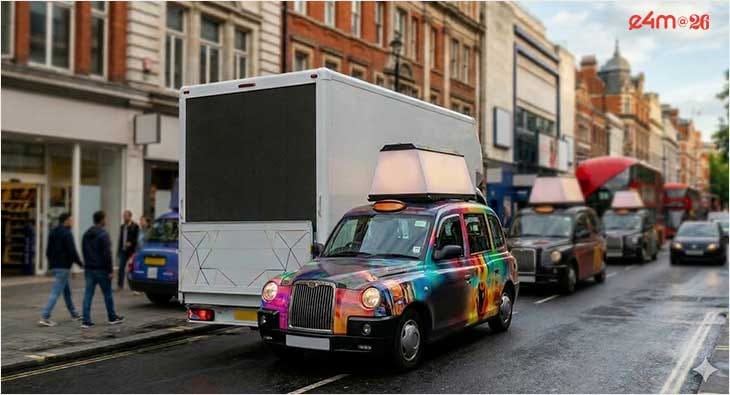

Mobile out-of-home advertising is gaining prominence as brands look to meet consumers where they are most active, on the move across cities. Increasingly, it is no longer consumers who discover billboards; rather, billboards are moving through cities to catch up with consumers and capture their attention.
A recent example is Swiggy Instamart’s Holi campaign, in which the brand deployed a brightly branded water tanker on city streets, turning a functional vehicle into a festive, high-visibility media asset. The activation drew attention on the ground and quickly gained traction on social media, underlining how mobility-led formats are increasingly being used to drive both visibility and buzz.
View this post on Instagram
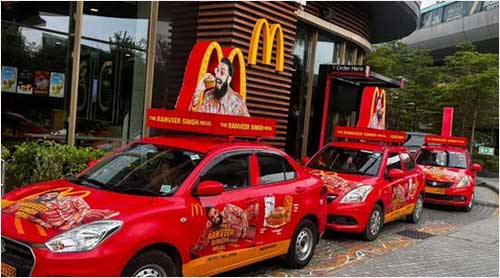
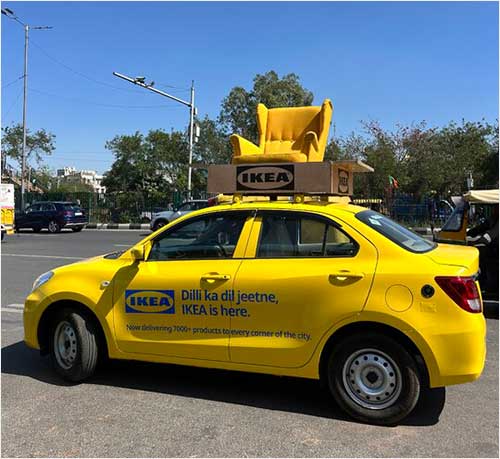
From cab branding and taxi tops to metro wraps and bus takeovers, transit-led media is becoming an increasingly visible part of the advertising mix. Recent activations by brands such as IKEA and McDonald’s further highlight how mobility is being used as a storytelling device, rather than merely a tool for visibility.
Read On: Why OOH is now traditional media’s brightest billboard
Why mobility matters more than cost
Industry executives say the appeal of mobile OOH lies in context rather than cost efficiencies.
“It’s not about being less expensive than billboards or bus shelters. It’s where the consumer is and how the medium lends itself to the communication,” says Dipankar Sanyal, CEO of Platinum Communications.
Adding to this, Yuvrraj Agarwaal, Chief Strategy Officer at Laqshya Media Group, notes that while advertiser interest is clearly rising, the format remains a niche within the broader OOH ecosystem. “What is driving this interest is fundamentally urban congestion. The average commuter in cities such as Mumbai or the Delhi-NCR region spends 45–90 minutes on the road daily. That is captive attention in motion,” he says.
Agarwaal notes that, unlike static formats, branded cabs and autos move through commercial corridors, residential areas, IT parks, and market zones throughout the day, delivering distributed frequency rather than single-point dominance. The rise of aggregator-based fleets such as Uber and Ola has further expanded inventory, enabling brands to scale campaigns across cities with improved tracking and execution.
Sanyal adds that transit media has evolved significantly in recent years. Improved aesthetics, enhanced design, and the integration of digital elements have enabled formats that allow interactivity, one-on-one engagement, and on-ground brand activation.
Unlike static billboards, mobile OOH moves with consumers across different parts of the city, from residential areas to commercial hubs, delivering repeated exposure and contextual relevance.
Infra boom opens new inventory
The growth of mobile OOH is also being driven by the expansion of urban infrastructure.
“The reflection of transit or mobile OOH’s growth is evident from the opportunities and the supply that now exists,” says Fabian Cowan, Director – Connect Digital at Connect Network, pointing to the rapid expansion of metro networks, expressways and public transport systems.
According to Cowan, the format offers strong mass reach combined with high-frequency visibility. At the same time, captive audiences in metros, cabs, and buses can be targeted with contextual messaging that drives engagement and potential conversion.
He adds that sectors such as D2C, retail, finance, and quick commerce are among the most active adopters of transit media.
Read On: Why Budget 2026 could be a turning point for Indian OOH
High buzz, low share of spends
Despite the growing traction, mobile OOH still accounts for a relatively small share of overall outdoor advertising spends.
Industry executives note that formats such as taxi-top branding and cab takeovers are typically used for innovation-led bursts rather than large-scale deployments. Brands like Amazon Prime have used these formats to create buzz, but overall volumes remain limited.
“There is demand since this media has digital virality value, but its contribution to overall OOH spend is minuscule,” says Vikas Nowal, CEO of Interspace Communications.
Agarwaal echoes this, noting that mobile OOH remains a small subset within transit media, contributing only a low single-digit percentage to overall OOH spends.
He further points out that campaigns tend to be seasonal and event-led, with spikes during IPL, festive periods, product launches and market entries.
The pricing lens: Mobile vs Static
Adding a pricing lens to the debate, Agarwaal says the comparison between mobile and static formats is often misunderstood.
A premium static billboard in a Tier-1 city costs between ₹5–15 lakh per month depending on size, location and visibility, with marquee sites going up to ₹20–40 lakh. These are single-location, high-impact placements, with billboard prices in 2026 estimated to have risen 8–12% year-on-year, according to agency averages.
In contrast, cab branding operates on a very different price architecture. Industry rates range between ₹2,500–5,000 per car per month, with a minimum order of 50–100 vehicles. A 100-car fleet across a metro city would cost ₹2.5–5 lakh per month, comparable to one mid-tier billboard, but delivering city-wide mobile coverage.
On a like-for-like monthly spend basis, mobile OOH can be 60–75% more cost-efficient per market than a premium static billboard.
However, Agarwaal notes that the comparison is not entirely equivalent. While static billboards offer landmark dominance with large-format visibility at a single location, mobile OOH delivers distributed frequency across multiple touchpoints across the city.
Transit media rides OOH growth wave
The rise of mobile OOH comes at a time when the broader outdoor advertising segment is demonstrating resilience. According to PMAR 2026 estimates, OOH was the only traditional medium to record growth in 2025, expanding by around 4 percent, even as overall traditional ad expenditure declined.
The medium’s share remained steady, signalling that brands continue to value a physical presence across cities and high-traffic corridors. With urban mobility having normalised post-pandemic, advertisers are once again turning to real-world formats to maintain visibility and recall.
Within this context, transit media is emerging as a tactical layer that complements traditional formats by enhancing both reach and frequency.
Read On: OOH delivers 4% growth in 2025: PMAR
Creativity takes centre stage
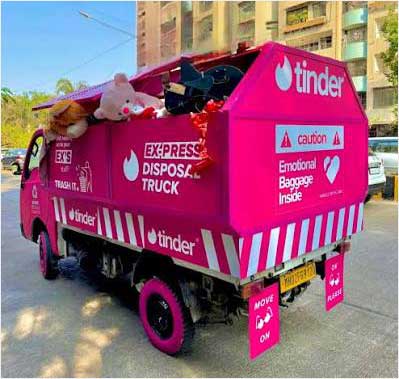
Mobile OOH is increasingly being used as a canvas for creative experimentation. Alongside Swiggy Instamart’s Holi activation, campaigns such as Tinder’s garbage truck collaboration with creator Pranjali Papnai demonstrate how brands are employing unconventional formats to spark conversation.
A similar example of high-impact storytelling was seen last year when Posterscope executed a striking campaign for Warner Bros. to promote the release of Final Destination: Bloodlines. The activation featured a truck carrying a seemingly precarious load of logs, paired with the chilling message, “Reach home in peace, not in pieces.” Designed to evoke the franchise’s signature sense of danger, the campaign blurred the line between real-world context and cinematic storytelling, showcasing the disruptive potential of mobile OOH.
Agarwaal notes that the social amplification potential of such formats is real, but only when the creative execution stands out. “A standard cab wrap does not go viral. But a 3D rooftop installation or a culturally timed activation can generate significant earned media,” he says.
These executions are designed not only for physical visibility but also for social amplification. Visually striking and contextually relevant formats are more likely to be photographed and shared, extending their reach beyond the streets.
From oversized installations mounted on vehicles to themed fleet branding, mobile OOH is enabling formats that blend outdoor media with experiential marketing.
A strategic add-on to OOH plans
For media planners, mobile OOH is emerging as a complementary layer within the broader OOH ecosystem, rather than a replacement for traditional formats.
“It forms part of the OOH media mix with a strategic requirement and adds to the reach of the plan,” says Sanyal.
Agarwaal reinforces this, describing mobile OOH as a strong supplementary format rather than a primary medium. He notes that its value lies in extending reach into areas where static inventory is limited, enabling deeper market penetration and faster visibility during new market entries.
While billboards and large-format outdoor continue to deliver scale, mobile OOH offers flexibility, contextual relevance, and creative impact. For brands navigating fragmented attention and dense urban environments, advertising that moves with the consumer is becoming an increasingly important tool.
As cities expand and transit networks grow, mobile OOH is likely to see further experimentation and gradual scale-up, strengthening its position as a high-impact, innovation-led medium, within the landscape.
Read more news about Out of Home, Internet Advertising, Marketing, Digital Media, TV Media
For more updates, be socially connected with us onInstagram, LinkedIn, Twitter, Facebook, YouTube & Google News