How nostalgia is reshaping Indian advertising strategies
From McDonald's and Cadbury to Coca-Cola's Rimzim Jeera, brands are discovering that recycling emotion the right way is the sharpest tool in the creative arsenal right now
 by
by
Published: Mar 18, 2026 9:54 AM | 6 min read
 Follow Us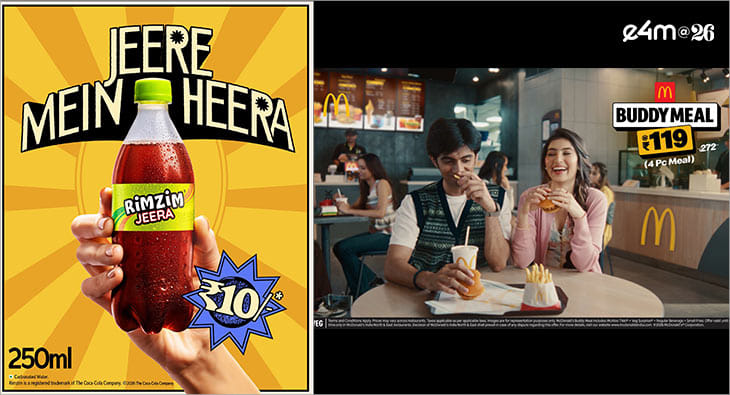

McDonald's India – North and East recently announced actor Sara Arjun as its brand ambassador, marking a nostalgic homecoming. The campaign returns to the very same park bench setting from the original 2011 ad. The product being sold is the new Buddy Meal: two burgers, two Cokes, one medium fries, priced at ₹119. But the real product, the one doing the heavy lifting in every frame, is a feeling. The feeling of watching something familiar come back to you, just a little older, a little wiser, and altogether more charming for it.
In the new ad, Sara Arjun appears all grown up, confidently flipping the original storyline. She jokes about how modern relationships often come with too many expectations. When the boy hints at the typical boyfriend-girlfriend dynamic, she shuts it down, only for the film to reveal he simply wants a McAloo Tikki. The banter is light, warm, and instantly familiar to anyone who grew up watching the original. The twist is not a reinvention; it is a continuation. And that continuity is precisely the point.
Anant Agarwal, Vice Chairman of MMG Group and CPRL, frames this as emotional continuity. "Sara's return to McDonald's is a wonderful reminder of the deep emotional connections many customers have grown up with," he says. Sara herself acknowledges the pull. "McDonald's has been a special part of my journey since childhood. Returning to the brand for this campaign feels incredibly nostalgic. The Buddy Meal captures the simple joy of sharing food and laughter with friends," she says.
The architecture of a good throwback
What separates a well-executed nostalgia campaign from a lazy one is structural intelligence. The McDonald's film is not simply riding on Sara Arjun's return. The timing, as industry observers have noted, is not coincidental. It’s the entire point. The campaign dropped in the same window as the trailer for ‘Dhurandhar: The Revenge’, where Sara plays a lead role, flooding her back into cultural consciousness just as McDonald's planted its flag. That is not nostalgia as sentiment; that is nostalgia as strategy.
The brand that perhaps wrote the definitive Indian playbook on this was Cadbury Dairy Milk, when Ogilvy India took a 27-year-old classic and gave it an elegant gender inversion in 2021. Cadbury Dairy Milk's cricket advertisement with the tagline 'Asli Swad Zindagi Ka' was first introduced in 1994. In that film, a young woman in a floral dress ran past stadium security and broke into an uninhibited jig after her cricketer boyfriend scored a century. It was one of those rare ads that changed not just brand perception but cultural behaviour. It told India that adults could eat chocolate, and that women could be carefree in public.
The 2021 remake reversed those roles entirely. Instead of a man hitting a six and a woman cheering him from the crowd, a man ran onto the field during a women's cricket match to celebrate a batter's six with an impromptu dance. The original jingle, sung by Shankar Mahadevan, returned intact.
What Ogilvy understood, and what made the film land, is that the best nostalgia work does not simply replay the past. It uses the past as a foundation to say something new. Piyush Pandey, who scripted the original and serves as Ogilvy's Chairman Global Creative and Executive Chairman India, was clear on this distinction. The remake earned not just social media virality but genuine cultural endorsement, with cricketer Ravichandran Ashwin tweeting that he was glad his daughters would grow up watching it.
The jingle as time machine
If the visual remake is the most visible expression of nostalgia marketing, the sonic remake may be the most potent. Indian advertising has long understood the value of a jingle: the ‘Washing Powder Nirma’ anthem that aired first on the radio in 1975 before becoming a TV institution in 1982, the ‘Kuch Khaas Hai’ of Cadbury. These are not merely tunes; they are involuntary memory triggers. Hear four bars, and you are ten years old again.
The automobile industry, in particular, has made an art form of retrofitting old melodies into new campaigns. Hero Honda's ‘Desh Ki Dhadkan’ jingle defined a generation's relationship with the open road, and returned to those sonic signatures decade after decade.
The latest brand to deploy this is Coca-Cola, with its revival of Rimzim Jeera. Led by the campaign thought "Jeere mein heera, Rimzim Jeera," the brand marks Rimzim's return not simply as a nostalgic favourite, but as a proudly OG ethnic beverage for every generation. The campaign reimagines an iconic R.D. Burman track ‘Duniya Mein Logo Ko’, transforming the familiar "Biiraa…" into an unforgettable "Jeeeeera…" It is a masterclass in musical appropriation done right: the hook is borrowed, but the adaptation is sharp enough that it becomes the brand's own.
Why it works, and why it keeps working
The commercial logic behind nostalgia marketing is well-established globally, and the numbers in India's context make a compelling case. According to a Deloitte 2025 CMO report, seven in ten consumers associate nostalgic ads with more genuine brand storytelling. Separate data from Nielsen reveals that 61% of millennials say nostalgia improves their perception of a brand and drives buying intent. More significantly, nostalgic ads carry a thirteen-point higher likelihood of going viral compared to non-nostalgic work, and consumers are willing to pay 10-15% more for products that evoke nostalgic feelings.
In India, these dynamics are amplified by the country's cultural architecture. The intergenerational household structure means that a single ad can trigger simultaneous emotional responses across parents, children, and grandparents watching the same screen. Research published in an Advances in Consumer Research journal in 2025, drawing on a survey of 386 Gen Z respondents across urban India, found that digital nostalgia significantly influences brand affinity, trust, and impulsive buying, even among a generation that did not experience the original campaign. This is the paradox at the heart of nostalgia marketing's current boom: you do not need to have lived the memory to feel its emotional weight.
The risk of overuse
The craft community, naturally, watches all of this with a mix of admiration and wariness. The concern is not that nostalgia marketing is happening; it is that it is happening everywhere, and not always with the discipline these examples demonstrate.
The cases that earn their place in culture, like the McDonald's park bench, the Cadbury cricket field, and the Rimzim Jeera, all share one discipline: they do not merely borrow from the past. They do something with it. They use the emotional collateral of the original to say something new, whether that is a gender reversal, a grown-up returning home, or a cult beverage reclaiming its identity in a market that had all but forgotten it.
Done right, nostalgia is not a creative shortcut. It is one of the few advertising tools that works simultaneously on the gut and the brain. The gut remembers the feeling, and the brain approves the purchase. In an industry increasingly cluttered with noise, that combination is worth more than a thousand new ideas that nobody remembers.
Read more news about Internet Advertising India, Marketing News, PR and Corporate Communication News, Digital Media News, Television Media News
For more updates, be socially connected with us onInstagram, LinkedIn, Twitter, Facebook YouTube & Google News