Beyond Cricket: How brands are expanding India’s sports marketing playbook
From FIFA’s global scale to Wimbledon’s younger audiences and pickleball’s growing appeal, non-cricket sports are opening new opportunities for brands across campaigns, sponsorships and advertising
 by
by
Published: Jul 9, 2026 9:03 AM | 6 min read
 Follow Us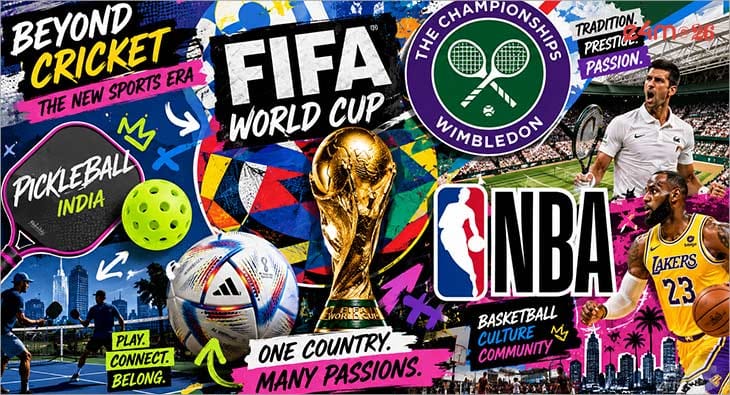

- Sports marketing in India is diversifying beyond cricket, with brands investing in football, Wimbledon, and emerging sports like pickleball, reflecting a broader range of consumer interests.
- The FIFA World Cup has become a significant platform for brands like Hisense, which reported a 40-50% increase in sales of larger-screen TVs during the tournament, highlighting the growing audience for football in India.
- The NBA's BUDX NBA House event exemplifies the shift towards multi-sport engagement, with brands focusing on year-round consumer connections rather than just single-event marketing.
- Pickleball is gaining traction in India, driven by local investments and celebrity involvement, indicating a trend towards building new sports ecosystems that complement traditional sports like cricket.
For decades, sports marketing budgets in India largely followed one rule: invest where cricket is. That approach is now evolving. From a 120-year-old Delhi kulfi brand reimagining itself through Wimbledon, to Bollywood celebrities being coached by NBA legends at the BUDX NBA House celebrity basketball game, to a traditionally American backyard sport emerging as one of India's fastest-growing participation sports, brands are recognising that the country's sporting interests now extend well beyond cricket.
Industry estimates suggest that football now attracts an audience of nearly 300 million viewers in India, second only to cricket, while South Asia has become Wimbledon's largest market by reach, with 82.4 million viewers from India each year. This isn’t a niche shift anymore. It’s a parallel economy, and the brands moving early are already writing the playbook for everyone else.
Brands Look for Deeper Consumer Connections
No property illustrates the "go big" strategy better than the FIFA World Cup. Hisense, an Official Partner of the tournament since 2017, has treated India as a frontline market for this edition. Pankaj Rana, CEO, Hisense India, laid out the thesis with hard numbers: "The FIFA World Cup Qatar 2022 reached over 110 million viewers in India across platforms, while the 2026 edition is expected to surpass 150 million viewers, presenting a significant opportunity to engage consumers considering an upgrade to premium televisions."
Read On: FIFA World Cup 2026: What's drawing Indian brands beyond the pitch?
That opportunity has already converted into sales. “We have seen a 40–50% increase in sales of larger-screen TVs during the tournament so far, with momentum expected to reach around 60% by its conclusion,” Rana said, noting the strongest response has come from "West Bengal, Odisha, the North East, Kerala, Delhi and Bengaluru,” markets where football has deep historical roots but is now spilling into premium metro demand.
Crucially, Hisense isn't treating this as a one-size-fits-all media buy. Rana described "extensive outdoor branding across key football markets," on-ground radio activations, a social-first '3AM Club' campaign timed to live match hours, and in-store engagement, a localisation instinct that echoes what we've seen elsewhere in Indian sports marketing, from Wimbledon's kulfi collaboration to regional-language reels of tennis stars racking up outsized engagement in the comments section.
Diageo takes a different route into the same tournament, not hardware demand, but cultural belonging. "At Diageo, we see these platforms evolving beyond sporting events into cultural moments that drive deeper consumer engagement," Varun Koorichh, VP Marketing, Diageo India, framed it plainly. For Black & White Non-Alcoholic Carbonated Beverages, built around "the philosophy of 'The Magic of Sharing,'" the World Cup becomes a platform to "celebrate togetherness through football" brand purpose stitched directly into fan behaviour, not just fan numbers.
Both brands independently arrive at the same guardrail: reach is the entry ticket, not the winning condition. As Koorichh put it, evaluation goes beyond reach alone to "how effectively it drives visibility, consumer trials and meaningful engagement, while strengthening long-term brand equity."
Building Fandom Beyond the Game
Where Wimbledon leaned into Indian street food to soften its Britishness, and Hisense leaned into regional-language activations, the NBA has taken the opposite bet, leaning into being unmistakably American. BUDX NBA House, its interactive fan festival co-produced with Budweiser, returned to New Delhi in 2026 after a Mumbai debut that drew over 6,000 fans in two days, complete with a celebrity 3-on-3 game, NBA legends, and tourism partners Brand USA and Visit California using the event to sell India on visiting the actual United States.
Sunny Malik, Country Head, NBA India, framed this as part of a structural shift in how Indian fans consume sport altogether: "India is entering a true multi-sport era, and we're seeing brands expand their sports marketing strategies well beyond traditional cricket-led platforms." He pointed to the league's broader ecosystem, "live games, social media, grassroots programs, and immersive events, such as the BUDX NBA House" as the real asset brands are buying into, not a single tournament window. "The opportunity lies in aligning with like-minded organizations, building authentic connections with passionate fans, and driving sustained engagement throughout the year," Malik added a pointed nudge to brands still thinking in campaign bursts rather than always-on partnerships.
Read On: What a kimono at Wimbledon signals for Naomi Osaka’s brand
Building India’s Next Sports Ecosystem
If FIFA and the NBA represent brands attaching themselves to established global sporting giants, pickleball tells a different story. While the sport comes from the US, the ecosystem around it in India, the tournaments, leagues and communities, is being built locally. And powering its growth is an unmistakably filmi influence.
Pickleball’s rise in India is being shaped not only by brands and leagues, but also by prominent figures from entertainment and sport. Karan Johar’s association as brand ambassador for the Indian Pickleball League and Samantha Ruth Prabhu’s role as team owner of the Chennai Super Champs reflect a shift from endorsement to participation. Meanwhile, tennis player Sania Mirza’s move as an athlete-investor with sportswear brand Boldfit highlights the growing focus on building the sport’s infrastructure and accessibility in India.
Even hospitality is beginning to embrace the trend, with hotel groups adding pickleball courts to their properties and treating the sport less as a passing fad and more as an amenity guests increasingly expect, much like gyms or pools.
Siddhant Jatia, Founder & CEO, Picklebay, is unambiguous about the strategy: "Our investments today are directed towards building our own sports IPs." Through the Picklebay India Tour, Picklebay Zonals, and Picklebay Open, the company is building long-term assets rather than renting attention from someone else's platform, though it has stepped in as the Powered By Partner for Team India's Open and Juniors categories at the Pickleball World Cup, a rare case of investing outward.
What's notable is who Picklebay is watching for cues. "We're also closely watching properties like the NBA, Wimbledon, and the Bundesliga because they attract young, affluent, and digitally engaged audiences, the same demographic driving pickleball's growth," Jatia said. His guiding principle doubles as a warning to brands chasing reach for its own sake: "Our decisions are always led by audience alignment rather than sheer reach."
Jatia's closing point may be one of the most useful lines for any marketer. "The future isn't about replacing cricket, it's about creating a balanced sports marketing portfolio where emerging and global sports deliver deeper engagement, stronger community building, and more measurable business outcomes alongside cricket's unmatched scale," he said.
Read On: IPL 2026: Under-10-sec ads rule linear TV as brands compress storytelling
Building a Balanced Approach to Sports Marketing
The real story isn’t that cricket is losing relevance, it’s that attention is no longer concentrated in one sport. FIFA is selling televisions, Wimbledon is inspiring hyperlocal collaborations, the NBA is turning fandom into lifestyle culture, and pickleball is creating entirely new commercial inventory from courts to communities. These properties are giving brands something increasingly difficult to buy in a fragmented media environment: passion, identity and year-round engagement.
The shift is no longer experimental. It is structural. The brands entering these ecosystems today are not chasing side bets; they are securing early positions in what could become India’s next major sports-marketing growth engine!
Read more news about Marketing News, Advertising News, PR and Corporate Communication News, Digital News, People Movement News
For more updates, be socially connected with us onInstagram, LinkedIn, Twitter, Facebook, YouTube & Google News
