The map and the courage to follow It
Kartik Sharma, Group CEO, Omnicom Media India, speaks to Shripad Kulkarni on why attribution is not a science problem — it is a courage problem
 by
by
Published: May 2, 2026 8:56 AM | 6 min read
 Follow Us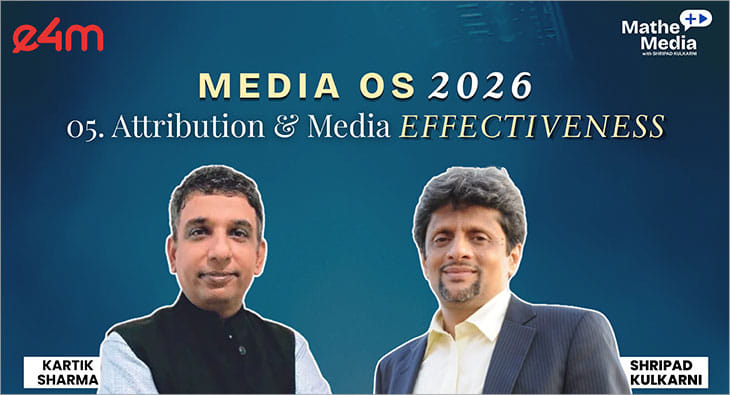

- Kartik Sharma, with over fifteen years of experience in building attribution models for major Indian brands, emphasizes the discomfort that can arise when these models reveal past marketing strategies as ineffective.
- He defines attribution as a mathematical relationship between marketing inputs and business outputs, requiring extensive data analysis and continuous updates to remain relevant and effective.
- Sharma advocates for a balanced approach to marketing investment, suggesting a 70-20-10 allocation strategy for proven methods, emerging strategies, and experimental initiatives, respectively, to foster innovation and adaptability.
- He highlights the importance of a "courage culture" within organizations, encouraging teams to embrace both the insights from attribution models and the need for experimentation, ultimately aiming to enhance marketing accountability and effectiveness.
Kartik Sharma has spent more than fifteen years building attribution models for some of India's largest brands. He has seen the models produce outputs that were elegant, accurate, and — in a number of cases — deeply uncomfortable for the clients who had commissioned them.
This is the thing about attribution that nobody mentions when they advocate for it. The math is not the hard part. The hard part is what happens when the math tells you that what you have been doing for the last decade is wrong.
"I have been doing this for fifteen years," he says, with the candour of someone who has lived this personally. "Now it is telling me something totally different. It's not comfortable. It's not sitting well."
That discomfort, Kartik believes, is not a problem to be managed. It is the point.
He begins with the fundamentals — because brands that say they want attribution need to understand what it actually is.
Attribution is not a report. It is a mathematical relationship between marketing inputs and business outputs — built from weekly data across at minimum three to three-and-a-half years, incorporating every variable that could plausibly affect sales: media, distribution, pricing, competitive pricing, weather if it matters to the category. You run not one model but ten thousand, twenty thousand models using machine learning, stress-test them against data you held back, and arrive at the handful that best explain what actually happened.
The right analogy, he says, is Google Maps. "Why do we use a map? Because of a fair degree of accuracy that it tells you from point A to point B. Yes, there may be some minor errors. But most often if it gets you through, you are going to use the map."
A model at 92-95% accuracy is not a perfect oracle. It is a reliable navigation system. And like a map, its value comes not from being consulted once but from being used continuously — fed new data, updated as markets shift, queried every time a decision needs to be made. "Once you have this, you do a lot of what-ifs. That is where human creativity will come into picture."
The what-ifs are where attribution stops being a measurement exercise and becomes something far more powerful — a business simulation engine.
What if I switch off television in one market and increase digital? What if I do a price-off in Delhi but not in Mumbai — what is the actual lift? What if my 100-crore brand increases its creative investment three or four times? What if I have been allocating 30% to the mother brand and 70% to sub-brands — is that the right split, or does the data suggest the inverse?
"Intuitively, brands know it," Kartik says. "But mathematically, do they know it?" In one portfolio study, the model identified the optimal allocation between mother brand and sub-brand spending — and also surfaced an unexpected finding about influencer ROI. A small test, two or three executions with minimal budget, showed measurable returns. "We were pleasantly surprised. The influencer ROI was a very rare thing to quantify — and it was a pleasant outcome." The brand increased its influencer investment. Not based on instinct. Based on the model.
The arithmetic is direct: take a 100-crore brand, optimise its media allocation through attribution, reduce wastage by even 10%. That is 10 crores of pure PBT. The model does not just improve marketing. It improves the P&L.
But here, Kartik arrives at the part of the conversation he cares most about — and it has nothing to do with models.
It has to do with mindset.
He has a beautiful expression: epic failures. He says companies must celebrate epic failures. The key question is how many companies will reward you for epic failures?
His point is this: the model tells you what has worked historically. It is, by definition, a backward-looking instrument. But markets move forward. New platforms emerge. Consumer behaviour shifts. A media mix optimal in 2022 may be suboptimal in 2025. The model, followed blindly, will keep optimising a past that no longer exists.
This is why the experiment budget is not optional. It is structural. His operating principle is what he calls 70-20-10: 70% on proven approaches, 20% on things that are working but not yet fully understood, 10% on deliberate experiments — new platforms, new formats, new hypotheses. "Test and document. Test and document. Pass on. So when new people come into the organisation, they learn."
Going anti-model — committing to a bold creative investment, testing a channel the data does not yet support, experimenting when the safe choice is to optimise — is the act that generates the data that makes the next model better. "That requires courage, conviction and the ability of the stakeholders to say, okay, let's do it."
Science and courage are not in tension. Science requires courage to be useful.
The last dimension Kartik brings is the one that bridges attribution and creativity — and it is where his thinking is most original.
"All GRPs are not equal."
His agency has invested in AI-based attention measurement tools that track — frame by frame, second by second — exactly where a viewer's eye moves as they watch an ad. Not asking them. Watching them. An eye-tracking panel, significant scale, generating data trails showing precisely where attention drops off, where the logo is invisible, where the proposition is being lost in the noise of multitasking.
"We have tested more than 1,000 ads before going on air. With a great degree of directionality, we can say: this is good, bad, ugly." When a creative is identified as bad, the recommendation is almost always not to edit it incrementally but to fix it properly — because running bad creative on a large budget is money being destroyed. And when the fix is made, the improvement in attention translates directly into measurable improvement in business outcomes — which closes the loop back into the attribution model.
An ad in a mobile environment and the same ad on a large television screen are not the same communication. They demand different levels and types of attention. Planning should reflect this. "Rather than looking at pure CPM, you should look at attention-adjusted CPM. And then the ball game — the optimisation — totally changes."
The through-line across all of Kartik's thinking is a single conviction: that the tools now exist to make marketing genuinely accountable — to move it from the realm of belief and intuition into the realm of measurement and learning. But tools do not create cultures. And the culture required is not a data culture. It is a courage culture.
The courage to follow the model when it is uncomfortable. The courage to go against it when intuition says the model is missing something. The courage to experiment, fail, document the failure, and begin again.
"Once you get it," he says of attribution, "it is magic."
The magic is not in the numbers. The magic is in what happens to a marketing organisation that decides to trust them.
Kartik Sharma is Group CEO, Omnicom Media India. He is a contributor to the Media OS 2026 Report examining how Indian advertising is being rebuilt from the ground up.
Read more news about Marketing News, Advertising News, PR and Corporate Communication News, Digital News, People Movement News
For more updates, be socially connected with us onInstagram, LinkedIn, Twitter, Facebook, YouTube & Google News
