I truly believe marketers must wear bifocal lenses: GCPL’s Ashwin Moorthy
Ashwin Moorthy, Global Head of Category Direction & Head of Marketing – India at Godrej Consumer Products, spoke about the challenge of balancing brand building with immediate performance pressures
 by
by
Published: Mar 13, 2026 4:17 PM | 6 min read
 Follow Us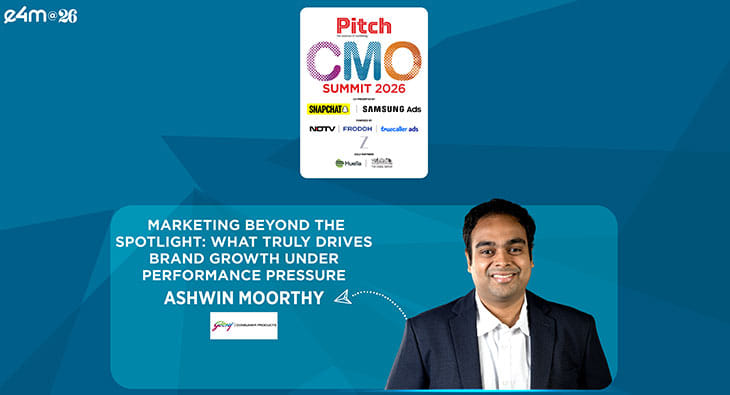

At the Pitch CMO Summit, Ashwin Moorthy, Global Head of Category Direction and Head of Marketing - India, Godrej Consumer Products, spoke about the challenge of balancing brand building with immediate performance pressures, arguing that marketers must deliver short term results while simultaneously building long term brand value.
Opening his session, Moorthy acknowledged that marketing remains a discipline driven as much by judgment as by rules, even though it commands significant investment across industries.
“Marketing is probably the only profession that spends a lot of capital without an accepted set of rules,” he said. “We share opinions, we debate frameworks, but we rarely agree on what the rules actually are.”
He also noted the irony of discussing performance at the end of the financial year in India, when companies are closely monitoring business outcomes.
“It’s a bit brave to talk about performance in March in an Indian company when the financial year closes in a couple of weeks. Everything we say will be monitored,” he remarked.
Speaking on the theme of driving brand growth under performance pressure, Moorthy said marketers must learn to manage both immediate outcomes and long term brand equity.
“I truly believe marketers must wear bifocal lenses. We have to see what will happen in the long term, but at the same time clearly see what will happen in the immediate term,” he said.
According to him, marketers cannot afford to focus exclusively on long term brand building without ensuring near term performance.
“You cannot ignore the short term because you don’t know if the long term will even exist,” he added.
Moorthy also highlighted the longstanding tension between marketing and finance functions within organisations. From an accounting perspective, organic brands are not recognised as assets unless they are bought or sold, while marketing investments are immediately recorded as expenses.
“On a balance sheet the value of organic brands is exactly zero. But 100 percent of marketing spend hits the P&L the moment you spend it,” he said.
However, he argued that the scale of marketing investment over decades demonstrates that it clearly creates long term business value.
Using internal category data from GCPL’s home care business, Moorthy illustrated how sustained marketing investment drives revenue growth over time.
“Marketing drives revenue today and it compounds revenue tomorrow,” he said.
According to him, brand growth rarely happens overnight. Instead, it emerges from consistent actions that build momentum over time.
“There is no long term magic. It is simply the accumulation of efforts you make in the short term that then compound,” he explained.
Drawing on the classic diffusion of innovation theory, he said brands typically grow by steadily acquiring new consumers before eventually reaching scale.
“Brands are compounded, not conjured,” Moorthy said.
He added that one of the most practical ways to assess marketing effectiveness is to track consumer acquisition.
“A simple question marketers should ask is whether more consumers are being acquired today compared to the same time last year,” he said.
Moorthy then discussed the importance of selecting marketing models that can scale efficiently with investment. Today’s marketing ecosystem spans a wide spectrum, from mass media advertising to performance marketing, influencer campaigns and retail media.
However, regardless of the channel mix, he argued that the underlying economics of marketing must remain strong.
“Your marketing model must scale with capital. The more money you put in, the more revenue it should generate,” he said.
Over time, strong marketing systems should also begin to deliver efficiency gains.
“When scale comes in, revenue must start growing faster than marketing spend. That is when you know the model is working,” he explained.
If revenue collapses the moment marketing investment is reduced, he cautioned, the brand is likely overly dependent on constant spending.
Moorthy also shared his personal perspective on what brands represent in consumers’ minds, describing them as memory structures built through repeated associations.
“All of us in our brains have a set of neurons that connect and form meaning. If enough of us share that meaning, you have a brand,” he said.
According to him, brand value grows when marketers consistently invest in visibility and consumer reach.
“Your inputs or deposits are advertising reach, being available and making sure more people see you, buy you and know you. Your brand bank balance accumulates,” he said.
He likened brand equity to a bank account in which marketers continuously make deposits through communication and distribution.
“There are times when you stop putting things in quite as much. You may compromise on a new film or reduce your reach a little bit. That is a withdrawal,” he said.
Over time, if withdrawals exceed deposits, the brand weakens.
“If you make more withdrawals than deposits, your brand starts weakening,” Moorthy warned.
He also highlighted the role of repeat customers in creating sustainable marketing economics. According to him, the core operating model of marketing revolves around acquiring consumers and then encouraging repeat purchases.
“You pay a cost to acquire a consumer. That generates revenue, which leads to margin and profit,” he said.
The real leverage in marketing, however, emerges when customers return without additional acquisition costs.
“Acquisitions cost money, but repeats are free,” he noted.
The profits generated from repeat buyers eventually fund further customer acquisition and growth.
“It is the profit of people who repeat you that pays for more acquisitions,” Moorthy said.
According to him, a defining moment in a brand’s journey arrives when repeat customers begin to outnumber new consumers.
“A beautiful day in the life of a brand is when you have more repeaters than people you acquire,” he said.
Moorthy concluded by reiterating the four principles he believes marketers must follow while navigating performance pressures. First, brands grow through compounding rather than sudden breakthroughs. Second, marketing models must scale with capital and eventually deliver efficiency. Third, brands function like banks where marketers make deposits and withdrawals over time. And finally, marketers must take ownership of profit outcomes.
“Marketers must hold accountability for profit. It gives you credibility in the boardroom and makes your marketing more effective,” he said.
Reflecting on the evolving role of marketing leaders, Moorthy added that adopting a stronger business perspective can help marketers make better strategic decisions and gain greater influence within organisations.
“I find it quite relieving when I think about marketing wearing a finance hat and a P&L hat,” he said, adding that understanding ROI deeply often gives marketers greater credibility when seeking investment for brand growth.
Read more news about Marketing News, Advertising News, PR and Corporate Communication News, Digital News, People Movement News
For more updates, be socially connected with us onInstagram, LinkedIn, Twitter, Facebook, YouTube & Google News