Brands want ads, consumers want content: Maruti Suzuki’s Bhuvan Dheer on marketing paradox
At the Pitch CMO Summit, Bhuvan Dheer, Executive Officer – Marketing and Sales, Maruti Suzuki India, outlined the evolution of India’s automobile industry and the company’s role in shaping its growth
 by
by
Published: Mar 13, 2026 4:06 PM | 7 min read
 Follow Us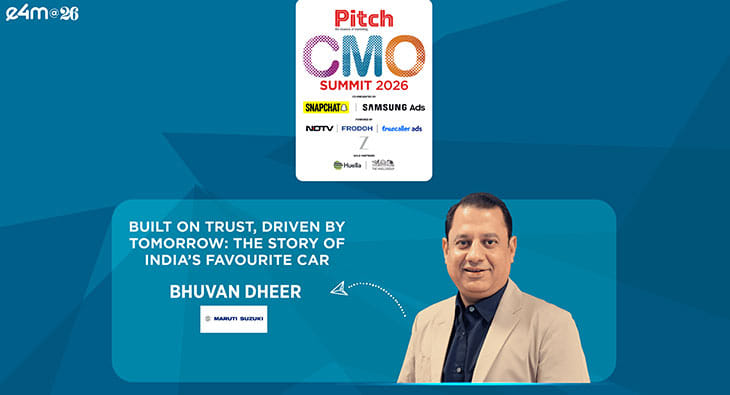

At the Pitch CMO Summit 2026 on Thursday, Bhuvan Dheer, Executive Officer – Marketing and Sales at Maruti Suzuki India, outlined the evolution of India’s automobile industry and the company’s role in shaping it, while highlighting the next phase of growth driven by rising affluence, demographic shifts, and changing consumer behaviour.
Delivering a special address titled “Built on Trust, Driven by Tomorrow: The Story of India’s Favourite Car,” Dheer reflected on his journey within the company. Having spent nearly 22 years at Maruti Suzuki across multiple roles, including heading sales for several years, he noted that he has been serving as CMO for the past 24 months.
“I’ve been with Maruti for almost 22 years and have worked across various levels. Now I’m in the CMO role for the last 24 months,” he said.
He also referenced one of the brand’s iconic campaigns, the Kancha advertisement, revealing that Maruti Suzuki released a sequel to the film in December last year. The new film features the same protagonist from the original ad two decades later, now shown alongside his son.
“We have a sequel to that which launched last December. We have the same protagonist who was the young chap in that ad 20 years back. He has grown older now and his son is featured in the new film,” Dheer said.
Dheer then shifted to the broader context of the automobile industry, describing India as a bright spot globally amid technological transformation and infrastructure growth.
“I think India today stands at a cusp of a transformative era with technological innovation and world class infrastructure. We are a big bright spot globally,” he said.
Globally, the automobile industry sells around 80 million vehicles annually, but India remains one of the fastest growing markets. Tracing the country’s automotive journey, Dheer highlighted how annual car sales have grown from about 0.2 million units in 1990 to an estimated 4.7 million units in the current financial year.
“In the last 35 years India has consumed about 70 million cars and around 50% of that has been sold by Maruti Suzuki. That is the trust capital we enjoy in this country,” he said.
He also outlined the company’s four-decade journey alongside India’s economic and consumer evolution.
In the 1980s, when personal mobility was still limited, the company introduced the Maruti 800, widely considered India’s first mass market people’s car. A decade later, as consumer expectations began rising, models such as the Zen and Esteem marked the shift toward more aspirational offerings.
By the early 2000s, Maruti expanded beyond selling vehicles to building a broader ecosystem around ownership, launching initiatives such as Maruti Insurance, Maruti Finance and its used car business. The mid 2000s saw the arrival of the Swift, which Dheer described as an OG hatch that continues to enjoy strong popularity since its launch in 2005.
The company further evolved its retail approach in 2015 with the launch of Nexa, a premium retail channel designed around experiential buying rather than purely product led selling. Over the past decade, Nexa has sold nearly 2.5 million vehicles.
More recently, Maruti Suzuki has been focusing on greener mobility options, introducing hybrid and CNG vehicles while preparing for electric vehicles as part of the broader energy transition.
Highlighting the company’s current scale, Dheer said that out of its 17 car models, nine sell more than 10,000 units per month, a level that few competing models in the industry achieve.
Maruti Suzuki also operates an extensive distribution and service network with more than 10,000 touchpoints covering around 2,700 cities through four distribution channels. The company runs 10 production plants across four locations and supports a workforce of more than 5.5 lakh people across the organisation and its dealer network.
Dheer underscored the company’s market dominance by pointing out that Maruti Suzuki commands roughly 40% market share in India, a level of leadership rarely seen in other automotive markets globally.
“We are the only company in the world where a single car OEM enjoys around 40% market share in one country. There is no other OEM with such dominance in any market,” he said.
Looking ahead, he identified rising affluence as a key growth driver for the automobile market.
Citing household income data, Dheer noted that affluent households in India are projected to grow from 31 million in 2010 to 108 million in the coming years. At the same time, the proportion of households earning less than Rs 1.3 lakh annually is expected to decline significantly.
This shift in income distribution will expand the potential car buying base, comprising affluent, aspirational and middle class consumers, from 21% of households in 2010 to about 43%.
Drawing a comparison with China’s automotive growth trajectory, Dheer pointed out that China’s car market began accelerating rapidly once its GDP per capita reached about $3,500 in 2008.
“We are expected to touch this inflection point of around $3,500 GDP per capita by 2027. We hope that a similar kind of trend will happen in India,” he said.
Another indicator of growth potential, he said, is India’s relatively low car penetration. The country currently has about 34 cars per 1,000 people, far lower than most developed markets.
“With just a seven car increase per 1,000 people penetration, we would be adding about 2.5 crore new cars on the road in the next six years,” Dheer said.
India’s demographic advantage will further fuel demand, he added. With more than half the population in the working age group and the median age still under 30, the country is expected to benefit from a demographic dividend lasting until the mid 2050s.
He noted that around 81% of car buyers in India fall within the 25 to 45 age group, a segment that will increasingly be dominated by Gen Z consumers in the coming years.
Understanding this generation will be crucial for brands, he said. According to Dheer, Gen Z consumers value authenticity and expect brands to be transparent and real in their communication.
“Three out of four Gen Z consumers want to be authentic and therefore they expect realness from brands. Brands have to be more real and more transparent,” he said.
Being digital natives, their purchase journeys are heavily influenced by social media, digital platforms and emerging technologies such as generative AI.
Dheer also emphasised that Gen Z consumers are highly experience driven.
“A product alone will not do. As a brand you have to create a story, you have to create a moment and you have to create a memory for them,” he said.
These shifts are forcing brands to rethink how they engage with consumers, particularly in terms of media and content strategy.
Dheer observed that most discovery and exploration today begins on digital platforms, including social media and even large language model based search tools.
“The paradox is that brands want to talk about ads but consumers want content. As brands we have to bridge this gap,” he said.
Turning to future mobility trends, he said that green vehicles will play a significant role in India’s automotive landscape in the coming years.
“Almost 50% of the cars sold in this country in the future could be green cars, which would include EVs, CNG, hybrid and CBG vehicles,” he said.
Artificial intelligence will also shape the next generation of automobiles. Dheer highlighted several emerging use cases for generative AI inside vehicles, including AI powered chatbots embedded in the car interface, assistive driving systems and predictive maintenance tools.
“For example, you could ask your car why the brake pedal feels sluggish and the car will be able to diagnose possible reasons and even suggest whether you should visit a workshop,” he explained.
Future vehicles may also offer deeper personalisation inside the cabin, from personalised sound settings and ambient temperatures to mood based lighting.
He concluded by reflecting on how manufacturing companies must evolve with changing consumer expectations.
“We started as companies focused purely on manufacturing. Then we became marketing and brand driven companies. Now the future will be about becoming intelligent data driven companies,” he said.
For automobile makers, he added, the shift will be from being just car manufacturers to becoming mobility companies powered by data and technology.
Summing up Maruti Suzuki’s journey and future vision, Dheer said the brand’s story has been built on trust and continues to move forward with the goal of delivering “from the first ignition to a million smiles.”
Read more news about Marketing News, Advertising News, PR and Corporate Communication News, Digital News, People Movement News
For more updates, be socially connected with us onInstagram, LinkedIn, Twitter, Facebook, YouTube & Google News
