Human understanding remains irreplaceable in marketing: Lakshmi Narayanan B, CEAT
Speaking at Pitch CMO Summit 2026, Lakshmi Narayanan B, CMO at CEAT said while AI can generate content quickly, differentiation will come from insights rooted in real human behaviour
 by
by
Published: Mar 13, 2026 9:16 AM | 8 min read
 Follow Us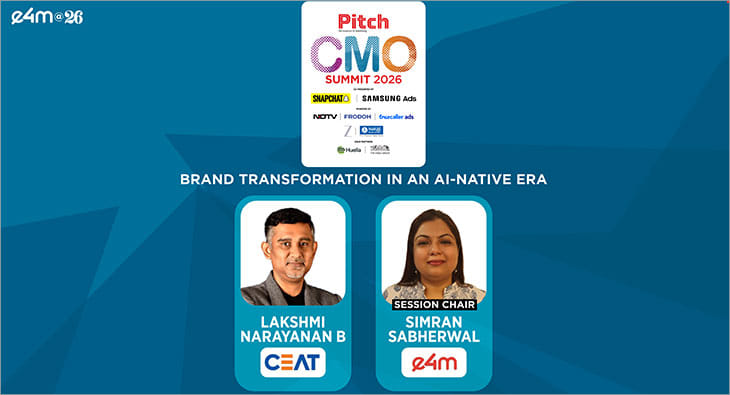

At the Pitch CMO Summit 2026, industry leaders came together to discuss the changing dynamics of marketing in a rapidly evolving technological landscape. One of the key conversations of the day was a fireside chat titled ‘Brand Transformation in an AI-Native Era’.
The session featured Lakshmi Narayanan B, Chief Marketing Officer at CEAT Limited, in conversation with Simran Sabherwal, Executive Editor at exchange4media. The discussion explored how brands, even those in commodity categories such as tyres, are rethinking storytelling, consumer engagement, and marketing strategies as artificial intelligence begins to reshape the industry.
Understanding Consumer Evolution and the Push Toward Premiumisation
Opening the conversation, Sabherwal pointed to the growing trend of premiumisation across industries and asked why a tyre brand would push in that direction. Narayanan explained that the change is closely linked to how consumers today relate to their vehicles. Over the past two decades, the role of vehicles has transformed significantly. “A couple of decades back, a vehicle moving from point A to point B which was just used as a mobility tool. Today, that relationship has shifted. For some, it is entertainment, for some it is adventure, and for others it is family time.”
As vehicles evolve with the rise of SUVs, crossovers and electric mobility, consumers are paying more attention to the components that shape the driving experience, including tyres. Narayanan explained this shift through a simple analogy. “Tyres are nothing but the shoes for your car. Today you choose different shoes for running, walking, parties or formal occasions. The same transformation is happening in our category. The shift from sedans to ESUVs and SUVs, along with growing EV electrification, has renewed consumer interest in understanding vehicles, bringing categories like tyres into greater consideration and discussion”
This growing awareness, he said, creates an opportunity for tyre brands to reposition themselves and push premium offerings.
Sabherwal also highlighted the challenge brands face when they attempt transformation and how to evolve while retaining existing consumers and brand loyalty. Narayanan stressed that brands should recognise that consumers themselves evolve over time. “Twenty years back I was driving a 150cc motorcycle. Fifteen years ago, I moved to a sedan. Five years back, I shifted to an SUV. Same consumer, only the journey has changed.”
According to him, brands must grow alongside the consumer rather than constantly chasing new audiences. “When that evolution happens, you’re partnering with the consumer through time. As they evolve, you evolve with them.”
The conversation also touched on how electric vehicles are opening new possibilities for the tyre category. Narayanan pointed out that EVs are far quieter than conventional vehicles, which makes tyre performance far more noticeable.
“Electric vehicles are super silent, implying comfort. Even the noise levels suddenly become more important for the consumer.” Because of this, consumers are becoming more conscious of the role tyres play in delivering a smooth and quiet driving experience. “In an electric vehicle, unless the tires are silent, you will notice the noise. That’s the opportunity for a brand like CEAT to be noticed by the consumer.”
Making the Tyre the Hero of Advertising
During the session, a CEAT campaign featuring filmmaker Zoya Akhtar was showcased. The ad focused on tyre grip and precise braking, using humour and exaggeration to highlight the brand’s performance credentials.
Narayanan explained that one of the biggest challenges in tyre advertising is that many commercials end up looking like car advertisements. “Most tyre ads don’t even look like tyre ads, they look like SUV ads. For us, the first challenge was to make the tyre the hero. We are here to sell tires, so the tire better be the hero.”
The campaign was built on a simple insight: sometimes just a few centimetres of braking distance can make a crucial difference. “It’s that small micro advantage of those few centimetres of early stopping that can make a huge difference for the consumer.”
The choice of Akhtar was also deliberate. “We wanted someone who represents perfection. Zoya is known to be a perfectionist, so the fit was quite natural.”
Interestingly, Narayanan revealed that the campaign’s 90-second version, the longest commercial he has worked on, delivered surprisingly strong engagement metrics. “We expect around 30 percent completion for a 30-second video which is nearly two to two-and-a-half times that. That tells us there’s intrigue and memorability in the storytelling.”
The conversation then moved toward the changing media landscape and the growing complexity marketers face in planning campaigns. Narayanan pointed out that media fragmentation has intensified in recent years, making it harder for brands to rely on a single platform. “From a media perspective, it has become difficult to bet on just one channel today. The media has been fragmented for a while now.”
Connected TV (CTV), however, is becoming increasingly relevant, especially for premium consumer segments. “CTV is turning out to be one of the important media platforms for us because the audience we are targeting, SUV and premium car owners, are present there.” However, measurement remains a challenge. “Today’s challenge lies in metrics while impressions are visible, the real reach and frequency remain unclear,” he said.
AI’s Growing Role in Marketing
Narayanan outlined multiple use cases already emerging in the marketing ecosystem. One key application is in creative production and testing.“ The animatics for the campaign you saw actually came out of AI. That helped us visualise the ad even before we went into the shoot.” Another major area is consumer insight generation. “Twenty years back, as a brand manager you had to go to the market, build hypotheses and test them yourself. Today, even before you step out, AI can help you build those hypotheses.”
For a global company operating across dozens of markets, AI also helps process large amounts of information. “When you’re working across 100-plus countries, sitting in Mumbai and understanding what will sell in Greece or the UK, it is a huge challenge. AI gives us a much more coherent set of information.”
Media planning is another space where AI is beginning to play a role. “Right now, AI is more of a validation tool rather than a complete media planning tool. But somehow it helps us question the basics and make more informed choices.” Despite the growing influence of AI, Narayanan stressed that human understanding remains irreplaceable in marketing. “Human touch will never change. AI can validate things, but authenticity cannot be replicated by machines.”
He added that while AI can generate content quickly, differentiation will ultimately come from insights rooted in real human behaviour. “Today every brand can generate communication at scale using AI. But what will differentiate is communication that no one else can replicate and that comes from true human insights.”
Building Strong Brand IPs Takes Time
CEAT has created strong sporting properties such as the CEAT Cricket Rating Awards and the CEAT Strategic Timeout within the Indian Premier League ecosystem. Narayanan emphasised that building such initiatives requires patience. “With Strategic Timeout, the initial years had no metrics, a common reality for any IP as it takes time for consumers to respond.”
He also pointed to long-standing global examples such as the Michelin Guide, which took decades to become influential. “Consumers pay back when you are consistent over time. IP building is all about patience.”
The fireside chat ended with a discussion on road safety in India. In 2025, India experienced about 4.88 lakh road accidents and this led to about 1.72 lakh fatalities. All the tyre companies have tried their best via communications, CSR to highlight safe driving where thousands of accidents occur every year. Narayanan emphasised that awareness campaigns alone are not enough to solve the problem “Tyres don’t carry your vehicle, it's the air that carries your vehicle. If you don’t maintain the right tire pressure, you are compromising everything on the road.”
CEAT has begun working with startups and NGOs to analyse accident-prone road stretches using data-driven approaches. “If you take a 4-kilometre stretch of highway with the highest accidents, you may need more than 200 interventions to actually reduce those incidents.”
According to Narayanan, improving road safety requires coordinated action across infrastructure design, driver awareness, vehicle maintenance and emergency response systems.“If we want to make a real difference, we have to get into lock, stock and barrel with data, partnerships and multiple interventions working together.”
Instead, it is about building smarter marketing ecosystems where data, creativity, technology and human insight work together to create meaningful consumer experiences.
Read more news about Marketing News, Advertising News, PR and Corporate Communication News, Digital News, People Movement News
For more updates, be socially connected with us onInstagram, LinkedIn, Twitter, Facebook, YouTube & Google News