What happens when brands stop introducing themselves
Brands are increasingly hiding or removing their logos to spark curiosity, conversation and recall, showing that modern marketing is as much about building memory as boosting visibility
 by
by
Published: Jul 11, 2026 9:20 AM | 4 min read
 Follow Us

- Zomato's recent advertisement for its 18th birthday featured no logo or brand name, instead thanking consumers for their support, sparking social media speculation about the brand behind it.
- This approach reflects a broader trend in marketing where brands aim to build recognition without relying solely on logos, focusing instead on distinctive brand assets like colors and shapes.
- Similar strategies were seen during the FIFA World Cup, where Levi's and Heinz utilized branding restrictions creatively, demonstrating that strong brand recognition can exist without explicit logos.
- While this interactive marketing strategy encourages consumer engagement, it carries risks, as brands may overestimate the recognizability of their distinctive assets, potentially leading to misidentification.
When Zomato published a full-page newspaper advertisement to celebrate its 18th birthday, something was missing.
There was no logo. No app icon. No brand name.
Instead, readers were greeted with a simple message thanking them for keeping the company "in your heart. And bank statements."
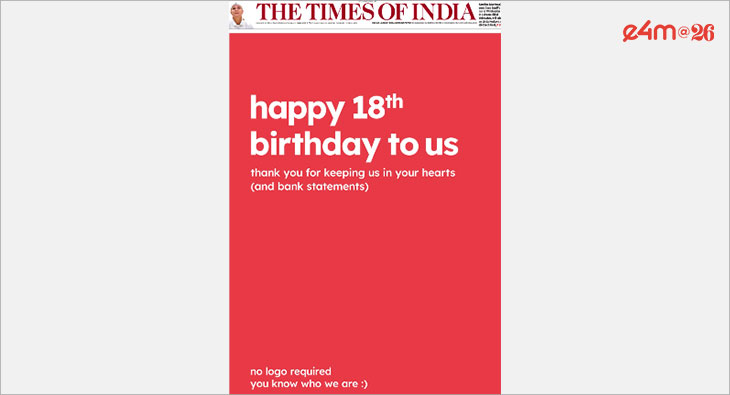
Within hours, social media was doing exactly what Zomato probably hoped it would. People were trying to figure out who had placed the advertisement. Some guessed Airtel because of the red colour. Others thought it was Coca-Cola, Kotak Mahindra Bank, HSBC or redBus. Marketing professionals quickly decoded the clues. Many consumers, however, were less certain.
The advertisement had achieved something unusual. It turned a newspaper ad into a public conversation.
At first glance, it looked like another clever campaign from Zomato. In reality, it reflected a much larger shift taking place in branding.
The strongest brands are no longer trying to make consumers notice their logos. They are trying to prove consumers no longer need them.
The same phenomenon played out during the FIFA World Cup at Levi's Stadium in Santa Clara.
Under FIFA's clean stadium policy, non-sponsor branding had to be covered during matches. The Levi's name disappeared from the stadium. Only the familiar Batwing symbol remained.
According to Levi's, fans still recognised the venue instantly.
View this post on Instagram
Heinz approached the same restriction differently. Instead of treating the mandatory black tape covering non-sponsor branding as an inconvenience, it embraced it. The company released a limited-edition ketchup bottle with its own logo obscured by black tape, mirroring what visitors saw inside World Cup stadiums. The packaging itself became the campaign.
View this post on Instagram
Three campaigns. Three different executions.
All asked consumers the same question.
Do you still know who we are if we don't introduce ourselves?
For decades, advertising followed a simple formula. The larger the logo, the stronger the branding. Every advertisement ended with a pack shot, a wordmark or a mnemonic to ensure consumers remembered the company behind the message.
Today's marketers appear to be working backwards.
The objective is no longer to expose consumers to a logo as many times as possible. It is to build enough memory over time that the logo becomes almost unnecessary.
Marketing science describes these cues as distinctive brand assets. They include colours, typography, packaging, shapes, mascots, sounds and symbols that help consumers recognise a brand instantly. The logo is only one of many assets. Research from the Ehrenberg-Bass Institute suggests shape-based assets such as logos and packaging are among the strongest memory cues, while colour on its own is often much weaker because it is frequently shared by competing brands.
That is precisely what happened with Zomato.
Its signature red certainly attracted attention, but it did not belong exclusively to the company. Consumers associated the same colour with Airtel, Coca-Cola and Kotak Mahindra Bank. The advertisement succeeded in generating conversation, but it also exposed the limitations of relying on colour alone.
Levi's faced no such ambiguity.
Its Batwing symbol has appeared consistently for decades across products, stores and advertising. Years of repetition meant the symbol had become shorthand for the brand itself. Even when the company name disappeared, recognition remained.
Heinz benefited from something similar. The bottle silhouette, the white label and the overall visual language were enough for consumers to identify the product despite the covered logo.
There is another reason these campaigns work.
People enjoy solving puzzles.
Instead of passively consuming an advertisement, audiences become participants. They guess the brand, debate their answers, tag friends and post explanations on social media. The advertisement stops being a one-way message and becomes an interactive experience.
In an age where every campaign competes with thousands of posts, reels and memes, that interaction has become a valuable marketing outcome.
However, the strategy is not without risk.
Recent research suggests marketers often overestimate how recognisable their distinctive assets actually are. Internal teams frequently believe consumers identify their assets more easily than they do in reality.
That makes logo-free advertising one of the biggest confidence tests a brand can take.
Get it right and consumers complete the story for you. Get it wrong and they complete someone else's. Perhaps that is the biggest lesson from these campaigns.
The real purpose of branding has never been to make consumers remember a logo.
It has always been to ensure that when consumers encounter a colour, a shape, a bottle, a symbol or even a blank newspaper page, they instinctively know whose story they are looking at.
Read more news about Marketing News, Advertising News, PR and Corporate Communication News, Digital News, People Movement News
For more updates, be socially connected with us onInstagram, LinkedIn, Twitter, Facebook, YouTube & Google News
