Why purpose, not persuasion, is driving the next era of Indian brand storytelling
At the dentsu-e4m Digital Advertising Report 2026 launch, brand and platform leaders unpacked how purpose, trust, and human connection are reshaping storytelling beyond campaigns in an AI-driven era
 by
by
Published: Feb 3, 2026 8:14 AM | 12 min read
 Follow Us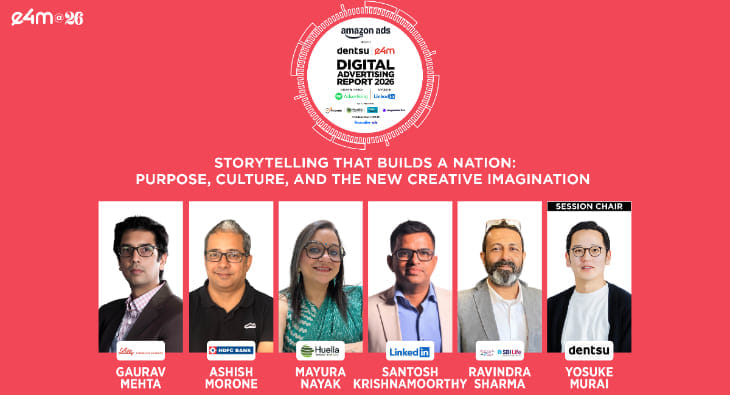

As India’s audience base grows younger, more diverse, and increasingly values-led, brand storytelling is moving beyond persuasion to responsibility, culture-building, and trust.
These themes came into sharp focus at the launch of the dentsu-e4m Digital Advertising Report 2026, where senior marketing and brand leaders gathered for a panel discussion titled “Storytelling that builds a nation: Purpose, Culture, and the New Creative Imagination.” Moderated by Yosuke Murai, Head of Sports & Entertainment, dentsu India, the session explored how brands can shape culture through purpose-driven narratives in an era of cluttered media and mindful consumption.
Opening the discussion, Murai asked the panellists to name the single biggest shift that brands must make to ensure their stories go beyond selling and actively shape culture and trust, as India enters into its next phase of growth?
Responding from a banking perspective, Ashish Morone, Executive Vice President & Head – Brand, Marketing Communications & Retail Marketing, HDFC Bank, said the starting point was often misunderstood. “When you talk about culture and purpose, it is not CSR necessarily,” he said, stressing that brands must look beyond commercial objectives to define their core reason for existence.
For Morone, purpose begins with a deep understanding of the category itself. “If I’m a bank, how do consumers look at money? How do they interact with money? How is money shaping the future, societal culture, and behaviour?” he asked.
He explained that this understanding helps organisations define what they stand for and what role they can play in shaping culture within their category. “It’s about building a purpose that helps people achieve their dreams, aspirations, and goals.”
When that alignment is clear, he noted, “It gives far more affinity with the audience, but it also gives a sense of purpose to the entire organisation,” adding that the real question for brands is how they make a difference in people’s lives beyond commercial transactions. “If you get that right, culture follows.”
Adding a platform-led perspective, Santosh Krishnamoorthy, Head of Strategic Accounts – India, LinkedIn, said responsibility does not rest with brands alone. “The responsibility lies with platforms as well,” he said, noting that platforms play a critical role in how purpose is communicated and amplified.
He pointed to LinkedIn’s organisational purpose as an example. “Our purpose is to give economic opportunity to the global workforce.” This clarity empowers individuals and companies operating on the platform. In a digital environment flooded with content, he emphasised that authenticity is what helps brands cut through. “There is a huge clutter of content today. When a brand is true to its purpose and is actually doing purpose-led storytelling, that’s when it makes a difference,” he said.
He added that delivering meaningful narratives requires collective effort. “It cannot come only from the platform or only from the brand,” Krishnamoorthy said. “Agencies, clients, creative partners, everyone has to come together to ensure that the purpose of the organisation is communicated clearly to the customer.”
Shifting the lens to participation-led creativity, Mayura Nayak, Co-Founder & CRO, Huella, argued, “Purpose cannot come without participation,” adding that the most effective way to drive attention is by involving users in the communication itself.
She pointed out that strong local storytelling often achieves global resonance. “The more local you get, the more global storytelling becomes,” she said, referring to the widespread affinity audiences have for stories emerging from southern India, regardless of language. According to her, this connection stems from grounded narratives and strong creative intent, but true impact comes when users are encouraged to actively engage with the story.
The discussion then moved to healthcare, with Murai asking how purpose-led storytelling in the sector can inspire proactive empowerment rather than a sense of obligation.
Responding, Gaurav Mehta, Senior Director – Marketing and Strategic Capabilities, Eli Lilly and Company (India), reflected on his transition into the sector. “Healthcare hasn’t done a great job of addressing the real-life problem statements people face when a health issue arises,” he said.
Drawing from personal mentorship, Mehta highlighted the emotional intensity of health-related decisions. “Till the time you’re healthy, you think of ten thousand things. The moment there’s a health issue, you think of only one thing,” he said, explaining that this is where healthcare companies need to step in and offer genuine support.
He emphasised that a health issue extends far beyond the individual. “It’s not just about that person’s health. There is family trauma, social elements, psychological elements, and economic elements,” Mehta said. In this context, content and solutions must address emotional and psychological security, not just clinical outcomes.
Mehta added that consumers actively seek information during health crises, often turning online. However, he cautioned that not all available content is credible or science-led. “That’s where the purpose of a healthcare company should come in,” he said, stressing the need to address patient needs comprehensively through responsible content and services.
While acknowledging that the healthcare sector has been slower than others represented on the panel, Mehta also discussed how change is underway.
As the conversation progressed, the focus shifted to the role of AI and immersive formats in modern storytelling, and what elements of human narrative should never be automated.
Raising the question, the moderator noted that while AI had been widely discussed across sessions, its growing presence in creative and immersive formats demanded clarity on where automation must stop.
Responding, Krishnamoorthy pointed out that with audiences consuming content across multiple screens simultaneously, there is an overwhelming clutter that brands must navigate. “There is so much content across platforms. People are watching something, reading something else, and listening to something at the same time,” he said.
In this environment, Krishnamoorthy argued, trust becomes the defining differentiator, and AI complicates it further. “When you add a layer of AI, it makes life much more difficult for marketers, media sellers, and platforms,” he said. Using LinkedIn as an example, he noted that while the platform is widely seen as synonymous with B2B advertising, recent research shows that a significant share of B2B discovery is now happening through large language model (LLM) searches. “People are not searching on traditional search engines anymore. They are talking directly to Gen AI or agent AI.”
In that context, LinkedIn’s role as a trusted data source carries added responsibility. “Most LLMs are taking data from LinkedIn because it is trusted,” Krishnamoorthy said, adding that this places greater onus on platforms to ensure credibility. “We have to make sure that whatever members or companies are putting on our platform is trustworthy, because it goes beyond the platform and into the AI ecosystem.”
Offering a creative services perspective, Nayak said AI’s real value lies in efficiency, not replacement. “AI will drive scale and speed, but it cannot replace human intervention,” she said. She noted that AI outputs are only as good as what humans feed into them. As marketers seek to free up mental bandwidth for more strategic thinking, Nayak positioned AI as a complementary tool. “What we do is scale and speed on creative output. That’s how we complement intelligent marketers today,” she said.
The discussion then moved to cultural responsibility, particularly for brands that are deeply embedded in everyday life. Asked whether banks carry a cultural role beyond products and campaigns, Morone responded unequivocally. “Definitely,” he said.
Consumers today increasingly value experiences over possessions, many of which are enabled by money. “How do I present myself? How do I enhance these experiences when I’m an enabler of them?” he asked. He explained that this opens up opportunities for banks to engage at moments that matter to consumers, aligned with their passion points. “We see our role as much bigger than just being a money provider or money manager,” he said.
Turning to the creator economy, Murai raised a question around authenticity versus control, and what changes when creators are treated as co-authors rather than mere channels.
Nayak pointed to brand safety as a core concern. She explained that creators chosen by brands effectively become ambassadors, making platform-level controls and third-party validation critical. From her perspective: “The ecosystem works best when brands operate within controlled, validated environments while actively endorsing co-creation.”
Addressing whether this approach carries risk, Ravindra Sharma, Chief – Brand, Corporate Communication & CSR, SBI Life Insurance, offered a firm clarification. “Brands don’t control the script,” he said. Instead, he framed the issue as one of alignment. “Every brand has a personality. When I work with creators or agencies, my brief is for them to work within that personality.”
If content does not align, it is not a matter of fear or dilution, but fit. “It’s not about controlling creativity. If it meets the brief, we take it forward. If it doesn’t, we don’t,” he said. He added that this approach has allowed SBI Life to create content that connects across age groups, from young consumers to middle-aged audiences.
Building on that point, Mehta said one of the biggest responsibilities of marketing leaders is ensuring that creative partners deeply understand consumer pain points and brand guardrails. “The best outcomes come when partners understand customers as well as we do,” he said.
Sharing an anecdote from his time setting up OLX India, Mehta recalled a moment when a director proposed a tagline different from what the agency had suggested. “He said, ‘Let’s just say Bech De,’” Mehta said. While the team initially had no clear way to evaluate the suggestion, they trusted the director’s conviction and went ahead with it.
The result, Mehta noted, was transformative. “‘Bech De’ became so strong that people started using it in everyday language,” he said. Crucially, the idea did not originate internally. “It came from a director who understood exactly what we were trying to do,” he added.
For Mehta, “Magic happens when true knowledge exchange happens between creators and brands,” he said, concluding that when partners fully grasp a brand’s intent, they can add value beyond what the brand itself might imagine.
The discussion next turned to professional identity, the panel examined how storytelling on professional platforms is evolving beyond careers and credentials, becoming more human and value-driven.
Responding to the question, Krishnamoorthy said the shift was already visible in how people engage on professional platforms today. “On LinkedIn, there is nearly fifteen times more content being created than job posts,” he said, pointing out that the platform has increasingly become a space for expression, not just employment.
He highlighted India’s growing significance in this transformation. “India is the second-largest LinkedIn market globally after the US, and it is growing so fast that it will soon become the largest.” According to Krishnamoorthy, much of this growth is being driven by Gen Z users, many of whom create profiles as soon as they are eligible. “Students, fresh graduates, people looking for opportunities are all coming in very early,” he said.
He also noted that profiles are often checked even before face-to-face meetings. “It’s not just about hiring anymore. People look you up before they meet you.”
Because of this, he stressed that professional profiles should no longer be treated like static résumés. “It’s not just bio-data. It’s a destination. It’s your personal brand,” he said. In a world where purpose-driven organisations attract stronger loyalty, Krishnamoorthy added that individuals, too, must articulate what they stand for.
Another theme that emerged was ‘what, if anything, Indian storytelling must protect above all else.’
Sharma offered a reflective response, saying storytelling has always evolved with time. “There is nothing to protect in that sense,” he said, noting that while formats and styles change across generations, certain fundamentals remain constant. “Do I have emotion? Do I create motivation? Am I real?” he asked, identifying these as the three enduring pillars of storytelling.
Purpose cannot be delivered through communication alone. “Purpose is delivered by three critical factors.”
The first is visual communication or advertising, the second is digital, how purpose plays out across digital platforms, and the third is human connection. “How do I drive my brand's purpose to the consumer through human interaction?” he asked.
He explained that when purpose is embedded seamlessly across these three pillars, its impact is far stronger than when it is limited to campaigns alone. Drawing from SBI Life’s approach, Sharma said the brand has consciously moved away from fear-based narratives traditionally associated with life insurance. “If liberation is our brand purpose, you will see it reflected across communication, on-ground experiences, and human interventions,” he said.
Adding to the point, Morone said storytelling is shaped by two dominant forces. “One is culture,” he shared, noting that India’s diversity naturally produces varied narratives across regions and geographies. When local culture is allowed to seep into storytelling, it creates authenticity and resonance.
The second force comes from the democratisation of content creation. “As content goes to the grassroots, it becomes rooted in human behaviour,” he said. That human behaviour often transcends borders. “The joy a parent feels for a child is similar across cultures and geographies,” he noted, explaining why certain stories find universal appeal.
However, Morone cautioned against losing local nuance in the process. “We need to be mindful of the small cultural aspects that give us higher affinity with our local audiences,” he said. While human truths travel well, brands must ensure they remain true to their cultural context as they create more and more content.
Read more news about Marketing News, Advertising News, PR and Corporate Communication News, Digital News, People Movement News
For more updates, be socially connected with us onInstagram, LinkedIn, Twitter, Facebook, YouTube & Google News
