Virality is an outcome, not a brief: Marketers decode the formula at Pitch CMO Summit 2026
Held at the Pitch CMO Summit 2026, the session explored the idea that viral marketing cannot be engineered on command but emerges when brands tap into authentic human insight and storytelling
 by
by
Published: Mar 12, 2026 6:08 PM | 5 min read
 Follow Us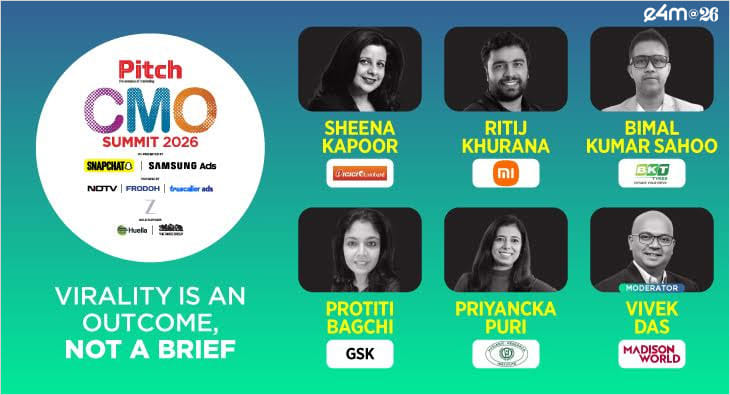

The Pitch CMO Summit 2026, hosted by the exchange4media Group today, brought together leading marketing minds and CMOs to decode how brands can navigate growth, creativity and technology in an increasingly AI-native world. One of exchange4media’s flagship marketing forums, the summit convened senior marketers, brand leaders and strategists to discuss how human insight, creativity and cultural understanding continue to shape brand-building even as artificial intelligence transforms marketing workflows.
Among the key discussions at the summit was a panel titled “Virality Is an Outcome, Not a Brief.” The session explored the idea that viral marketing cannot be engineered on command but emerges when brands tap into authentic human insight and storytelling.
Moderated by Vivek Das, Chief Digital Officer, Madison World, the panel featured Bimal Kumar Sahoo, Marketing & CX Leader at BKT Tires; Protiti Bagchi, Associate Director, Global Lead for Content & Marketing Operations & CX at GSK; Ritij Khurana, Associate Director, Marketing at Xiaomi India; Sheena Kapoor, Head, Marketing, Corporate Communications & CSR at ICICI Lombard; and Priyanka Puri, Senior Vice President – Marketing at Hygiene Research Institute.
Opening the conversation, panelists agreed that virality is rarely the starting point of a marketing strategy.
Sheena Kapoor stated, “Good marketing is about making companies and brands look smart, whereas great marketing and virality is where you make the customers actually feel something, something more authentic and relatable.” She added that brand-building is fundamentally an outside-in process, noting that while products can be manufactured in factories or labs, “brands are really created in the mind of the customers.”
Building on this, Ritij Khurana of Xiaomi India said the real driver of virality is a strong consumer insight that people instantly relate to. “Virality is just an outcome of a very good consumer insight. If you are able to crack an insight that a really large pool associates with, that is pretty much what virality is,” Khurana explained.
For Bimal Kumar Sahoo, virality is indeed an outcome, though it can still feature as an aspiration in marketing briefs.
“Virality is an outcome. It can be a part of the brief,” he said, adding that successful campaigns often sit at the intersection of internal alignment and external consumer insight.
Sahoo emphasised that impactful marketing connects not only with logic but also with emotion.
“It is not always just the mind. The emotion that makes content travel is a combination of heart and mind,” he noted, adding that marketers must balance external insights with internal brand perspectives and stakeholder alignment.
Highlighting the unique challenge of marketing in the insurance sector, Sheena Kapoor of ICICI Lombard said that unlike most products where value is delivered immediately, insurance operates on trust and promise.
“Insurance is one such category where you are paying a premium upfront with uncertainty. You don’t know when that eventuality will befall you,” Kapoor said. She added that trust, empathy and authenticity are central to communication in the category. “Within the guardrails of legal and regulatory frameworks, there is still a lot of play available for good storytelling,” she noted.
Offering a perspective from the beauty and personal care category, Priyanka Puri spoke about how brands must evolve their storytelling while retaining their core identity.
She pointed to legacy brands within the company’s portfolio that have built strong consumer trust over decades.
“The essence of the brand continues the same. The promise remains the same, but the storytelling evolves to stay relevant for consumers,” Puri said. She added that authentic storytelling rooted in brand ethos is what ultimately drives organic reach.
“Only when the ethos of the brand is strongly linked with the content you are promoting does it eventually become viral,” she said.
The panel also addressed the growing influence of the creator economy in marketing. Khurana argued that brands must be willing to relinquish some control when collaborating with creators.
“If I am coming to a creator’s channel, I am coming to see what the creator has made. I am not coming to see an ad,” he said, adding that brands should trust creators to communicate in their own voice.
However, Kapoor noted that this freedom must be balanced with compliance in regulated sectors.
“We cannot give the full liberty because the product features cannot be misrepresented,” she explained, adding that creators can still bring authenticity as long as they operate within defined guardrails.
Looking at global marketing ecosystems, Bagchi pointed out that virality today is influenced by multiple interconnected factors. Bagchi said, “In a highly regulated category like pharma, you have playbooks, guardrails, compliance and legal teams involved at every step. But marketers still need to be bold and mission-led about the problem they are trying to solve.”
“The challenge in global marketing is maintaining brand consistency while also adapting to local nuances,”
Summing up the discussion, moderator Das said that while platforms, algorithms and creator ecosystems continue to evolve, the fundamentals of marketing remain unchanged. In an increasingly automated and AI-driven marketing environment, the panel concluded that human understanding remains the real driver of resonance, and virality remains a by-product, not the brief.
Read more news about Marketing News, Advertising News, PR and Corporate Communication News, Digital News, People Movement News
For more updates, be socially connected with us onInstagram, LinkedIn, Twitter, Facebook, YouTube & Google News