Are festive ads running out of new stories to tell?
As Indian households shrink and platforms chase clicks over culture, ad folks are asking if the festive campaign playbook needs a proper creative reset
 by
by
Published: Jul 28, 2026 8:38 AM | 6 min read
 Follow Us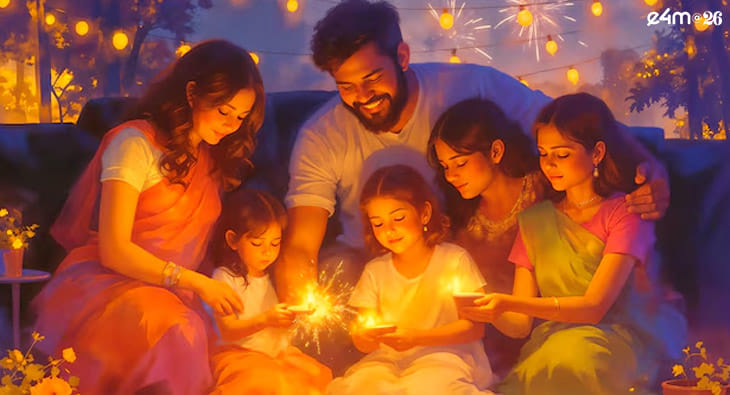

- Indian festive advertising is facing criticism for its repetitive themes centered around traditional family structures, which no longer resonate with a growing number of nuclear and single-person households in urban areas.
- Creative leaders argue that brands must evolve their storytelling to reflect contemporary celebrations, as younger generations engage in different festive practices, such as solo travel and friend gatherings, rather than traditional family reunions.
- The pressure for immediate returns in advertising, driven by performance marketing and digital platforms, is leading to formulaic campaigns that prioritize clicks over cultural relevance, stifling creativity in festive storytelling.
- A call for a creative reset in festive advertising emphasizes the need for brands to accurately represent the diverse ways people celebrate, moving beyond nostalgic tropes to connect with a broader audience.
Every year, the Indian television screen turns into a familiar ritual during the festive quarter. A son takes a flight back home, a daughter-in-law is welcomed with a thali, a family gathers around a table groaning with mithai, and a brand logo appears just as the lights come on. It has worked for decades, and that is precisely the problem. The festive campaign, in its most repeated form, has started to feel like a rerun rather than a story, and the advertising fraternity is beginning to ask out loud whether the genre needs a genuine creative reset rather than a fresh coat of paint on the same template.
The discomfort is not just aesthetic; it is structural. According to the National Family Health Survey, the share of nuclear families in India rose from 27% in 1991 to 45% in 2021, a shift that has quietly rewired what a "homecoming" even looks like. For a large chunk of the audience, a festive film is supposed to move. Add to that the rising number of single-person and non-family urban households, and the sepia-toned image of three generations under one roof stops being a universal truth and starts becoming a nostalgia trip for a shrinking demographic. The story that once united every Indian living room is now speaking to only some of them.
If audiences have changed, the language of festive storytelling must change with them.
While the emotional core of festive advertising remains rooted in culture, creative leaders argue that brands need to rethink the vocabulary they use to connect with it.
Ashish Pathak, a senior creative voice in the industry who has worked across Edelman, Ogilvy, and JWT, frames it this way. "Festive storytelling at its core will always be rooted in culture," he says. "Expressions of it, however, will evolve. How Gen Z or even Gen Alpha in the future choose to express, share, or celebrate will be different. So, relevance for brands doing festive campaigns will come through if they take inspiration from what's happening in society and culture." That is a meaningfully different brief than the one most creative teams have been handed for years, where the mood board still opens with a rangoli and a joint family breakfast table.
The generational shift Pathak points to is already visible in how younger audiences mark festivals, from solo travel over Diwali weekends to friend groups doing potlucks instead of extended family lunches, to festive gifting that increasingly flows through UPI and quick commerce rather than a box of sweets carried home. A campaign built entirely around the physical homecoming misses an audience that is celebrating just as sincerely, only differently.
Brand strategist Harish Bijoor, Founder of Harish Bijoor Consults Inc., puts the fatigue in festive storytelling in blunt terms. "I do believe festivals and the yearly routine of family bonding, gifting, and traditional formats exploited to the hilt are getting to be very, very boring," he says. "I do believe everything needs to be reinvented with the new context of a new generation wanting to celebrate. Therefore, let's look forward to some excitement on this count this festive season." Coming from someone who has watched Indian brand building evolve across cycles, that is not a casual complaint; it is a call to arms for the category.
The reset that Bijoor is nudging the industry toward does not necessarily mean throwing out the emotional core of festive storytelling. Culture, after all, is still the reason festive advertising exists in the first place, giving brands a shared calendar moment to plug into. What is changing, creative folks argue, is the vocabulary brands use to access that culture, not the culture itself.
When platforms outgrow the purpose
There is a second, less-discussed force pushing festive creative toward sameness, and it has less to do with family structures and more to do with how brands buy media. The festive quarter has become one of the most contested periods on the media calendar. Category momentum is expected to be led by e-commerce, consumer electronics, smartphones, FMCG, automobiles, BFSI, travel and quick commerce, with digital-first and marketplace-led advertisers particularly aggressive as they chase share during the season, according to industry opinion. Retail media, quick commerce and performance-led digital channels are pulling festive budgets closer to the checkout counter than ever before, precisely because they let a brand tie a campaign directly to a search, a cart addition or a sale.
That proximity to purchase is commercially useful, but it comes with a creative cost, according to Vaibhav Jain, Head of Media at First Economy, a Mumbai-based digital-first integrated marketing agency. "Right now, most brands are growing the platforms faster than they're growing themselves," he says. "The obsession with ROAS and short-term metrics has made marketers optimize for clicks, not for culture. Platforms are designed to reward instant action, but brands are built on consistent emotion." His point lands squarely on the festive season, where the pressure to show immediate returns nudges marketers toward safe, formulaic emotional shorthand rather than a genuinely new story, because a familiar trope is easier to greenlight and easier to measure than an unfamiliar one.
Jain is careful not to indict the medium itself. "That said, it's not the medium that's the problem; it's the mindset," he says. "When creativity meets data with long-term intent, platforms can absolutely build brand equity. We've seen it ourselves: when the storytelling is memorable and not just measurable, the returns compound over time. The platforms aren't the enemy. The lack of patience is." It is a useful corrective to any narrative that blames performance marketing alone for creative staleness. The tools are neutral; the brief writing them is not.
A reset, not a rejection
Put together, the picture that emerges is less about festive advertising abandoning family and togetherness as themes, and more about brands being honest about which version of family and togetherness they are actually reaching. The homecoming train journey will still work for a segment of the audience, but a growing share of urban India is celebrating in flat shares, in friend circles, in solo splurges timed to a festive sale notification, and in family WhatsApp groups rather than family dining tables. A creative reset, in that sense, is really an accuracy correction, updating the festive story to match how the country actually lives now rather than how it lived when the format was first written.
The categories fighting hardest for festive attention this year, from postponed big-ticket electronics and auto purchases to jewellery riding the wedding season tailwind, are themselves proof that consumer behaviour has already moved on from the single homogenous festive narrative. Advertising's job, as Bijoor, Pathak and Jain each point to in their own way, is to catch up to that behaviour with a story that feels lived rather than recycled. The festivals are not getting smaller. The definition of who is celebrating them, and how, is simply getting wider, and the campaigns that notice this first will be the ones that do not feel like a rerun.
Read more news about Internet Advertising India, Marketing News, PR and Corporate Communication News, Digital Media News, Television Media News
For more updates, be socially connected with us onInstagram, LinkedIn, Twitter, Facebook YouTube & Google News