From silver screen to mobile phone: Can stars drive microdrama monetisation?
From Vidya Malvade to Zareen Khan and Hiten Tejwani to Karan Patel, popular film & TV actors are entering mobile-first dramas. For platforms, the challenge is turning faces into paying subscribers
 by
Published: Oct 26, 2026 9:27 AM | 9 min read
 Follow Us


- Indian microdramas are gaining popularity, with established television actors like Vidya Malvade and Zareen Khan transitioning to this mobile-first format, which features short episodes and cliffhanger narratives.
- The microdrama market in India has seen significant growth, with revenue estimates doubling from $125 million to nearly $260 million within a year, driven by subscription-based platforms like Kuku TV and Quick TV.
- While familiar actors can attract initial viewer interest, the long-term success of microdramas depends on compelling storytelling and audience engagement, as retention remains a challenge in a competitive landscape.
- Production costs for microdramas are significantly lower than traditional television, making them an economically viable format, but platforms must effectively convert viewer attention into paid subscriptions to ensure profitability.
India’s latest sensation, Microdramas, are attracting a familiar kind of star power. Actors who built their careers on Indian television’s prime-time dramas are increasingly appearing in mobile-first, bite-sized stories built around short episodes, rapid narrative turns and cliffhanger-led viewing.
The latest entrant is Vidya Malvade, best known for her role in Chak De! India, who is making her microdrama debut with Story TV’s Scam 2024 – The Digital Arrest Story. Earlier, actress Zareen Khan, known for ‘Veer’, ‘Housefull 2’, and ‘Hate Story 3’, made headlines for doing a series with Pocket TV.
Produced by Small Town Boys and directed by Alok Sharma, the thriller ‘Scam 2024 – The Digital Arrest Story’ also stars Big Boss 15 Runners Up Pratik Sehajpal and Vineet Raina.
Malvade’s entry follows a growing list of television and film actors exploring the format. Hiten Tejwani, recognised for his role in TV serial ‘Kyunki Saas Bhi Kabhi Bahu Thi’, leads Kismat Ke Dhage on Quick TV. Karan Patel, best known as Raman Bhalla in ‘Yeh Hai Mohabbatein’, has stepped into Story TV’s Mafia Don, while Avinash Sachdev leads the legal thriller Vaqeel Sahab Ka Badla on Kuku TV.
Other television stars Jay Soni, Mouli Ganguly, Gaurav Chopra, Karanvir Bohra and Aman Verma had already bagged lead roles in micro-dramas a year ago. The format has also drawn Asmit Patel, Omkar Kapoor and Kunal Kapoor.
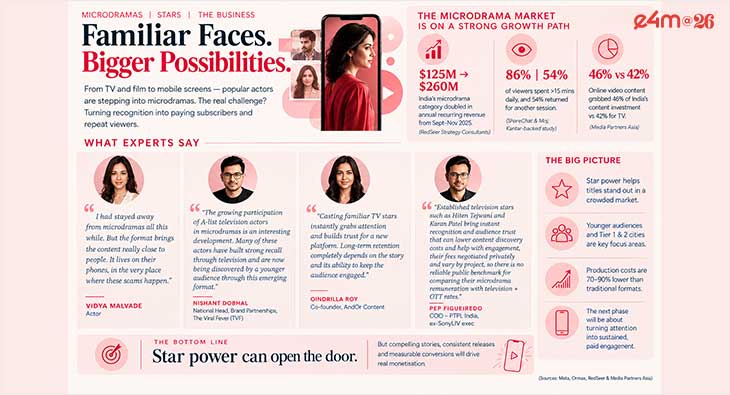
For Malvade, the appeal goes beyond audience reach. “I had stayed away from microdramas all this while. But the format brings the content really close to people. It lives on their phones, in the very place where these scams happen.”
Pratik Sehajpal sees significant headroom for growth. “To me, this microdrama format is the next big thing in entertainment, and I have felt that ambition on the set every single day.”
Also Read: From Streaming Disruptor to TV Playbook: Is Netflix rethinking content?
The IP gold rush: Why everyone wants a piece of India’s microdrama market?
India has the video audience, but is the monetisation catching up?
Familiar faces, a different storytelling grammar
Several platforms—Kuku TV, Bullet, Quick TV, Terribly Tiny TV and Fatafat—have launched in the last couple of years, most on a subscription-based model, carving out a $9 million share of the global $9 billion micro-drama market, with China accounting for 83 per cent, according to The Gaming and Interactive Media Opportunity in India report by BITKRAFT Ventures and Redseer Strategy Consultants.
The category’s growth is also reflected in its revenue trajectory. RedSeer Strategy Consultants estimated that India’s microdrama category doubled from roughly $125 million in annual recurring revenue in September 2025 to nearly $260 million by November 2025. As platforms seek to scale in this fast-growing market, they face stiff competition for consumer attention across mobile screens and social feeds.
The subscription economics also explain why familiar faces could matter. Several microdrama platforms offer monthly plans at around ₹99 and annual subscriptions at approximately ₹500, alongside promotional offers that provide access for ₹1 for two to three days.
While low-cost trials can encourage viewers to sample the format, platforms must convert that initial interest into paid subscriptions. Recognisable actors could help attract audiences, but sustained viewing will determine whether that attention translates into revenue.
GSN Aditya, COO, Eloelo Group, which owns Story TV, says, “Established actors bring familiarity and an existing audience connection. However, the format’s strength lies in combining recognisable talent with compelling, fast-paced storytelling that keeps audiences coming back. Actor fees vary by popularity, role and production scale, however making direct comparisons with television or OTT remuneration is difficult given the differences in format and production requirements.”
“Star power can help a microdrama attract attention, but its ability to retain viewers ultimately rests on the strength of the story. The same principle applies to monetisation: audiences are more likely to pay when the content consistently delivers value and keeps them invested. As microdramas evolve, pricing models will develop around audience behaviour, content preferences and the value viewers place on the experience,” Aditya explained further.
Nishant Dobhal, National Head, Brand Partnerships, The Viral Fever (TVF), tells e4m, “The growing participation of A-list television actors in microdramas is an interesting development. Many of these actors have built strong recall through television and are now being discovered by a younger audience through this emerging format. This reflects a larger shift in content consumption. Unlike the days of appointment viewing, audiences today consume content on their own terms, across platforms and in shorter, more accessible formats. Microdramas are well placed to cater to this change.”
What makes the format particularly exciting is the willingness of actors, producers and brands alike to experiment with a new form of storytelling, Dobhal says.
The intensity of consumption offers another indication of the format’s appeal. A Kantar-backed study by ShareChat and Moj found that 86% of viewers spent more than 15 minutes watching microdramas daily, while 54% returned for another session. The challenge for platforms is to translate this engagement into sustained viewing and paid consumption.
Filmmaker Vivek Anchalia, founder of Amazing India Stories, believes familiar casting can help titles cut through the clutter. “In a medium where everything looks the same and almost all viewers discover microdramas through social feeds, that’s a big differentiator. If successful, this may end up making microdramas the new TV.”
But established screen presence alone may not be enough. Microdramas must establish conflict quickly, sustain momentum across short episodes and give viewers a reason to continue watching. Character development and dramatic pay-offs must work within a compressed format, even when the larger story unfolds over multiple installments.
Oindrilla Roy, Co-founder AndOr Content, draws a distinction between initial discovery and long-term engagement. “Casting familiar TV stars instantly grabs attention and builds trust for a new platform. This drives initial discovery. Long-term retention completely depends on the story and its ability to keep the audience engaged.”
She also points to the potential of performers who build their following within the format. “Established platforms usually invest in homegrown stars who connect deeply with their specific audience, and apparently, they are just as valuable as hiring household names. Kasey Esser and Adam Daniel are great examples. They have both gained significant popularity and following after starring in successful micro-dramas,” she noted.
The choice between established names and emerging performers also has a financial dimension. According to Roy, “TV/OTT stars charge typically upwards of ₹1.5 lakh per day, compared to fresh faces who might charge as low as ₹10,000 for a day. But as micro-content typically requires a much shorter shoot schedule, the total payout per project is lower, even for a household name.”
Pep Figueiredo, COO - PTPL India, ex-SonyLIV exec, cautions against assuming that star casting automatically improves monetisation. “Established television stars such as Hiten Tejwani and Karan Patel bring instant recognition and audience trust that can lower content discovery costs and help with engagement, their fees negotiated privately and vary by project, so there is no reliable public benchmark for comparing their microdrama remuneration with television + OTT rates.”
He adds, “Familiar star power can justify testing premium episode unlocks or higher priced packages, but the real pricing power emerges only when a recognisable face converts curiosity into completed episodes, repeat purchases and measurable lifetime customer value.”
The economics of production offer another advantage. Faster cycles, smaller crews and more targeted scripts have made microdramas a relatively low-cost format. The average cost of producing a micro-drama ranges between Rs 20,000 and Rs 30,000 for a minute-long episode, translating to roughly Rs 12–18 lakh for an hour-long series. This represents a 70–90 per cent reduction compared to mainstream television or OTT production costs, insiders told e4m.
Customer acquisition, not retention
Celebrity casting may help attract viewers, but platforms need to establish whether that attention translates into paying subscribers, industry executives highlight.
Figueiredo puts the challenge in commercial terms: “Microdrama platforms compete for attention in social feeds before competing for subscriptions inside their apps. A study by Meta and Ormax found that 89% of Indian microdrama viewers discover the format through social feeds. A recognised television actor could improve the response to a promotional clip, but the platform must still persuade viewers to install the app, cross the paywall and pay for subsequent episodes.”
For platforms, the key metric is the incremental number of paying subscribers generated per rupee of star premium, rather than views, clicks or downloads. A controlled comparison between star-led and newcomer-led titles could help establish whether celebrity casting brings new audiences or merely lends recognition to a story that might succeed anyway.
Retention is another challenge. In a report published in 2025, the Los Angeles Times cited ReelShort data showing that weekly subscriber churn could exceed 50%, underscoring the need to continually attract and retain paying users.
The competition for audience attention is also reflected in media investment patterns. According to Media Partners Asia’s latest report, online video content accounted for 46% of India’s content investment, compared with 42% for television. For microdrama platforms, the opportunity lies not just in securing a share of online viewing, but in converting that attention into paying subscribers.
For India, one opportunity is to build a middle tier of bankable performers from television, regional cinema and digital entertainment who can attract loyal audiences without commanding the economics of major film stars.
According to Figueiredo, if a star-led title improves paid conversion by just 0.5 percentage points among one million qualified viewers, it could generate 5,000 additional subscribers. Whether that offsets the actor's fee depends on net revenue, retention and acquisition costs.
“Platforms must track conversions and retention at 7, 30 and 90 days, comparing similar titles to distinguish profitable acquisition from launch buzz. The opportunity is to treat familiar TV actors as measurable performance assets, while recognising that compelling stories and consistent releases drive continued payments,” he suggests.
Read more news about Digital Media, Internet Advertising, Marketing News, Television Media, Radio Media
For more updates, be socially connected with us onInstagram, LinkedIn, Twitter, Facebook, YouTube & Google News