AI or Instinct: Who understands India better?
As AI dashboards proliferate across agency war rooms, the real question isn't whether machines can track culture, it's whether they can ever truly feel it
 by
by
Published: Mar 5, 2026 9:21 AM | 7 min read
 Follow Us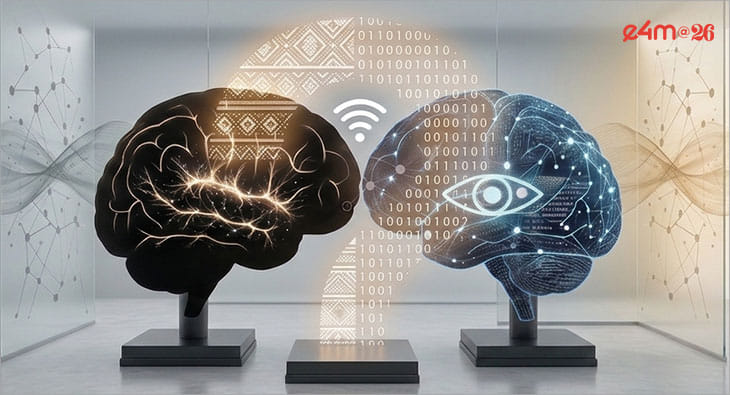

India does not trend. It ignites. One moment, a dialogue from a mid-budget film languishes in a press junket clip; the next, it has colonised every WhatsApp forward, every brand post, and every stand-up comedian’s set. A last-ball IPL finish detonates across 200 million screens simultaneously. A regional meme page in Tamil Nadu cracks an inside joke that, somehow, lands in Punjabi drawing rooms by Tuesday. The speed is staggering, and on the surface, the logic seems absent.
This is the terrain that modern advertising agencies are now attempting to navigate with AI. Trend dashboards, sentiment-mapping tools, meme-tracking software and real-time cultural monitors are proliferating, and so is the tension. The more sophisticated the algorithm, the sharper the question it raises: can a machine, however well trained, decode a country that runs on feeling?
India's advertising industry, which crossed ₹1,00,000 crore in total ad spend in 2024 according to the Pitch Madison Advertising Report, is no longer asking whether to use AI. That debate is settled. The question now is subtler, and far more consequential: where does the machine end and the strategist begin?
Read On: Can AI predict what will go viral in India?
Reading pressure, not lightning
Aparajita Biala, Head of Strategy Planning (Samsung) at Cheil Worldwide, is precise about what AI can and cannot do. "AI is very good at spotting early signals — rising keywords, format shifts, creator clusters, meme templates, regional spikes — far earlier than an average marketer would notice them," she says. But she is equally clear about where the technology hits its ceiling. "Virality in India doesn't build gradually. It usually ignites. A cricket moment, a throwaway dialogue, an unscripted creator reaction — that human spark decides what travels."
The metaphor she reaches for is telling: "Not a crystal ball, more a weather radar. It can tell you pressure is building, not where lightning will strike." That distinction sits at the heart of the AI-versus-instinct debate in Indian advertising today. Prediction requires understanding meaning, she argues. Reaction requires detecting scale. And right now, AI is decisively better at the latter.
This gap matters enormously in a market where trends migrate from niche to national in hours. The window for cultural relevance is brutally short. A brand that joins the conversation on day one of a meme cycle is a participant. A brand that joins on day four is a punchline. AI, Biala suggests, helps compress the reaction time, but it is the human in the room who recognises whether the moment is even worth entering. "The strongest role of AI is not deciding what to say, but deciding whether the brand has the right to say anything at all. AI can tell you a trend is rising, but has your brand earned its place in it — that has to remain a human judgement."
Read On: In two years, AI platforms could account for around 5% of AdEx share: Neil Patel
One country, many cultures
If the challenge were simply speed, AI would have already solved it. The deeper problem is plurality. India is not one cultural conversation. It is several hundred, running in parallel, in different languages, with different reference points, at different temperatures.
Sundeep Sehgal, Senior Vice President and Executive Creative Director at VML India, names this complexity directly, saying, "India is not one culture. It is many cultures moving at the same time — different languages, regions, age groups, and internet habits. Something can trend in Coimbatore and not matter in Chandigarh." This is not a quirk of the Indian market. It is its defining characteristic. And it is precisely what makes algorithmic cultural mapping so structurally difficult.
AI, Sehgal explains, can detect rising conversations and flag unusual spikes. What it cannot do is understand context: why people care, what emotion is driving a particular moment, or whether the energy around a topic will sustain or collapse within 48 hours. "AI can see signals. It cannot judge significance." The machine sees volume. The strategist reads weight.
There is a further irony embedded in the agency ecosystem's growing reliance on shared AI tools. When every agency and every brand draws from the same cultural dashboards, the outputs begin to converge. "When every brand is looking at the same dashboard, 'safe' becomes the same," Sehgal says.
Safety, in Indian advertising, has never been a competitive advantage. The brands that become culturally iconic (Fevicol, Amul, Asian Paints) did not get there by consensus. They got there by conviction. "AI can reduce tactical risk. But strategic courage still comes from human conviction. No algorithm has ever built a cult brand, so far."
Read On: How Indian brands are turning to AI giants for vernacular growth
Speed and Visibility vs. Emotion and Edge
For independent agencies working without the infrastructure of large networks, the AI question is both practical and philosophical. Aayush Bansal, Co-founder and Director of Black Cab, frames the relationship with characteristic directness, saying, "AI can detect movement, but culture in India doesn't move in straight lines; it moves in emotional spikes." The gap between detecting a trend and understanding its trigger, he argues, remains stubbornly human. "Sometimes it's a glance, a dialogue, or an unexpected fan reaction that becomes the moment. AI gives you signals. Humans recognise moments."
What Bansal describes at Black Cab is a division of labour that many agencies are moving towards instinctively, even if they haven't formalised it. AI maps where attention is accumulating. Humans decide whether a brand belongs in that space, and what it should say when it gets there. The cultural instinct, built from years of watching how Bollywood nostalgia travels, how cricket emotion is different from cricket data, how a regional humour style can go national with the right push, is not something that can be imported from a dashboard. It is accumulated. "AI gives you speed and visibility. But the real edge comes from combining that with teams who are culturally plugged in — people who don't just see the data but understand the emotion behind it."
There is also a critical point about false confidence. AI tools, Bansal notes, make brands more confident, but not necessarily safer. And that distinction matters. The tool can flag that sentiment around a topic is turning negative. It can show that a meme format is past its peak. It can validate timing. What it cannot do is supply the bravery to say something original when the data offers no clear answer. "Some of the most memorable brand moments weren't safe; they were timely, bold, and human," says Bansal.
The Client Shift
One of the more interesting developments in the AI-and-culture conversation is happening not inside agencies, but across the table. Clients (particularly the more digitally fluent ones) are arriving at briefs with a new vocabulary. They want meme tracking. They want regional pulse checks. They want volatility alerts. The dashboard has become, as Sehgal puts it, “table stakes”.
But the smarter clients, all three voices agree, are already moving past the "what's trending" question. They are asking the harder question: what should we do about it? Bansal sees this shift in the briefs that land at Black Cab. "The smartest clients also understand that dashboards don't create cultural moments; ideas do. Data tells you where attention is moving. Creativity decides how your brand enters that conversation meaningfully."
That is, finally, the most honest framing of where the industry stands. AI has earned a permanent seat in the agency's cultural intelligence process. It processes data at a scale and speed that no human team can replicate. It catches things before they are obvious. It prevents the most avoidable errors. But the work of meaning-making (understanding why a moment matters, whether a brand deserves a place in it, and what to say that is worth saying) remains irreducibly human. As Biala puts it, AI can sense the direction. The spark is still ours.
"The future isn't AI versus instinct — it's AI plus instinct," Bansal says. "The brands that win will be the ones that use data to stay alert and creativity to stay unforgettable."
Read more news about Digital Media, Internet Advertising, Marketing News, Television Media, Radio Media
For more updates, be socially connected with us onInstagram, LinkedIn, Twitter, Facebook, YouTube & Google News