Why are ad majors doubling down on content production?
From Publicis and Omnicom to WPP, global ad majors move to capture greater control of the content value chain amid a rapidly evolving marketing landscape
 by
by
Published: Mar 5, 2026 8:46 AM | 5 min read
 Follow Us

When WPP unveiled WPP Production in January 2026 — folding Hogarth Worldwide and its global production teams into a unified entity — the move signalled far more than an organisational restructuring. Led by Hogarth CEO Richard Glasson, WPP Production has been positioned as a technology-led global production engine integrating generative AI, virtual and hybrid production, and data-driven workflows to deliver always-on content at scale.
“Clients will experience faster turnaround times, greater cost-effectiveness and access to more innovative and diverse production solutions,” WPP said in a statement, ahead of the formal functioning of the unit from February 23.
The restructuring mirrors similar consolidation underway across rival holding companies. Publicis Groupe operates its global capabilities under Publicis Production, while Omnicom Group has expanded Omnicom Production as a centralized content infrastructure.
Collectively, these moves reflect a deeper structural reset in agency operating models as clients demand faster turnaround, exponentially higher content volumes, and tighter cost efficiencies across digital, social and performance-led ecosystems.
Also Read: WPP launches WPP Production to unite global creative and production teams
Sergio Lopez named CEO of Omnicom Production
Vineet Bajpai is CEO, Omnicom Production, India
Publicis Groupe India launches new content studio
A $60-billion opportunity
The push toward in-house production is fundamentally structural rather than cosmetic.
Brands today require thousands of platform-specific assets instead of a handful of television campaigns. Legacy production models — designed around high-cost, long-cycle advertising films — struggle to match the cadence of always-on marketing environments. Integrated production allows agencies to compress timelines, iterate in real time and deliver high-frequency content without external vendor friction.
The commercial rationale is equally compelling. By internalising production, holding companies retain a larger share of the marketing value chain, reduce third-party mark-ups and defend margins at a time when creative and media fees remain under pressure.
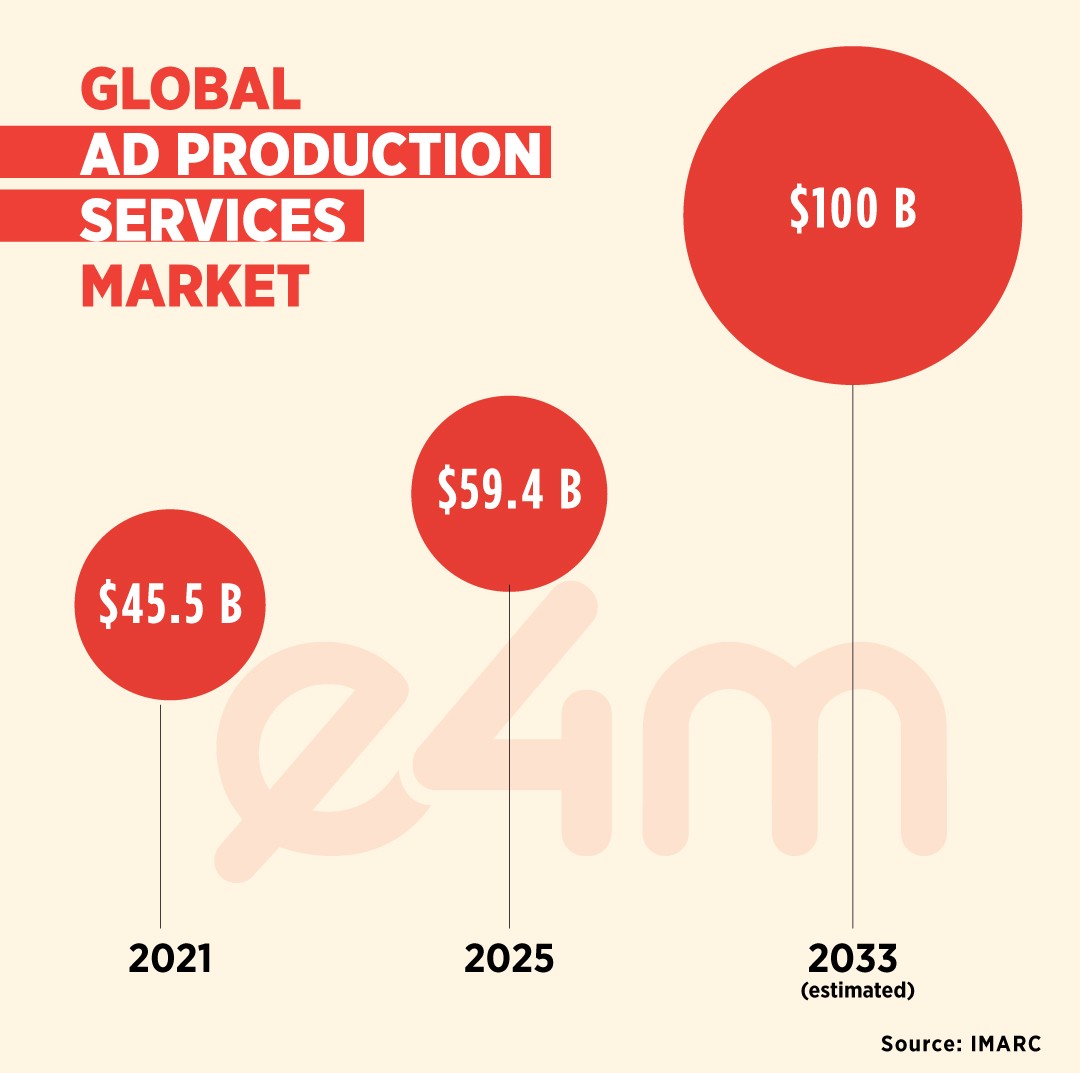
According to IMARC estimates, the global advertising production services market — valued at $45.5 billion in 2021 — is projected to reach $59.4 billion by 2025 and exceed $100 billion by 2033, underscoring why agency networks are seeking tighter ownership of production capabilities.
Technology redraws the production stack
Rapid technology democratisation has materially lowered barriers to building internal production ecosystems. Cloud-based workflows, AI-assisted editing, virtual production environments and automation tools now enable lean, scalable studios capable of delivering volume without proportionate cost escalation.
Simultaneously, programmatic advertising and data-led personalisation are pushing creative towards modular, dynamically optimised formats — making centralised production both operationally viable and strategically necessary.
Production, once viewed as an outsourced execution layer, is increasingly moving upstream into strategy, media and commerce integration. Ownership of production also enables agencies to retain first-party creative data, intellectual property and workflow intelligence — strengthening long-term client lock-ins.
Vineet Bajpai, Founder & CEO, Omnicom Production/Magnon (India), opines, “In a new world where brands and marketing are driven by content-centric initiatives, decoupling Production from Creative mandates drives value for both clients and agency networks alike. With nearly 70% of marketing spends going digital, production assumes a never-before strategic position.”
He added that limitless formats, vernacular targeting and analytics-led optimisation demand specialised production capabilities as brands compete for granular consumer attention while optimising marketing investments.
Varun Shah, Managing Partner, Publicis Production India, noted that the shift goes beyond operational efficiency. “The move to strengthen in-house production capabilities is often framed as an efficiency play… But fundamentally, this is about control of value creation in an AI-enabled content economy.”
As content becomes modular and platform-native, production is no longer the final execution layer but an integrated function closer to strategy, media and commerce, enabling faster idea origination, tighter data alignment and improved margin management.
“This isn’t just cost containment. It’s about building intelligent content ecosystems where creativity, technology, and distribution are designed together, not stitched together,” Shah noted.
Pressure on independent production houses?
For the wider ecosystem, the consolidation marks a redistribution of power across the content supply chain.
Agencies gain speed, control and margin efficiency; brands benefit from faster execution cycles; while independent production houses face increasing pressure to differentiate through craft, innovation and specialised storytelling.
An ad filmmaker observed, “As agency-owned studios mature, distinctions between network production units and independent companies may increasingly blur — raising questions around competitive neutrality and creative IP ownership during pitches.”
Clearly, the emerging battleground is no longer agency versus production house, but ecosystem ownership versus fragmentation. As content volumes surge and AI compresses production cycles, competitive advantage will increasingly lie with players capable of integrating strategy, technology, production and distribution within a single operating framework.
Nisha Singhania, CEO & Managing Partner at Infectious Advertising, summarised the shift succinctly: “Scale solves efficiency. Craft solves memorability. Independent production houses won’t disappear — but the middle will shrink.”
High-volume adaptation-led and always-on content is steadily moving in-house, she said, while culturally nuanced storytelling and cinematic craft will remain the domain of specialised independents.
Singhania added that Infectious anticipated the transition early through the creation of its content division, Epidemk, built to deliver content velocity without diluting brand thinking. “In a world where brands need 200 assets instead of two films, integration isn’t optional — it’s strategic.”
Shah echoed a similar view, arguing that independent production companies will remain relevant, but under an evolving definition of value.
“High-end craft, distinctive directorial voices, cultural sharpness, and long-form storytelling depth cannot be industrialised.”
What is likely to shift, he noted, is the volume layer of production — including always-on content, adaptation and multi-market versioning — which structurally favours integrated agency networks.
“The future isn’t binary. It’s layered… industrialised intelligence at scale coexisting with specialised craft and cultural authorship,” Shah quips.
Read more news about Internet Advertising India, Marketing News, PR and Corporate Communication News, Digital Media News, Television Media News
For more updates, be socially connected with us onInstagram, LinkedIn, Twitter, Facebook YouTube & Google News