ShareChat & Moj’s Kartik Patiar calls for cultural targeting shift in auto marketing
Kartik Patiar, National Head - M&E, ACHT, Online, at ShareChat & Moj, urges brands to move beyond demographics and tap into language, microdrama, and hyperlocal voices to drive purchase intent
 by
by
Published: Mar 3, 2026 3:22 PM | 4 min read
 Follow Us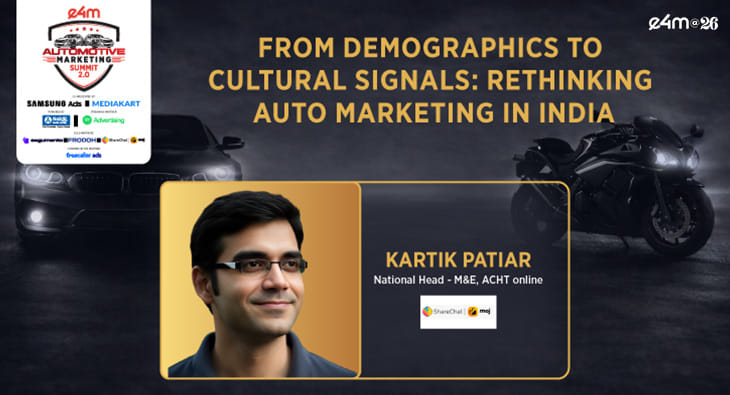

At the e4m Automotive Marketing Summit 2.0, Kartik Patiar, National Head - M&E, ACHT, Online at ShareChat & Moj, challenged marketers to rethink how they approach India’s fast-evolving auto consumer fundamentally. Speaking on the topic, “From Demographics to Cultural Signals: Rethinking Auto Marketing in India,” Patiar argued that the category can no longer rely solely on age, gender and income brackets to drive growth.
“Today, what I want to do is provoke your thinking towards how we actually rethink marketing for auto as the consumer landscape has changed so much,” he said. “I would consider my time successful if I have moved your thinking even a little bit in terms of how one needs to rethink auto marketing.”
Patiar outlined a clear shift from what he called a “demographic-based targeting stack” to a “cultural-graphics-based targeting stack.” While India’s four-wheeler growth story continues to be driven by aspiration, he stressed that the nature of aspiration itself has evolved.
“India is not just growing. It is upgrading,” he said, pointing to two major upgrade trends: consumers moving from hatchbacks to SUVs, and two-wheeler owners aspiring to higher-end two-wheelers or four-wheelers. On ShareChat and Moj, he noted, “three out of four users already have a two-wheeler and are either looking to upgrade to a higher-end two-wheeler or to a four-wheeler.”
This upgrade, however, is not purely economic. “The shift that’s happening is not just about income expansion. It is much deeper than that. It is cultural,” he asserted. Consumers today, he explained, are viewing automobiles not merely as mobility devices but through “an aspirational lens and an identity lens.”
Backing his argument with research, Patiar cited a Kantar data point that he described as ‘hard-hitting’. “Seventy-two per cent of consumers are more likely to buy from your brand when the content is in their native language of consumption,” he said. “It’s not marginal. It’s a significant shift that moves purchase intent.”
Equally critical is the demand for relatability. “Sixty-seven per cent of consumers today are looking for social proofing,” he noted, adding that buyers want to hear from “people who look like them, who sound like them, who live their lives.” For Patiar, culture is not limited to language or festivals. “Culture is not a trend. It is not just one festival. It is a form of shared identity. It is about aspiration and everyday rituals that give people a sense of belonging.”
For a high-involvement category like auto, which often represents “the largest financial decision a family will take that year,” building this cultural and emotional connection becomes critical. Patiar illustrated the idea with a simple metaphor: demographics define the outside of the container (age, gender, device usage) but “the real stuff lies inside,” including how consumers make decisions, who they trust and what triggers action.
He was quick to clarify that this is not an either-or debate. “You need demographic targeting to get precision reach at scale, and you have to layer that with culture signals. That’s when the impact of ROI becomes maximum,” he said.
At ShareChat and Moj, he explained, these cultural signals are first-party and user-driven. From language self-selection to engagement with hyperlocal creators, hashtag challenges and community participation, the platforms gather deep cultural insights. The scale is significant: over 200 million monthly users across 15-plus Indian languages, with average daily time spent jumping from around 34 minutes to 55 minutes in the past six months.
The surge, he revealed, has been driven by the rise of microdrama. “Microdrama is one of the strongest cultural pillars for us,” he said, adding that the format now sees over 300 million daily views on the platform.
Patiar also highlighted the power of hyperlocal influence. With coverage across more than 4,200 PIN codes, creator penetration extends far beyond metros. “Creators who collaborate with brands are not just limited to metro audiences. They have deeper penetration across PIN codes, and that becomes powerful when you want to speak like the people coming from those areas,” he said.
Festivals, too, must be viewed through a broader cultural lens. “For us, festivals happen almost every 15 days,” he remarked, noting that even regional celebrations generate significant user-generated content and engagement.
Summing up, Patiar identified four cultural pillars for auto marketers: true native language communication, hyperlocal voices, microdrama-led storytelling and leveraging both large and micro festivals. “Layer demographic precision with cultural signals,” he concluded, “because that is how you truly connect with the aspirational Indian auto consumer.”
Read more news about Marketing News, Advertising News, PR and Corporate Communication News, Digital News, People Movement News
For more updates, be socially connected with us onInstagram, LinkedIn, Twitter, Facebook, YouTube & Google News