Future of automotive growth is not more leads: Ankur Mittal
Ankur Mittal outlines how data fragmentation, delayed response times and dealership inefficiencies are costing brands nearly 40% of qualified leads
 by
by
Published: Mar 2, 2026 12:08 PM | 7 min read
 Follow Us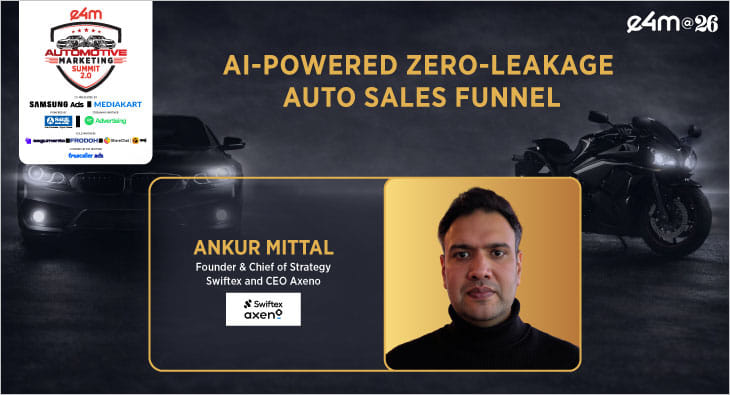

At the e4m Automotive Marketing Summit 2026, in a session titled “The Zero-Leakage Funnel: Transforming Automotive Mid-Funnel Economics with AI & Data Enrichment,” Ankur Mittal, Founder & Chief of Strategy at Swiftex and CEO at Axeno, broke down the structural inefficiencies that cost the industry millions in lost conversions. What followed was not a pitch-heavy presentation, but a detailed unpacking of how data fragmentation, dealership inefficiencies, and delayed response times are quietly eroding mid-funnel economics.
The Demand Obsession vs. The Conversion Problem
Ankur began by contextualising the industry’s current fixation. “There were a lot of conversations around how to bring in more leads, how to bring in more demand.” From CTV platforms to digital campaigns, brands are investing heavily in top-of-funnel growth. But he posed the more uncomfortable question: “Are we able to still make best use of those leads?” Having worked for 17 years across automotive markets in the Americas, Middle East, and India, Mittal said the real problem lies in what happens after the lead enters the funnel specifically in the dealership-driven mid-funnel stage, “where the control starts becoming a bit shaky… that’s where things start becoming murkier.”
To illustrate the leakage, he shared his own EV buying journey. After researching online, watching YouTube reviews, downloading brochures, and submitting contact details to three brands, he observed stark differences in response. “My first top priority… I did not get a call from them for almost 7 days,” he said. Meanwhile, other brands responded immediately. One asked him to visit the showroom because a test-drive vehicle wasn’t available. Another offered to send the vehicle home.
He explained. “Once you put down your thoughts that you want to buy a car, you want it quickly. You don't want to wait for 7 days.” Despite Brand A being his first choice, he ultimately purchased Brand C purely because of dealership responsiveness and contextual follow-up. “They did an amazing follow-up. They knew a little bit about me already.” The insight: dealership experience can override brand preference.
Ankur cited macro numbers to underscore the stakes. “In 2025, 5.2 million cars got sold in India. Next year it becomes 5.5- 6 million.” But demand isn’t expanding infinitely. “There are still many people who are going to buy the car. So what it means essentially is it's a race to that finishing line.” The winner isn’t the brand generating the most leads, it's the one converting them efficiently.
The Fragmentation Crisis: 32 Integrations for One Region
Working with one of the world’s top 10 automotive companies, Ankur’s team rolled out their platform in a single region. “Can you imagine we did 32 integrations to just stitch this data together?”
The ecosystem includes ad platforms (Meta, Google, CTV), CRMs, DMS systems, AI bots, voice solutions, and CDPs. “All these systems don't talk to each other, every stage generates a lot of data. No stage is sharing it with the next stage.”
This fragmentation has measurable consequences:
- 40% of qualified leads get lost due to mishandling
- 8% of calls were marked “lost” simply because they connected to voicemail
- Dealership says no, no attribution is less than 10%, digital says we contribute about 30%
- Walk-ins influenced digitally cannot be tracked end-to-end
In one case, a 30-second voicemail interaction resulted in a high-intent lead being marked as lost despite the customer having downloaded brochures and spent significant time on the website. “By the nature of the way the system is made up, it got disqualified,” Ankur said.
The Response Time Collapse
Another critical issue is response speed. “The problem was not the absence of systems. It's the lead overwhelm. The capacity.” Dealership development executives (DDEs) often handle thousands of leads weekly with limited manpower. Since their KPI is to “process” leads, some are prematurely marked as lost or handled superficially.“You basically assume that this is the natural course of the funnel,” he noted. But in reality, many of these drop-offs are avoidable.
While most automotive brands have implemented AI chatbots, Mittal questioned their intelligence depth. “AI is only smarter than the kind of data you provide to it.”
Context is missing. Creative-level insights such as whether a user clicked on a mileage-focused ad or a finance-offer creative rarely reach dealership sales executives. “All you have is a UTM parameter. That UTM parameter doesn’t help a lot.” Without closed-loop feedback, ROAS declines and creative optimisation becomes guesswork.
The Zero-Leakage Architecture: Lead Data Platform (LDP)
To solve these structural issues, Swiftex built a unified intelligence architecture called the Lead Data Platform (LDP). “We are not replacing your CRM, we are not an ad tech platform, we sit somewhere in the middle of all these platforms and kind of bring the whole story together.” The LDP consolidates behavioural signals from CDPs, campaign creatives, UTM mappings, DMS ownership history, qualification data and real-time call transcripts. On top of this, proprietary machine learning models generate actionable insights and smarter lead scoring mechanisms.
Importantly, Ankur emphasised simplicity. “We don’t show them hefty dashboards. We simply tell them this is what you need to do, this is your script.” Instead of overwhelming dealership staff with analytics, the system delivers contextual prompts in real time, enabling more relevant and timely interactions.
A key innovation discussed during the session was agentic workflow orchestration. If a customer mentions “mileage kitna aata hai,” the platform identifies frugality intent and prompts the executive to focus on fuel efficiency statistics, comparative advantages and relevant work cards. Similarly, if a customer inquires about finance offers, a finance agent is triggered instantly. “Through our agentic workflow we fire the agent which in real time sends a signal to the finance agent,” he explained. Using third-party fintech integrations, the system can pre-qualify salary data and streamline approvals eliminating redundant calls and preserving the customer experience.
“This is not really an automation, this is really intent driven orchestration,” Ankur stressed. The distinction lies in responsiveness: multiple agents activate dynamically based on conversational cues, ensuring every interaction remains context-aware.
AI-Based Sales Coaching and Accountability
Beyond conversion, the platform introduces AI-driven sales coaching. Instead of relying on static training assessments, Swiftex analyses real conversation transcripts from CTI systems. “We are taking all these conversations and identifying whether that dealer sales executive is really doing justice,” he said. If gaps are detected whether in product explanation, EV infrastructure clarity, or mileage discussions coaching workflows recommend targeted courses. Post-training, conversation quality is monitored to measure measurable improvement tied directly to sales outcomes. “If you don’t fix accountability, you don’t know what to fix.”
From 7% Attribution to 30%
Ultimately, Ankur positioned the zero-leakage funnel as both an economic and operational imperative. “How do we take that 7% attribution to 20%, 30%? How do we make sure that we really, really believe in zero leakage funnel theory?” His closing message distilled the session’s core thesis: “Future of automotive growth is not more leads. We have enough leads. We need to work on intelligent conversion. We need to act responsibly with all the leads that we are generating.” As the session concluded, His argument was clear Iin an industry where demand generation is increasingly commoditised, competitive advantage will belong to those who master mid-funnel orchestration, eliminate data silos and ensure that no qualified lead quietly disappears from the system.
Read more news about Marketing News, Advertising News, PR and Corporate Communication News, Digital News, People Movement News
For more updates, be socially connected with us onInstagram, LinkedIn, Twitter, Facebook, YouTube & Google News