Scale is not what makes Hero big. Trust does: Aashish Midha, Hero MotoCorp
Aashish Midha, Head of Marketing at Hero MotoCorp, says Hero’s four-decade journey focuses on ‘democratising mobility’ without reducing mass-market products to affordability pitches
 by
by
Published: Mar 3, 2026 8:45 AM | 4 min read
 Follow Us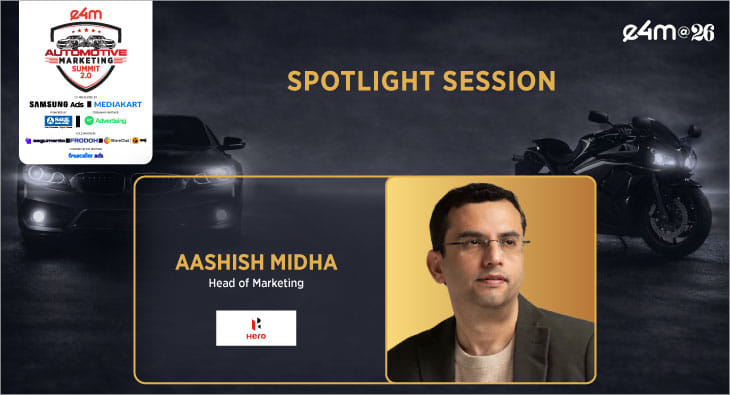

Hero MotoCorp’s growth is not anchored in price wars but in aspiration-building, said Aashish Midha, Head of Marketing at Hero MotoCorp, underlining that the brand’s communication strategy has consistently elevated entry-level mobility into a badge of progress.
Speaking at the e4m Automotive Marketing Summit 2026, Midha said the core of Hero’s four-decade journey lies in “democratising mobility” while ensuring that advertising does not reduce mass products to mere affordability pitches. Instead, the company positions even its most accessible motorcycles as enablers of ambition for a rising India.
For a brand that has remained the world’s largest two-wheeler manufacturer for 25 consecutive years, Midha argued that scale is an outcome, not a strategy. Hero’s 125 million-plus global customers represent trust built over time. “When a customer presses the start button in the morning, there is confidence that the bike will start. That trust is our real equity,” he said.
From Price-Led to Aspiration-Led Storytelling
Midha pointed out that in the entry motorcycle segment, most communication tends to revolve around mileage, price and savings. Hero has consciously moved away from that template. The HF Deluxe, for instance, is positioned as a symbol of upward mobility rather than just a value purchase.
He noted that for a first-time two-wheeler buyer, the proportion of disposable income invested in the vehicle can be significant. That emotional and financial commitment demands marketing that respects aspiration. “It is not about affordability. It is about reflecting the dreams of the customer,” he said.
Similarly, Splendor, described as the world’s largest-selling motorcycle for over two decades, is marketed as an emotion that cuts across generations and geographies. Campaigns focus on lived experiences rather than product specifications, reinforcing familiarity and nostalgia while maintaining relevance.
In the 125cc category, Hero introduced cruise control in the Glamour range, a feature traditionally associated with cars. The task for marketing, Midha said, is to communicate advanced technology in a simple and engaging manner so that innovation becomes relatable rather than intimidating.
The company’s performance narrative extends to the X-Pulse, including its Dakar Edition, which leverages Hero’s podium finish at the Dakar Rally. Here, the messaging shifts from utility to adventure and lifestyle, tapping into premium and enthusiast segments.
Beyond advertising films, Hero is investing in communities such as X-Clan rider groups to build long-term engagement. Midha said strong brand tribes ensure that loyalty is not dependent solely on media spends but on shared experiences.
Advertising Tailwinds and Sector Growth
Hero’s renewed focus on storytelling comes at a time when the auto sector is regaining advertising momentum. According to the Pitch Madison Advertising Report 2026, the automobile category is expected to grow in high single digits this year, aided by premiumisation, electric mobility launches and festive demand cycles.
Industry estimates suggest that the auto sector contributes around 7 to 8 percent of India’s total advertising expenditure, with two-wheelers accounting for a sizeable share within mass media spends, particularly television and digital. As competition intensifies across internal combustion and electric segments, sharper brand differentiation is becoming critical.
Midha said that while partnerships with global players such as Harley-Davidson and emerging electric mobility companies expand Hero’s product horizon, the communication principle remains consistent. “Brands must reflect society but also shape it,” he said, citing the long-running positioning of the Pleasure scooter around women’s independence.
The marketing push is supported by financial access. Hero FinCorp, the financial services arm of the group, plays a role in enabling ownership across income segments, furthering the company’s democratisation thesis. Easier financing, particularly in semi-urban and rural markets, continues to be a growth lever.
As India’s mobility landscape evolves with electrification, connected features and rising consumer expectations, Hero’s strategy, Midha suggested, will remain rooted in trust and aspiration. “Scale is not what makes Hero big. Trust does,” he said, framing the company’s advertising philosophy as a long-term investment in emotional capital rather than short-term promotional bursts.
Read more news about Marketing News, Advertising News, PR and Corporate Communication News, Digital News, People Movement News
For more updates, be socially connected with us onInstagram, LinkedIn, Twitter, Facebook, YouTube & Google News
