Attention, Context & Creativity: Shahad Anand decodes high-impact auto advertising
At e4m Automotive Marketing Summit, Shahad Anand, Business Head at Skylight Mediakart, unpacked how brands can engineer stronger consumer impact
 by
by
Published: Feb 27, 2026 5:11 PM | 3 min read
 Follow Us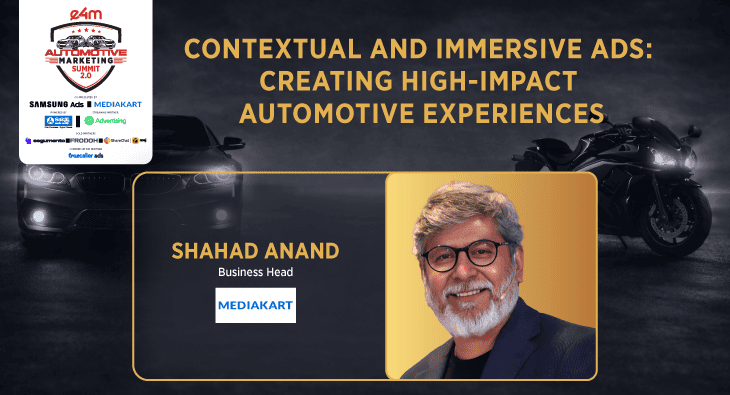

At the Marketing, Mobility & Momentum: e4m Automotive Marketing Summit, hosted by exchange4media, conversations around the future of automotive marketing moved beyond scale and reach to sharper discussions on attention, context and immersive impact.
In a session titled ‘Contextual and Immersive Ads: Creating High-Impact Automotive Experiences’, Shahad Anand, Business Head at Skylight Mediakart, unpacked how brands can engineer stronger consumer impact through rich media, CTV, contextual advertising and YouTube ecosystems.
Anand began with a brief introduction to Mediakart, describing it as a digital media company focused on precise targeting, contextual relevance, wide reach and high-impact imagery. He then structured his session around four key pillars — attention, creativity, context and the impact of images, explaining how each plays a critical role in building high-impact automotive advertising experiences.
From there, he moved to what he called the first and most critical trigger in advertising effectiveness, attention. According to Anand, the human mind naturally oscillates between imagination and memory, and only a strong stimulus can interrupt that loop. “Attention straight away does not lead to action. Awareness would not come unless there is attention,” he said. Illustrating the power of focused choice through a retail analogy, he emphasised that limiting distractions sharpens decision-making. In today’s ecosystem, he argued, rich media and immersive formats serve as that essential stimulus.
Creativity, he said, is the multiplier. Defining an idea as the coming together of two known but unrelated elements, Anand noted, “When two known things, which are apart, are taken together, what we get is called an idea.” Creativity, he explained, stems from curiosity, experience and practice — qualities brands must nurture to remain relevant.
On Connected TV in particular, he highlighted a distinct viewer behaviour pattern: users see an ad, decide whether to continue watching, and often reach for another device. The challenge lies in holding them at that crucial second stage. “They may not take an action, but they are looking at an opportunity for call to action,” he said, pointing to personalisation, compelling offers and interactive prompts as key retention levers.
Shifting to contextual advertising, Anand underscored that “contextual request depicts state of mind.” The content a user consumes, be it reviews, finance, health or entertainment, reveals intent. For automotive brands, aligning with relevant environments such as auto reviews or category-specific content creates a seamless bridge from attention to awareness and eventually action. At the same time, he cautioned that negative environments can dampen effectiveness. “Negative context diminishes awareness,” he noted, explaining that anxiety-led content narrows perception and reduces receptivity.
For automotive marketers operating across YouTube and other immersive platforms, he said, visual context can significantly influence perception and engagement.
Across his address, Anand tied together attention, creativity, context and imagery as interconnected levers. In an increasingly fragmented digital landscape, he suggested, high-impact automotive marketing is not just about visibility, it is about aligning message, medium and mindset at the right moment.
Read more news about Marketing News, Advertising News, PR and Corporate Communication News, Digital News, People Movement News
For more updates, be socially connected with us onInstagram, LinkedIn, Twitter, Facebook, YouTube & Google News