For a brand, it’s always important to stay true to yourself: Jyoti Malhotra, Volvo Car
At e4m Automotive Marketing Summit, Jyoti Malhotra, Managing Director, Volvo Car India, spoke to Dr. Annurag Batra, on how the Swedish luxury carmaker interprets its global ethos in India
 by
by
Published: Feb 28, 2026 9:51 AM | 4 min read
 Follow Us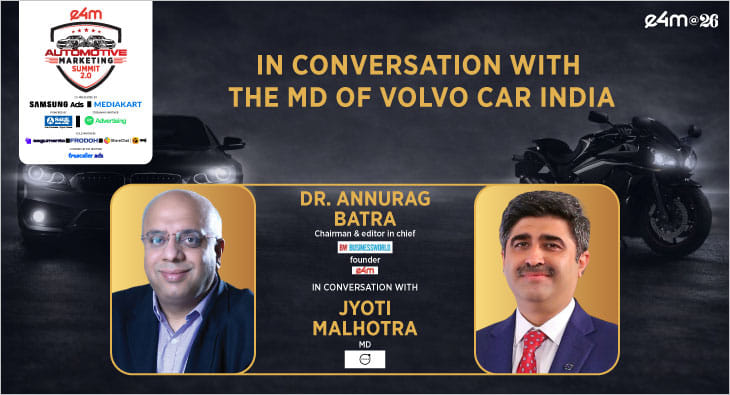

As Volvo approaches its 100th year globally in 2027, Jyoti Malhotra, Managing Director, Volvo Car India, says the brand’s core philosophy of safety and sustainability remains non-negotiable — even as it adapts to a fast-evolving Indian market.
In a fireside chat with Dr. Annurag Batra, Chairman and Editor-in-Chief, BW Businessworld and Founder, exchange4media, at the e4m Automotive Marketing Summit, Malhotra reflected on how the Swedish luxury carmaker interprets its global ethos in India, why cars are deeply emotional purchases, and why electrification is central to both Volvo’s and India’s future.
Founded in 1927, Volvo is a legacy brand with nearly a century of automotive history. In India, however, Malhotra admits the company is still “learning its ropes.” Yet, he emphasises that heritage brings clarity. “For a brand, it’s always important to stay true to yourself. Don’t try to be somebody else,” he said, underlining that Volvo’s DNA remains rooted in safety.
But safety, for Volvo, extends far beyond protecting passengers inside the vehicle. “It’s not just about keeping people inside the car safe. That was the starting point. We want to extend that philosophy to people around us as well,” she noted, pointing to India’s high incidence of road accidents. Over time, this philosophy has expanded further to encompass sustainability — what he describes as “the safety of Mother Earth.”
Acknowledging that the automotive industry is part of broader challenges such as pollution and road safety, Malhotra said the responsibility lies in being part of the solution. “If you acknowledge that you are part of a problem, then you must ask what you can do differently — while sticking to your core philosophy. For us, safety and sustainability are central.”
He also highlighted Volvo’s Scandinavian roots — minimalism, simplicity and understated luxury — in contrast to the often spectacle-driven luxury auto segment. “We operate in luxury, but we must live our philosophy. We stay true to simplicity, to what we believe in.”
On the question of what really sells cars — styling, features or marketing — Malhotra argued that automobiles are ultimately emotional purchases. “Cars are an extension of your personality. You live with them every day. The choice of brand reflects who you are,” he said. While features across vehicles may be comparable, she believes design language and brand association create differentiation.
Indian consumers, he added, are not merely cost-conscious but value-conscious. “Value doesn’t come only from price. It comes from the thought that you associate with — the reflection you see in the brand.”
Illustrating Volvo’s long-standing commitment to safety, Malhotra cited the invention of the three-point seatbelt, developed by Volvo and deliberately left unpatented so that other manufacturers could adopt it. “I can proudly say there is a little bit of Volvo in every car,” he remarked.
Using the platform to advocate responsible behaviour, he urged audiences to consistently wear rear-seat seatbelts, highlighting that despite rising awareness, compliance remains low in India. “The primary safety feature in a car is the safety belt. All other features can fail if you’re not wearing one,” he stressed.
Looking ahead to 2026 and beyond, Malhotra identified electrification as a key priority — not just for Volvo but for India’s automotive industry at large.
He pointed to three major reasons. First, urban pollution. “EVs are a much more efficient technology in terms of converting energy to power,” he said, drawing parallels with Delhi’s transition to CNG buses decades ago, which significantly improved air quality. A similar shift toward electric mobility across buses, cars, two- and three-wheelers could have a transformative impact.
Second, energy security. As a major oil-importing nation, India stands to benefit from reducing fuel dependency through greater EV adoption and local ecosystem development.
Third, global competitiveness. While India is now the world’s third-largest car market, Malhotra believes electrification presents an opportunity to leapfrog legacy barriers and emerge as a global manufacturing hub. “EVs are an emerging technology. If we take the lead, build ecosystems and leverage government support, we can create jobs and become a global hub,” he said.
For Volvo, the push toward electric mobility is not merely about market share but about alignment with its founding principles. “It’s about being part of the solution,” Malhotra concluded — reinforcing that as the brand enters its centenary year, its commitment to safety, sustainability and Scandinavian authenticity remains firmly in the driver’s seat.
Read more news about Marketing News, Advertising News, PR and Corporate Communication News, Digital News, People Movement News
For more updates, be socially connected with us onInstagram, LinkedIn, Twitter, Facebook, YouTube & Google News
