Auto's media allocation has seen dramatic shift in favour of targeted media: Kartik Sharma
In a conversation with Nawal Ahuja at e4m Auto Marketing Conference, Kartik Sharma, CEO, Omnicom Media Group India, said auto sector is entering 2026 with renewed consumer momentum
 by
by
Published: Feb 27, 2026 6:08 PM | 4 min read
 Follow Us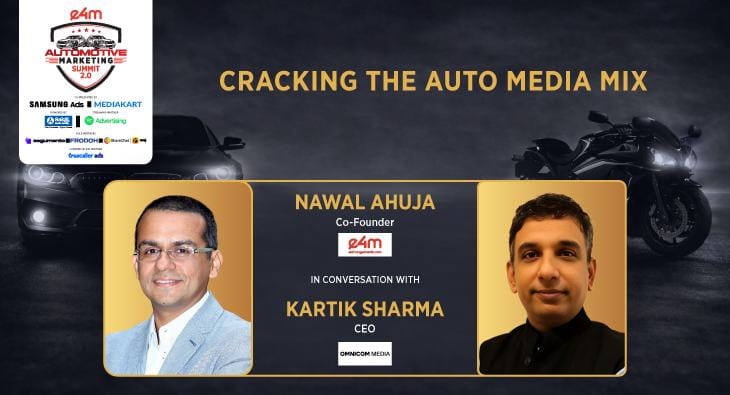

The Indian auto sector is entering 2026 with renewed consumer momentum, though global uncertainties continue to pose risks, Kartik Sharma, CEO, Omnicom Media Group India, said at the second edition of the e4m Auto Marketing Conference.
In conversation with Nawal Ahuja, Co-founder, exchange4media Group, Sharma described the previous year as a “mixed bag”, marked by a slow first half followed by recovery in the latter part of the year.
“Last year was not easy. It's a mixed bag, as you rightly put. First half, we were all worried about what's going to happen, but many of the structural changes announced by GST have actually helped. And overall, it's in a much better position,” he said.
He added that 2026 has begun on a more stable footing. At the same time, he cautioned that geopolitical tensions could impact sentiment. “We are in a very chaotic and very unpredictable world. So, what we say today could change in three weeks' time,” he said.
Media mix shifts in auto
Sharma said the auto category has seen a significant shift in media allocation post-COVID. “There's a dramatic shift in the media mix usage in auto. From 60-40 in favour of mass media to 40-60 in favour of more targeted media,” he noted.
While print saw a drop during the pandemic, Sharma said there has been an uptick since 2020. He added that print continues to play a role in building trust and providing dealer-level information for test drives.
Television, according to Sharma, remains critical for large-scale launches across metros and Tier I and Tier II cities. He said reports of the decline of television do not reflect ground realities in the auto category.
Outdoor advertising, he added, continues to grow within the auto segment, especially in creating visibility near dealerships and reinforcing brand recall.
On radio, Sharma said the medium remains underutilised. While some brands have leveraged it effectively, he described it as a potential opportunity area, particularly in smaller towns where entry costs are lower.
Digital and content evolution
On digital, Sharma said allocation varies across brands and segments. While digital accounts for a smaller proportion at the overall category level, certain segments and brands operate with a significantly higher digital focus.
He highlighted the growing role of content creators, noting that access to creators has expanded significantly. However, he cautioned about the presence of fake creators and the need for filters to ensure credibility.
Sharma said brands are experimenting across celebrity, mid-tier and micro creators depending on objectives and lifecycle stage. He added that meaningful content depends on consumer insight and cultural context rather than volume alone.
Addressing the debate around brand versus performance marketing, Sharma questioned the framing of performance as distinct from other media investments. “I think every dollar has to have some impact on the business,” he said, adding that attribution models are evolving beyond last-click frameworks.
AI and advertising
On artificial intelligence, Sharma described himself as taking a balanced view. “It's not AI will take all jobs. At the same time, we should not be so bold to say it will not impact. It's somewhere in between,” he said.
He noted that AI has already been embedded in media optimisation tools, particularly in digital, and is increasingly being used in creative production to reduce timelines and improve output quality.
Sharma also referred to predictive capabilities of AI in marketing, particularly when layered over first-party data to better understand consumer behaviour.
He said repetitive tasks are more likely to be automated, leading to workforce shifts.
At Omnicom, he added, the focus has been on training teams to use AI tools effectively.
“We don't need to become doomsday. I'm a great optimist,” Sharma said, adding that while there may be interim disruption, long-term productivity gains are expected to outweigh job losses.
The session highlighted the structural shifts underway in the auto marketing ecosystem, from media mix realignment to digital experimentation and AI adoption, as the sector navigates both growth opportunities and external uncertainties.
Read more news about Marketing News, Advertising News, PR and Corporate Communication News, Digital News, People Movement News
For more updates, be socially connected with us onInstagram, LinkedIn, Twitter, Facebook, YouTube & Google News