ShareChat & Moj’s cultural guide for understanding India beyond the metros
The Culture Intelligence Summit 2026 was hosted by ShareChat and Moj in Mumbai and Delhi
 by
by
Published: Aug 18, 2026 4:35 PM | 5 min read
 Follow Us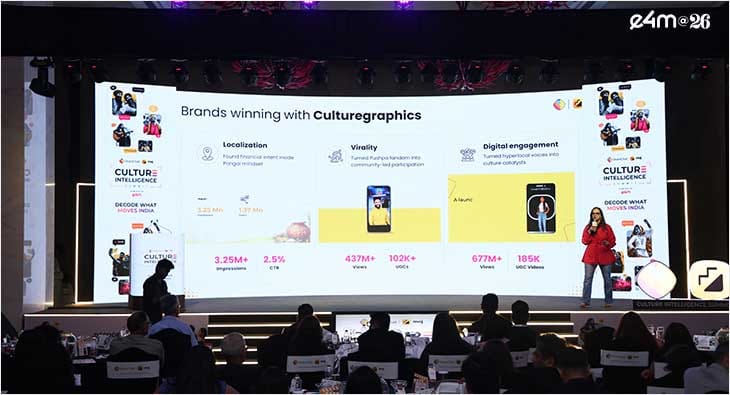

- The Culture Intelligence Summit 2026, hosted by ShareChat and Moj, focused on understanding India's diverse consumer behavior beyond traditional demographics, emphasizing the importance of local cultural contexts.
- ShareChat and Moj reported over 200 million monthly active users and highlighted their investment in microdramas, predicting that 30-40% of this content will be AI-generated by year-end, with a budget of ₹100 crore allocated for ecosystem development.
- Experts at the summit stressed the need for brands to move beyond language translation to embrace deeper cultural insights, recognizing the complexity of India's cultural landscape with over 1,300 mother tongues.
- The discussion highlighted the role of hyperlocal creators in connecting brands with consumers through relatable cultural references, emphasizing that effective marketing requires understanding local nuances and fostering engagement over mere follower counts.
For years, marketers have tried to decode India through demographics, geographies and languages. But as the country’s internet audience expands beyond its metros and consumer behaviour becomes increasingly shaped by local contexts, those markers are beginning to tell only part of the story.
The bigger question is: what makes a consumer in one part of India respond differently from someone who may look identical on a demographic chart but lives in another cultural context?
That was at the heart of the Culture Intelligence Summit 2026, an event hosted by ShareChat and Moj in Mumbai and Delhi.
Opening the summit, Ankush Sachdeva, Co-founder and CEO, ShareChat and Moj, highlighted the scale of the platforms, which have more than 200 million monthly active users spending around 40 minutes a day on them. But the company’s latest big bet is microdramas, which is generating over 900 million daily episodic views daily ShareChat and Moj expect 30-40% of their microdrama content to be AI-generated by the end of the year and have earmarked ₹100 crore to build the ecosystem.
“There are so many micro-festivals and cultural moments that we are not even aware of, and these are the moments that we miss because India is so broad and wide,” Sachdeva said, pointing to an opportunity for brands to tap into moments that are often overlooked.
ShareChat is also using AI to deepen this cultural personalisation, with a feature in development that can combine a user’s profile information with trending content to create personalised content around festivals and cultural occasions.
For Neha Markanda, Chief Business Officer, ShareChat & Moj, the sheer cultural complexity of India means that conventional approaches to localisation are no longer enough.
“India has over 1,300 mother tongues and when we translate our campaigns, we are only changing the language,” she said, making the case for a deeper approach to cultural intelligence.
The distinction matters because cultural diversity often exists within the same language and geography. This is where ShareChat and Moj come into the picture. With their deep understanding of regional audiences, cultural moments and content consumption patterns, the platforms can help brands identify the communities and occasions that matter to them and build communication around those moments.For marketers, the opportunity lies in identifying those cultural cues and turning them into moments that consumers recognise as their own.
The intersection of culture, content and attention was further explored in a fireside conversation between Prasanth Kumar, CEO - South Asia, WPP Media, and Sachdeva.
For Kumar, the fundamental objective of advertising remains building memory. But cultural relevance can provide brands with more opportunities to create that memory by connecting with consumers through language, festivals and other cultural contexts.
He also sees promise in microdramas, particularly because their continuous narratives can offer brands a more sustained storytelling opportunity than a single piece of communication.
India has no shortage of cultural moments, the task is knowing which moments matter to which communities. That question also underpinned the discussion among marketers on how brands can move beyond the assumptions of an urban-first consumer.
Deepa Jatkar, India Lead, WPP OpenDoor, said language should not be treated as the only marker of India's diversity. “Language, she argued, needs to be understood alongside consumer cohorts, cultural nuances and media consumption habits,” said Jatkar
The task for marketers is to identify a central cultural insight and then build an ecosystem around it, with different touchpoints working together rather than operating as disconnected pieces of communication.
This is where the growing influence of hyperlocal creators becomes significant. Their value lies not just in their ability to reach a particular audience, but in their familiarity with the everyday contexts and cultural references that shape that audience. Vikas Iyer, Marketing Head, Lenexis Foodworks, described such creators as “cultural collaborators”, noting that consumers are more likely to connect with familiar and relatable moments than with overtly promotional advertising.
Priyanka Shah, Head of Digital Marketing, Bajaj Auto, said her approach is built around three elements - the brand promise, the product promise and local cultural nuances. While the first two remain the responsibility of the brand, creators help bring the local cultural layer into communication. But she cautioned against judging creators simply by their follower numbers. Engagement, she said, is more important.
“The era of the first six seconds logo is gone,” Shah said. “You cannot have that done with creators. The day it happens, that means you've lost the plot.”
For Sonam Pradhan, Head – Media & Digital Marketing South Asia, Kellanova, cultural nuance becomes particularly important when brands are trying to change consumer behaviour. The mother tongue, she said, can play a crucial role in making communication more meaningful and relevant to consumers.
The discussion brought the summit back to a larger paradox: technology has made it possible for brands to reach audiences at an unprecedented scale, but the decisions consumers make remain deeply local.
As Kartik Patiar, Senior Director - Business, ShareChat & Moj, summed it up during the discussion, technology may have given marketers reach and scale, but consumer decision-making is still “very hyperlocal” and culturally nuanced.
For brands looking at India's next billion internet users, therefore, the challenge may no longer simply be reaching consumers. It is understanding the cultural context that determines whether those consumers notice, remember and ultimately act on a brand's message.
Read more news about Marketing News, Advertising News, PR and Corporate Communication News, Digital News, People Movement News
For more updates, be socially connected with us onInstagram, LinkedIn, Twitter, Facebook, YouTube & Google News
