Criteo playbook flags shift from on-platform retail media to full-funnel commerce strategy
At e4m RetailEX Conference, Medhavi Singh, Country Head, India, Criteo, positioned the development as part of a broader structural shift underway in the digital advertising ecosystem
 by
by
Published: Apr 20, 2026 2:35 PM | 5 min read
 Follow Us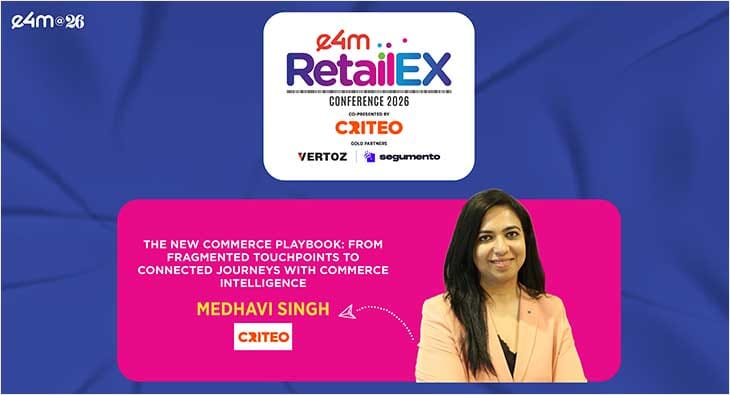

At a time when retail media is witnessing rapid expansion in India, Criteo has launched its first commerce playbook in India, outlining how brands, retailers and platforms must evolve to keep pace with changing consumer journeys and rising demand for measurable outcomes.
Speaking at the unveiling at the e4m RetailEX Conference, Medhavi Singh, Country Head, India, Criteo, positioned the development as part of a broader structural shift underway in the digital advertising ecosystem. She noted that retail media in India, currently valued at approximately $2.8 billion, is expected to grow to over $8 billion by 2030, accounting for nearly 46% of the digital advertising market.
“This is not just an incremental shift, this is a fundamental shift that is happening in the industry where people are migrating and expected to migrate towards more commerce outcomes,” Singh said.
The playbook highlights that the rise of retail media in India has been fuelled by the rapid proliferation of e-commerce and quick commerce platforms, which have reshaped consumer behaviour by enabling frequent online purchases. Platforms such as marketplaces and quick delivery apps have not only accelerated adoption but also generated rich streams of transactional and shopper data, allowing brands to move closer to performance-driven marketing.
However, Singh emphasised that the current definition of retail media remains limited, largely confined to on-platform advertising within retail media networks. According to her, this narrow approach fails to capture the complexity of today’s consumer journey, much of which unfolds beyond retail platforms.
She added, “The majority of the consumer journey today is happening outside retail platforms, which means brands need to expand beyond on-platform advertising and build presence across the open internet to stay relevant.”
A key insight from the report is that consumer discovery and consideration are increasingly happening across multiple touchpoints, including search, social media, content platforms and other digital touchpoints. Research cited in the playbook suggests that 41% of consumers discover new products through ads, but the point of discovery varies widely across channels.
This fragmentation is also reflected in consumer research behaviour. The report notes that up to 95% of users conduct product research partially or entirely outside shopping apps, relying on reviews, videos, feeds and other content formats before making purchase decisions.
For brands, this has significant implications. While conversion timelines are shortening, with 64% of users likely to convert on the same day after seeing an ad, the consideration phase is becoming more complex and distributed. This requires marketers to rethink media strategies, ensuring presence across the entire funnel rather than focusing solely on last-click conversions.
The playbook identifies a critical gap between where consumers are and where brands are currently investing. While a majority of consumer engagement happens off-platform, retail media strategies in India remain heavily skewed towards on-platform advertising. This imbalance is further compounded by the relatively low contribution of advertising revenue to retailer gross merchandise value (GMV), indicating that retail media monetisation is still evolving in India.
From a retailer perspective, the report underscores the need to improve data quality and enable closed-loop measurement at a granular level, including SKU-level insights. These capabilities are increasingly becoming priorities for global retail media networks but are still evolving in India.
At the same time, expansion into off-site media and full-funnel measurement remains a lower priority for many retailers, creating a disconnect between consumer behaviour and platform capabilities.
For brands, the challenges are equally pronounced. The report identifies measurement of outcomes and lack of a unified view across platforms as the two biggest hurdles. Many brands continue to rely on affinity-based targeting, with limited adoption of transaction- or intent-based audience segments, which are critical for effective commerce-driven marketing.
Singh pointed out that brands need to move towards more meaningful and contextual engagement strategies, driven by commerce intelligence and real-time signals.
“Brands need to meet consumers where they actually are in their journey, and ensure that they are delivering engaging, meaningful content at the right time to drive discovery and consideration,” she said.
The playbook also calls for a shift from siloed, channel-led marketing approaches to unified, consumer-centric strategies. This includes leveraging the open internet, integrating data across platforms, and deploying AI for personalisation and optimisation.
With increasing media fragmentation and rising costs, the emphasis is moving towards efficiency and incrementality, rather than traditional return on ad spend (ROAS) metrics alone. The report suggests that AI-led optimisation and unified platforms can help brands achieve scale while maintaining relevance across diverse touchpoints.
Criteo’s playbook positions commerce media as the next phase of digital advertising evolution, where the boundaries between branding, performance and retail media continue to blur. As consumer journeys become increasingly non-linear, the ability to connect signals across channels and deliver consistent experiences will be critical.
The launch marks Criteo’s first dedicated effort to map the Indian commerce media landscape, bringing together perspectives from retailers, brands and consumers. It also signals the company’s intent to play a larger role in shaping how commerce-driven marketing evolves in one of the fastest-growing digital markets globally.
As the report suggests, the future of retail media in India will depend not just on scale, but on how effectively the ecosystem adapts to a more connected, data-driven and consumer-first approach.
The session concluded with Achin Talwar, Head of account strategy at Criteo outlining the need for a more connected and unified approach to commerce media. He emphasised that as consumer journeys become increasingly non-linear, brands must move from siloed, channel-led strategies to audience-first planning across the funnel, leveraging AI-led personalisation, unified platforms and the open internet to drive efficiency and scale.
Read more news about Marketing News, Advertising News, PR and Corporate Communication News, Digital News, People Movement News
For more updates, be socially connected with us onInstagram, LinkedIn, Twitter, Facebook, YouTube & Google News