CTV is no longer linear TV’s extension. It is a demand engine: Lalatendu Das
At e4m Connected TV Conference, Publicis Media’s South Asia CEO Lalatendu Das said CTV’s real opportunity lies in combining data, commerce and AI
 by
by
Published: Jun 12, 2026 9:20 AM | 6 min read
 Follow Us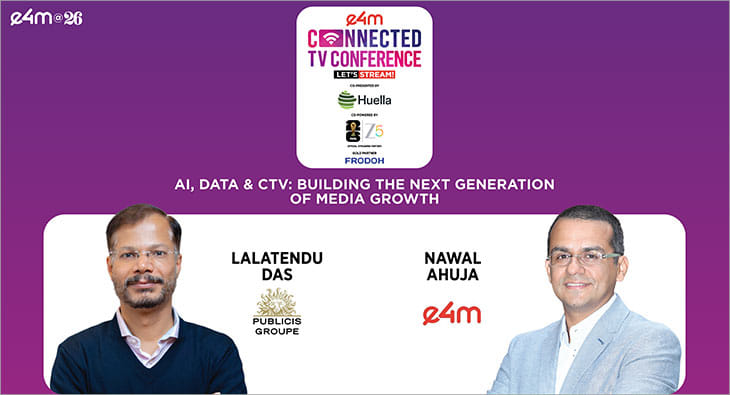

- Connected TV (CTV) is evolving from a digital extension of linear television to a performance-driven, data-rich medium that influences consumer purchasing behavior, as discussed at the e4m Connected TV Conference 2026 in Mumbai.
- Industry experts highlighted the importance of addressability in CTV, allowing brands to target audiences with precision and link awareness directly to purchase actions, moving beyond traditional metrics like reach and impressions.
- The conversation emphasized the role of AI in enhancing CTV advertising through dynamic creative production, enabling campaigns to be tailored based on audience data, geography, and context.
- Concerns were raised about the challenges of data collection and measurement in CTV, with calls for marketers to assess the value of data investments and the complexities of unified measurement across different platforms.
Connected TV is no longer being seen merely as the digital extension of linear television. It is increasingly becoming a performance-led, data-rich and commerce-enabled medium that can influence the consumer journey from awareness to purchase.
That was the central argument that emerged during the fireside chat titled ‘AI, Data & CTV: Building the Next Generation of Media Growth’ at the fourth edition of the e4m Connected TV Conference 2026, held in Mumbai on June 11. The session featured Lalatendu Das, CEO, South Asia, Publicis Media, in conversation with Nawal Ahuja, Co-Founder, exchange4media. The discussion looked beyond the headline growth of CTV and focused on a more urgent question for marketers: how does the medium move from attention to action?
Opening the conversation, Ahuja contextualised the scale of the market, pointing to industry estimates of around 129 million CTV users in India and strong year-on-year growth in connected television audiences. The sharp post-Covid acceleration, he noted, has made CTV one of the most closely watched areas in the media and advertising ecosystem.
Das, however, argued that the industry must move past the idea that CTV is simply linear TV on another screen. “There is one myth in the industry. Many marketers thought CTV is now an extension of linear TV, that we are just moving the same audiences which we were reaching over linear TV. But there is a realization creeping in now that CTV is an entirely different beast,” Das said.
According to him, the real power of CTV lies in addressability. Unlike linear television, which remains largely one-way and non-addressable, CTV allows brands to understand and reach audiences with far greater precision.
“Here you have an extremely powerful tool at your disposal to address an audience one-to-one. Link that CTV with the boom of commerce that is happening today, you cut through the funnel. You can make a user aware, drive consideration and complete the purchase cycle at the same go,” Das shared
Das described CTV as a “big demand generation engine sitting in your customer’s living room,” a framing that captures how the medium is beginning to sit between brand-building and conversion.
Ahuja pointed out that the CTV conversation has shifted significantly over the past 12 to 18 months. Earlier, brands largely asked for incremental reach, impressions and view-through rates. Today, the questions are sharper: what is the incremental sales lift, which geography is responding, and what outcome is being delivered?
Das agreed, saying the market has moved from average reach numbers to more granular accountability. For instance, he said, a state like Uttar Pradesh cannot be treated as one uniform media market. It includes affluent pockets comparable to premium neighbourhoods in Mumbai as well as areas with very different income profiles. The real question, therefore, is not just how many impressions a brand gets, but what lift it sees in a specific target market or pin code.
The discussion also moved to the creative opportunity enabled by AI. Das said CTV advertising should not simply replicate linear TV creative. Since advertisers now know more about the audience, geography, language and need state, campaigns can be contextualised far more effectively.
According to Das, AI is already making dynamic creative production more scalable. Publicis, he said, is using tools that can deconstruct master creatives into multiple layers — background, product image, copy, language, ambassador, speech and other elements — and generate different renditions depending on audience signals, time of day, geography and targeting needs.
“The good news is it is here. It is now mainstream,” Das said, adding that Publicis is testing such capabilities across static images and short video formats. “The average rendition for these assets is 3.9 seconds,” he noted.
On Data “Obesity”
On data and measurement, Das offered a more cautious view. While first-party data has become a major industry talking point, he said its usefulness varies sharply by category. For BFSI, internet companies or high-value D2C brands, first-party data may make strategic sense. But for FMCG brands selling low average-order-value products, the economics may not always justify the cost, complexity and compliance risk.
He described the industry’s rush to collect data as “data obesity,” warning that weak or unstructured data can quickly become a “garbage in, garbage out” problem. With DPDP compliance and consent management becoming more critical, marketers, he argued, must ask whether the return justifies the investment.
On unified measurement
On unified measurement of CTV, Das was blunt. “If somebody is saying I have a unified measurement, they are probably lying. Watch your pockets,” he said, underlining the continuing difficulty of measuring audiences and outcomes across walled gardens and screens.
The conversation also explored retail media’s growing relationship with CTV. Das said retail media data can help determine who to reach on CTV and what message to show. More importantly, it can help close the loop by linking exposure to actual purchase behaviour, both online and, in some cases, through offline retail data partnerships.
For Das, the larger shift is clear: CEOs and CFOs are increasingly asking what value media spends are delivering. CTV, when combined with commerce data, retail media and AI-led creative, has the potential to answer that question more sharply than traditional broadcast models.
The session also touched on linear TV’s future. Das said linear television remains relevant, particularly for live sports and large-scale brand launches, because different screens command different levels of attention. Linear TV, he said, still has a strong attention index in certain contexts.
On AI’s impact on agencies
On AI’s broader impact on agencies, Das said the conversation has matured from efficiency alone to effectiveness. At Publicis, he said, AI is being used in structured workflows across planning and operations, but also through everyday adoption by media practitioners. He referred to an internal initiative called “25th Hour,” aimed at helping teams use AI to save time and solve daily work problems.
The larger message from the session was clear. CTV’s next phase will not be defined only by audience growth. It will be defined by whether advertisers can use the medium to combine reach, personalisation, commerce, measurement and AI-driven creative at scale.
As Das framed it, CTV is no longer just a bigger screen for digital video. It is becoming a new engine for demand, sitting at the intersection of television, data and commerce.
Read more news about Digital Media, Internet Advertising, Marketing News, Television Media, Radio Media
For more updates, be socially connected with us onInstagram, LinkedIn, Twitter, Facebook, YouTube & Google News