The living room is the new performance engine: EY’s Raghav Anand on India's CTV horizon
From gaming hubs and retail media to IoT homes and creator studios, EY-Parthenon's Raghav Anand laid out why the television screen is rapidly becoming the most powerful commercial real estate in India
 by
by
Published: Jun 11, 2026 4:15 PM | 5 min read
 Follow Us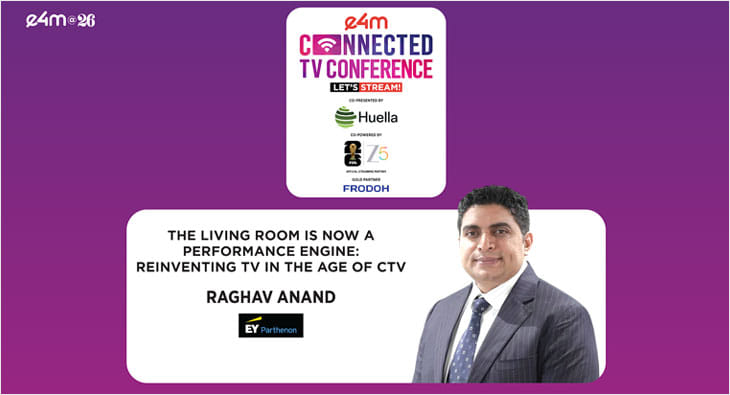

- Raghav Anand of EY-Parthenon highlighted the significant impact of connected television (CTV) on advertising, retail, gaming, and home management during the e4m Connected TV Conference 2026, noting that digital media will surpass ₹1,10,000 crore in India's media market by 2025.
- Currently, 63% of advertising spending in India is digital, with CTV driving a substantial portion of the ₹148 billion video segment, and projections indicate over 120 million households will have CTV access in the next couple of years.
- Anand emphasized the global trend of CTV, citing the U.S. where CTV commitments have surpassed prime-time linear television, and noted Samsung's role as a leading broadcast channel aggregator with over 4,300 channels.
- He identified key priorities for India's CTV landscape, including audience intelligence, FAST channel monetization, and the integration of commerce in advertising, while also stressing the importance of capturing the living room as a central hub for content and consumer engagement.
The transformation of the connected television screen is so sweeping that it is reshaping the economics of advertising, retail, gaming, and home management simultaneously. That was the central argument made by Raghav Anand, Managing Director, Partner, and Leader for Media and Entertainment at EY-Parthenon, during his spotlight session at the e4m Connected TV Conference 2026, where he delivered a data-driven, globally informed outlook on the future of CTV in India over the next four years.
Anand opened with a number that set the tone for everything that followed. In 2025, digital media crossed the inflection point to become the largest segment of India's overall media and entertainment market, surpassing ₹1,10,000 crore. More critically, 63% of every advertising rupee spent in India is now digital. "No longer are the days when we used to say digital is also contributing. It is 10, 20% of the budget," he said. "Today, it is, in fact, leading what we are doing."
Within that digital universe, video commands ₹148 billion, with CTV as a decisive driver. India currently counts more than 68 million monthly active CTV users clocking 170 minutes of average daily watch time, numbers Anand noted have grown further in 2026. Projections indicate that over 120 million households will have active CTV access in the next year or two, translating to more than 180 million viewers.
The session's real weight, however, came from global signals. In the United States, where streaming now accounts for close to 50% of all TV viewing, Anand pointed to sports as the catalyst, with live NFL on Netflix driving a structural shift that India should read carefully. But it was his observation on Samsung that drew the sharpest attention. "Never did we think that a TV manufacturer would be the largest broadcast channel aggregator," he said, describing how Samsung now operates over 4,300 channels with 100 million active users across 30 countries. India is just beginning to see FAST channel growth, with 200-plus channels currently in play. "The way an OEM manufacturer is going to grow out that entire product and become the dominant broadcaster is very interesting," he noted.
The US upfronts for 2026 delivered another telling signal: for the first time, CTV commitments exceeded those on prime-time linear television. "That is what you will see in India in the next two to three years," Anand said.
He then turned to two forces he described as less discussed but rapidly converging: retail media and gaming. Having recently returned from the UK, he described the logic behind Walmart's acquisition of TV maker Vizio with precision. "You're watching on a CTV, you're buying in a shop. Integrate that entire data." Retail media on CTV is on track to double to approximately $9 billion by 2029. On gaming, Anand described the traditional console barrier as dissolving. "Samsung Gaming Hub with 3,000 titles. You just need a controller and you can start playing. So suddenly your CTV screen becomes your console." He added that global gaming publishers who had long ignored India are now actively recalibrating. "India can become a huge market," he said, pointing to cloud subscriptions and rising CTV penetration as the twin enablers.
On IoT and the smart home, Anand described the CTV screen as the emerging command centre of everyday life, with Samsung SmartThings already counting 430 million users globally and managing everything from cameras to locks. "Everything in the West is starting to get controlled," he said, flagging Japan and Korea as particularly advanced markets on this front.
He reserved some of his most pointed observations for the creator economy, reframing the conversation entirely. "Previously, the whole pitch was that anybody can become a creator. Today, the pitch is that any creator can become a studio." With YouTube now the biggest network in the United States and creator content sitting alongside broadcast content on the living room screen, he argued that "the line between what is a traditional channel, what is a fast channel, and what is a creator channel on your TV in your living room is also getting very blurred."
For India specifically, Anand identified ACR-powered audience intelligence, FAST channel monetisation, commerce-integrated advertising, and full-funnel attribution as the defining priorities of the next 12 months. He also flagged the ₹30,000 crore SME advertising pool, currently concentrated on Meta and Google, as a significant opportunity for CTV to unlock. "Once CTV comes in, the ability of other people to access that becomes tremendous," he said.
He was equally direct about what the competitive landscape ahead would look like. "If you thought OTT was a foreplay battleground between telcos and content, this is going to be an 8 to 10 segment battle, with retail guys, gaming guys, and all of that coming in."
He closed with a question directed squarely at the marketers and content creators in the room. "Are you just doing it for the handset or for the household? How do you actually not capture just the screen, but capture the living room? That is going to be one of the most important questions." The living room, he concluded, is where India gathers. And it is fast becoming the country's most consequential performance engine.
Read more news about Digital Media, Internet Advertising, Marketing News, Television Media, Radio Media
For more updates, be socially connected with us onInstagram, LinkedIn, Twitter, Facebook, YouTube & Google News