Infra-led OOH pushes brands beyond visibility to attention & precision
For the OOH advertising industry, India's infrastructure boom spanning metros, airports, and expressways represents a shift in how brands reach, engage, and hold the attention of consumers
 by
by
Published: Apr 23, 2026 7:39 PM | 11 min read
 Follow Us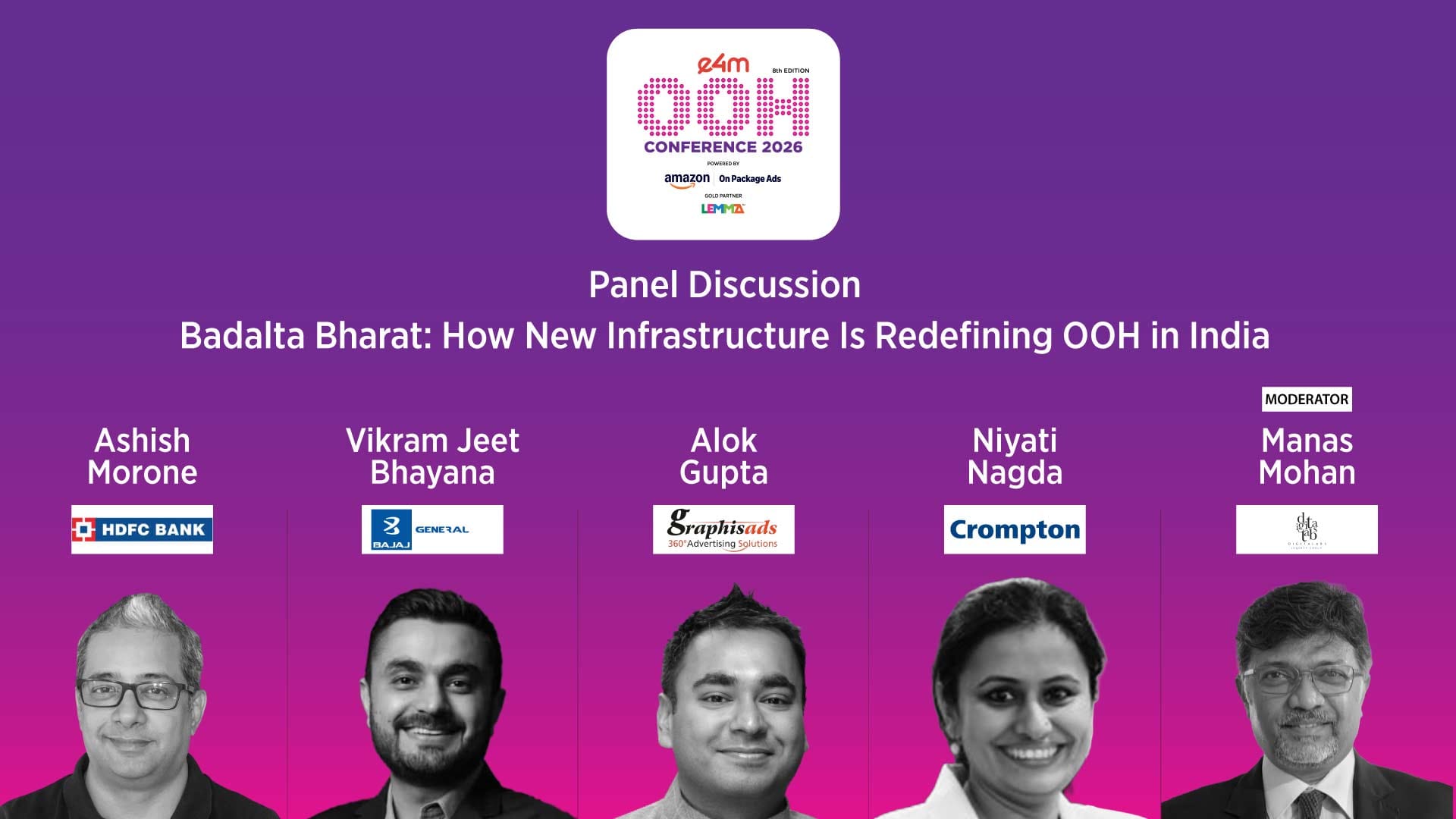

- A panel at the e4m OOH Conference 2026 discussed the transformative impact of new infrastructure on the Out-of-Home (OOH) advertising landscape in India, highlighting both opportunities and challenges for brands.
- Key insights included the growing potential for sharper targeting and experience-led OOH, but panelists emphasized the need for scalability and effective measurement to maximize impact.
- The discussion underscored the shift of OOH from a supplementary medium to a primary channel, particularly in high-dwell environments like airports and metro stations, where brands can engage consumers more effectively.
- Concerns about civic responsibility and urban aesthetics were raised, with calls for accountability in OOH practices to ensure safety and minimize visual clutter in urban spaces.
At the e4m OOH Conference 2026, a panel of senior marketers and industry leaders came together to examine how this transformation is reshaping the OOH landscape and what it means for the brands investing in it.
Moderated by Manas Mohan, Chief Data & Digital Officer, Laqshya Media Limited and CEO, Laqshya Digitalabs, the session titled "Badalta Bharat: How New Infrastructure Is Redefining OOH in India" featured insights from Ashish Morone, EVP & Head – Brand, Marketing Communications, HDFC Bank; Alok Gupta, Director, Graphisads Limited; Niyati Nagda, GM – Marketing, Crompton Greaves Consumer Electricals; and Pulak Sarmah, Head – Corporate Marketing & Brand, Sun Pharma.
Opening the discussion, Morone acknowledged the medium's growing potential but tempered enthusiasm with a note of pragmatism. "I think it's going to play a large role. We've already seen some offshoots in terms of the ability to do much sharper targeting and do interesting work in terms of experience-led OOH, or even being able to interact with consumers," he said.
However, he was quick to add that scale remained the central challenge. "The challenge for all of us is going to be how we scale this up to the extent that it makes a huge impact for a brand."
Gupta offered an expansive view of the infrastructure opportunity, framing it as a watershed moment for the industry. "If you look at the infrastructure growth that has happened in this country, it's not only about roads but rails, airports, metros and so on," he said.
For media owners, this formalisation of infrastructure has brought with it a formalisation of OOH. "All these authorities want good players to work with them. If you look at metro station branding alone, out-of-home is a substantial part of their business plan." He cited Delhi Metro as an example, noting that OOH revenues for the network run to approximately ₹250–300 crore per annum. With over 150 Vande Bharat trains each generating upwards of ₹1–1.5 crore annually from advertising, he said, the incremental opportunity was simply too significant to overlook.
The question of how reach and frequency factor into OOH planning drew one of the session's more animated exchanges. Nagda challenged the long-held perception of OOH as a frequency-building add-on to mainline media. "Think about how many of us really engage with content on our phones. You're literally just waiting for the skip button to get activated," she said. "But when you are captive in an airport, you are unlikely to miss what's being projected around you."
She pointed to the Fevicol-branded Marol metro station as a case in point. "I don't think, when I was travelling today, it was very hard for me to miss it." With dwell times at metros and airports stretching to 20 minutes or more, OOH had decisively moved from a supplementary medium to an active one. "It's no longer just being looked at as an incremental addition to my mainline media plan to build frequency, but also to get the serious attention of people."
Building on this, Morone pointed to emerging data that was beginning to add rigour to OOH planning. "There is data now that tells us which hoarding, at what height, at what angle, is being seen more by a commuter in a car," he said.
Beyond vehicle-based audiences, pedestrian exposure on key routes is increasingly being captured and analysed. "The definition has changed from standing on the street versus sitting in a car, which hoarding is visible to which cohort." This granularity is giving brands the confidence to make OOH an integral part of their plans rather than a peripheral one.
Sarmah, drawing on over two decades of OOH buying, echoed the shift. "OOH has been very complementary to the mainstay communication we do across mediums, and it really helps you build reach very fast. Unlike television, where activating a plan to reach an optimum audience level takes at least a week, OOH is instant visibility."
He added that the infrastructure-led boom had introduced a precision-targeting dimension that was previously unavailable. "If I am looking at frequency building, it is the metro stations and trains that do it for me.
When the conversation turned to experimentation and innovation, the panel was united on the principle that innovation must serve the brand's purpose, not the other way around.
This was illustrated with a series of examples by Morone. "There's a classic, timeless one that all of us still notice every time we travel to Pune and that’s the huge Jeep cutout. Innovation in the relevant place, for the right audience, makes a lot of sense."
He also recalled a car brand's activation at an airport conveyor belt, where the vehicle's rear was positioned to highlight boot space. "Relevant, meaningful, and an amazing use of a new OOH property," he said.
A third example, Asian Paints using an entire community of buildings to showcase their colour range, rounded out his point.
"Just because something innovative is out there, if my brand story doesn't fit the narrative, there's no point in doing it." He cautioned that this responsibility lay equally with those creating these spaces. "They have to be mindful that the innovation gets used in the right manner. Otherwise, it's just innovation for the sake of innovation, and I don't think that has a good, strong, happy future."
Nagda reinforced this with another reference. "Amul has been so contextual. You can't name a recent event that they won't have a billboard for," she said. "It's not just about doing fancy stuff on a billboard, but about getting the right message that resonates with your audience. We need to step back and ask what this is going to do for my brand. Is it just going to get me additional PR mileage, or is it really contextual to the needs of my consumer?"
Taking a broader industry view, Nagda argued that the very transformation of infrastructure into experiential zones was itself a form of innovation. "If you go to any airport today, you'll see so much experiential play by so many brands and that's where innovation is coming up in a big way. Also, if you go to any city with a decent metro presence, there's just a melange of colours across those stations." He pointed to brands like Fevicol and Muthoot Finance as examples of hyperlocal brand targeting at scale. "From a marketer's perspective, it's adding a lot of value to OOH. A consumer is no longer looking at plain colours in an infrastructure but they're looking at brand colours."
Sarmah recalled a particularly ambitious activation from his banking days. It was a real-time billboard integration where users could SMS a number and have their message displayed live on the hoarding. "It was monsoon in July in Bombay and there were electric sparks flying all around," he said, to laughter. "So we need to be practical at times as well."
As the panel explored the reach of infrastructure-led OOH, Nagda offered a perspective that cut against the metro-centric narrative. Operating across residential and agricultural pump categories, Crompton Greaves had found significant business impact through wall paintings deep in markets like Jharkhand and Bihar. "I don't think it's about doing that one innovative site and getting some PR mileage. There is so much more in being able to use inventory at scale and really driving business numbers. It's working equally well even in rural markets," she said.
Morone returned to his recurring theme of scale, but with a nuance. For HDFC Bank's 'Festive Treats' property, a month-long campaign built around the festival season, precision OOH targeting across key malls and marketplaces had delivered strong business outcomes even in the absence of television.
But he was candid about where the ceiling lay. "The moment I think of scaling up innovation, it stops. So it's good for very specific products and very specific niche audiences." He did, however, see a democratising effect at play. "It is helping democratise a large-scale, large-impact medium to a whole lot more marketers. You do not need big budgets to do precision targeting for a business segment you're targeting."
On measurability, Sarmah pointed to a gap that remained unaddressed. "From a measurability perspective, make it more measurable for brands. Mumbai is a different scenario, but if I was to invest in a place like Guwahati, I need to be sure it is monitored and measured well. Those things are still not happening in tier-two or tier-three locations."
Next, the panel's discussion of airports revealed both the medium's promise and the structural constraints holding it back. For Morone, the fit was clear in specific product categories. "We have credit cards that are suited for international or domestic travel. Airports are the first port of call for us when we want to communicate about those products." He confirmed the logic extended beyond the top metros. "If I'm talking about a domestic travel card, I will take it across the country. If it is more to do with international benefits, then we’ll be wherever the international traffic is."
Nagda framed airports as integral to Crompton's premiumisation journey. "We're on an active journey to reach the premium cohort, because home décor appliances have become so integral to how people spend their time."
She noted that tier-two and tier-three airports had opened up meaningfully. With India expected to see close to 400–450 million passengers annually, airport inventory had become a premium targeting imperative.
Challenging the assumption that airports were exclusively premium environments, Gupta said, "If you go to Delhi airport today, it's like a railway station in terms of footfall." The democratisation of air travel had not been matched by a democratisation of airport advertising formats. "Airports today are restricted to a bigger set of clients with deep pockets. The opportunities that existed earlier, smaller panels, lower-cost formats, have largely vanished.” Airport business could be doubled if authorities and media owners came together to devise solutions that brought in more clients.
Sarmah agreed on the breadth of formats available, noting that activations in airport gardens and other non-display spaces offered brand possibilities beyond conventional billboards. He also flagged the need for greater standardisation. "Different players involved in airport media selling use inventory differently. There should be some standardisation otherwise it becomes too overwhelming to see brands all over the airport."
No discussion of India's OOH boom is complete without addressing its flip side, i.e. the tension between commercial expansion and civic responsibility. Nagda invoked a sobering incident from the previous year in Mumbai, an outdoor accident that resulted in loss of life, to make the case for greater accountability. "We can't have stuff splattered on every building surface and every skyline. The onus lies on suppliers to ensure the right safety standards are being met, because brands are going to keep asking for more," she said.
Sarmah noted that brand consciousness on this front was improving. "A lot of brands have moved to the eco-solvent variant of printing rather than regular formats. There has to be that kind of accountability."
Gupta pushed back on the notion that OOH was antithetical to urban aesthetics. "Out-of-home will always be a PPP play. We are a part of infrastructure growth. A proper, well-laid-out OOH plan actually adds a lot of vibrancy to a city. If you look at bus shelters and the public utilities that have been created, I don't think any other media can match that." He pointed to the Swachh Bharat Mission as an example of OOH players building and managing public utilities through revenue-surplus models.
Morone acknowledged the grey areas but argued for a more intelligent approach rather than a restrictive one. "There are some spaces which are intrusive. LED hoardings with moving content can distract drivers." He suggested that brands and media owners alike needed to make conscious decisions about placement.
He made the affirmative case for dwell-based environments as a natural solution. "With metros and airports, the audience isn't doing much else so they are a much better way to engage."
The session closed with a consensus that India's infrastructure boom has handed the OOH industry a rare and consequential opportunity. The medium is now an active, data-rich, engagement-capable channel. But realising that potential demands more than infrastructure investment. It requires scale in innovation, rigour in measurement, responsibility in execution, and above all, an unflinching focus on what the medium can genuinely deliver for the brand.
Read more news about Out of Home, Internet Advertising, Marketing, Digital Media, TV Media
For more updates, be socially connected with us onInstagram, LinkedIn, Twitter, Facebook, YouTube & Google News