Sam Balsara shares eight-point agenda for OOH's growth
Sam Balsara, Chairman of Madison World, delivered a data-driven valedictory address at the e4m OOH Conference 2026, laying out a frank diagnosis and a concrete roadmap for the medium
 by
by
Published: Apr 22, 2026 6:12 PM | 5 min read
 Follow Us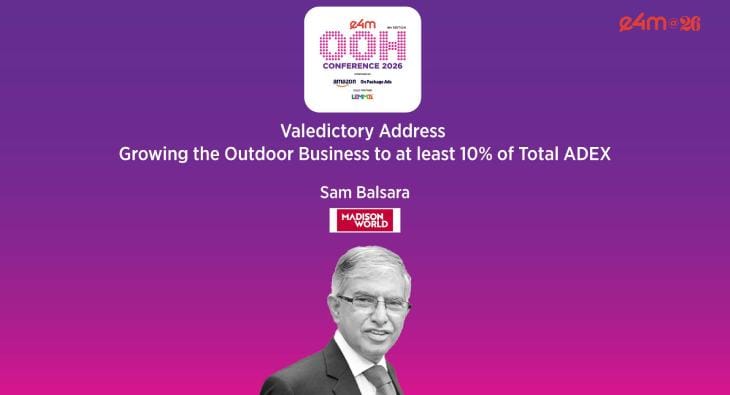

- Sam Balsara, Chairman of Madison World, delivered a candid valedictory address at the e4m OOH Conference, highlighting the stagnant global OOH advertising share of 5% and a decline in India's OOH share from 4.3% in 2024 to an expected 2.9% in 2026.
- He proposed eight actionable suggestions to enhance the OOH sector, including expanding the advertiser base, leveraging testimonials from marketing professionals, improving creative quality, and reintegrating media planners into the outdoor advertising conversation.
- Balsara emphasized the potential of digital OOH to attract luxury brands and advocated for the use of technology to enhance the medium's effectiveness and consumer engagement.
- He called for a dedicated quarterly advertiser forum and urged the industry to learn from successful OOH markets in countries like Japan, France, and Australia to increase its share of advertising expenditure in India.
Sam Balsara, Chairman of Madison World, has rarely been one to dress up inconvenient truths in comfortable language. At his valedictory address at the 15th edition of the e4m OOH Conference, he offered the assembled industry a characteristically unvarnished picture of where OOH stands, followed by eight concrete suggestions for where it must go.
The numbers he opened with were sobering. Globally, OOH accounts for just 5% of total advertising expenditure; a figure that has held stubbornly flat over the last five years. Digital, by contrast, commanded 79% of global adex in 2025 and is projected to reach 81% in 2026. In India, OOH's share fell from 4.3% in 2024 to 3.1% in 2025 and is expected to slide further to 2.9% in 2026.
"Imagine all other mediums which have been strong at one time or the other — TV, print, radio, cinema — collectively contribute only 19% to overall adex," he said, framing the scale of digital's dominance in stark relief. Even the silver lining needed careful handling. "Some of us can take the view that we are doing well, it's growing well, so let's not worry so much," he acknowledged, before adding, "The honest truth is that from an advertiser's point of view, all media are the same, and money can easily flow from one to the other."
His first suggestion addressed the alarming thinness of outdoor's advertiser base. While digital boasts 10 lakh advertisers and print 1.73 lakh, OOH has only around 1,100 regular advertisers. Balsara called for a rigorous, category-by-category body of knowledge, identifying where outdoor works, why it works, and where it does not, to be used in crafting attractive entry-level proposals for categories that have never tried the medium.
"By way of proof, I dare say we currently do not have too much of it except quite a few anecdotal stories," he said, proposing that the IOAA create a dedicated fund, pooled from a 2-3% contribution from agencies and media owners, to drive this effort in a sustained and scientific manner.
His second suggestion was to enlist the industry's believers. "We know there are some respected marketing professionals who are prominent in our world of marketing and who like outdoor - or should I say even love outdoor," Balsara said, calling for testimonials from such figures to be displayed on vacant hoarding sites.
He cited Madhur Pandey, VP Marketing at Palay Agro, as one such voice, an advertiser who allocates 20% of his media budget to outdoor during peak season and is willing to publicly vouch for its ROI. "Imagine the power of this statement coming from a genuine advertiser who is vouching for outdoor," Balsara said. "I am sure he will be happy if he sees his photo splashed on an outdoor hoarding."
On creative quality, his third pointer, Balsara was characteristically direct. "It is no secret that creative agency people do not focus their attention on outdoor creative. Creative reputations are built on TV films and now digital," he said. His prescription: no more than five to six words, one dominant visual, flat bold colours, and three distinct creative versions calibrated to sites with long, mid, and close visibility ranges.
He reserved particular impatience for overcrowded hoardings. "I see many hoardings cramped with too much information. This is the most common and I believe it does the biggest disservice to the medium," he said, urging both agencies and media owners to counsel advertisers against it in their own self-interest.
His fourth suggestion was to bring the media planner at the mainline agency back into the outdoor conversation. "It should not be left to the client to provide a separate allocation for outdoor when he receives the media plan," Balsara warned, calling for outdoor agencies to regularly update planners with handbooks on available formats, costs, sizes, and innovation possibilities, so that outdoor finds its way into the master media allocation rather than being bolted on as an afterthought.
The fifth pointer was about using the rise of digital OOH as a lever to open up an entirely new category of advertisers. "We should use this data to open up a new category of luxury goods, like luxury cars, perfumes, cosmetics, and fashion, to bring them into the outdoor market and see for themselves what sophistication we can offer," Balsara said, arguing that DOOH now has the creative and technical capability to genuinely serve the demands of premium brands.
Technology formed the core of his sixth suggestion. "It is quite amazing to see what technology can do when applied to outdoor," he said, acknowledging the cost barrier while remaining optimistic. "Hopefully the results will take care of that additional cost." He urged the industry to seize every opportunity to layer technology onto the medium to lift its power and consumer attention.
His seventh suggestion was a dedicated quarterly advertiser forum to keep outdoor front-of-mind. He did not shy away from pointing out the irony of the occasion itself. "I was very happy to see the advertisers in the session before me, but the honest truth is that they are from very few categories and not the high-paying categories. We didn't see FMCG, we didn't see so many other high-spending categories on the floor here just now," he said, making the case that such a forum needed to be a regular, not occasional, affair.
His eighth and final suggestion was to look outward: to study markets like Japan, France, and Australia, where OOH commands 10%, 8%, and 7% of adex respectively. "Surely they don't have just 1,000 advertisers," he remarked, calling on the industry to understand what structural, commercial, or creative conditions had allowed outdoor to claim a meaningfully larger share in those markets, and to bring those lessons back to India.
"Even if a few of my eight suggestions are implemented," Balsara concluded, "we will see a dramatic difference in our growth rates." From a man who has spent decades watching budgets flow past outdoor without stopping, it was as much a challenge to the industry as it was a benediction.
Read more news about Out of Home, Internet Advertising, Marketing, Digital Media, TV Media
For more updates, be socially connected with us onInstagram, LinkedIn, Twitter, Facebook, YouTube & Google News