Tata Realty’s Sarthak Seth on how real estate is turning OOH into storytelling
Tata Realty and Infrastructure Limited's Sarthak Seth highlights that integrated OOH allows brands to leverage audience data, map traffic patterns, and retarget potential buyers more effectively
 by
by
Published: Apr 24, 2026 9:01 AM | 3 min read
 Follow Us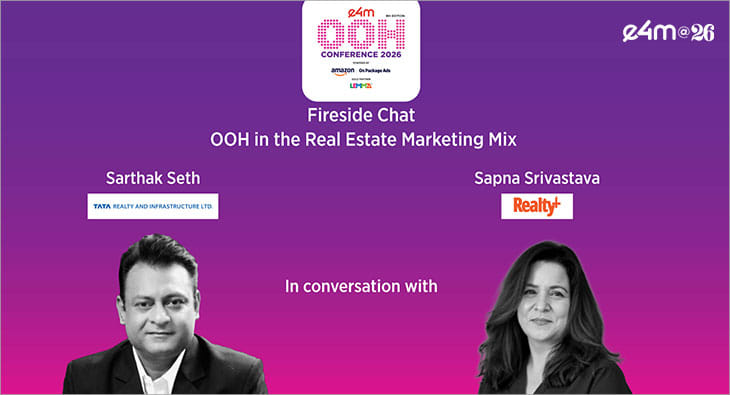

- At the Neon OOH Summit, Sarthak Seth from Tata Realty discussed the evolving role of out-of-home (OOH) advertising in the real estate sector, emphasizing its importance beyond traditional awareness metrics.
- Seth highlighted that real estate campaigns are long-term, often spanning three to four years, focusing on hyperlocal dominance and continuous engagement with consumers to build familiarity and trust.
- The integration of digital capabilities in OOH is enhancing its effectiveness, allowing for audience data collection and performance measurement, while traditional billboards remain vital for brand building.
- Looking ahead, key trends in OOH for real estate include deeper data integration, immersive advertising formats, and sustainability initiatives, indicating a shift towards more strategic and environmentally conscious marketing approaches.
At the Neon OOH Summit, a fireside chat featuring Sarthak Seth, Senior Vice President and Chief Sales and Marketing Officer at Tata Realty and Infrastructure Limited, offered a sharp lens into how out of home advertising is evolving within the real estate sector. In conversation with Sapna Srivastava, Editor at Realty Plus, Sethh unpacked why OOH in real estate goes far beyond traditional awareness metrics.
A medium built for the long term
Unlike FMCG or retail categories where campaigns are short and tactical, real estate operates within tightly defined micromarkets. Seth noted that nearly 60 to 70 percent of inventory is sold within a 5 to 7 kilometre radius, making hyperlocal dominance critical.
This fundamentally changes how OOH is deployed. Instead of burst campaigns, developers commit to sites over the full lifecycle of a project, often spanning three to four years. Over time, these sites become landmarks that consumers repeatedly engage with, building familiarity and trust.
Communication evolves across stages such as pre launch, launch and sustained visibility, ensuring the brand remains relevant without becoming repetitive. The objective is not just visibility but continuity, where consumers grow with the project and its story.
From awareness to credibility and storytelling
For a high involvement category like real estate, OOH plays a crucial role in building credibility. Sustained presence signals permanence and reliability, both key factors in influencing purchase decisions.
Seth highlighted that OOH becomes a storytelling canvas, where brands can showcase project evolution over months and years. Rather than a single static message, creatives are refreshed frequently to reflect new developments while maintaining a consistent identity.
He also emphasised simplicity in execution. With only a few seconds to capture attention, messaging must be concise and impactful. “Less is more” becomes especially relevant, with short, clear communication driving stronger recall.
Digital integration and measurable impact
The integration of digital capabilities into OOH is reshaping its effectiveness. Seth pointed out that integrated OOH allows brands to gather audience data, understand traffic patterns and retarget potential buyers.
This has made the medium more measurable and performance driven, contributing not just to awareness but also to site visits and conversions. At the same time, creative innovation such as anamorphic displays is helping brands bring projects to life in visually compelling ways.
Despite the rise of digital screens, Sethh maintained that traditional billboards continue to play a strong role in brand building, while digital formats are better suited for lead generation and performance outcomes.
He also cited Mumbai as one of the most effective markets for real estate OOH, given its scale and visibility.
Future focus on immersion, data and sustainability
Looking ahead, Seth identified three key trends shaping the future of OOH in real estate.
The first is deeper data integration, with more advanced dashboards enabling better decision making and campaign optimisation. The second is the rise of immersive formats that enhance engagement and bring projects closer to reality for consumers.
The third is sustainability. Seth pointed to the potential for greener OOH solutions, from solar powered billboards to innovations that could contribute to reducing pollution, indicating that environmental considerations will become increasingly important.
Summing up the future in one word, he described it as immersive. As OOH continues to blend storytelling, technology and data, its role in real estate marketing is set to become even more integral.
Closing the session, Srivastava noted that OOH in real estate has moved beyond mass visibility to become a strategic tool for building credibility, context and long term brand equity.
Read more news about Out of Home, Internet Advertising, Marketing, Digital Media, TV Media
For more updates, be socially connected with us onInstagram, LinkedIn, Twitter, Facebook, YouTube & Google News