We should really stop treating CTV like digital media: Ashwin Padmanabhan
At the e4m CTV Conference 2026 in Mumbai, Ashwin Padmanabhan, COO, WPP Media, delved into the evolution of connected television, how we need to approach CTV differently and more
 by
by
Published: Jun 12, 2026 9:41 AM | 7 min read
 Follow Us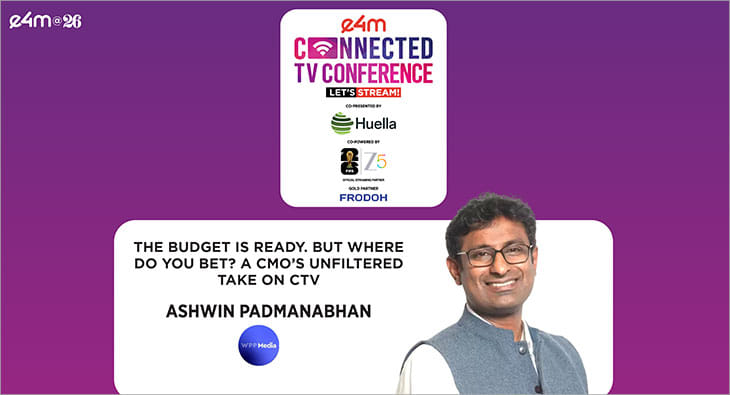

- Ashwin Padmanabhan, COO of WPP Media, emphasized at the e4m CTV Conference 2026 that Connected TV (CTV) is transitioning into a crucial segment of India's television advertising landscape, requiring a distinct approach that merges traditional TV strengths with digital capabilities.
- He projected that CTV could account for approximately ₹7,800 crore, or 18%, of India's total television advertising spend, highlighting the need for brands to adapt their strategies to navigate the fragmented CTV ecosystem effectively.
- Padmanabhan warned against treating CTV merely as digital media or linear television, advocating for a unique perspective that leverages CTV's combination of trust, engagement, and advanced targeting enabled by internet distribution.
- With around 60 million CTV households in India, driven by affordable data and smart TV adoption, Padmanabhan noted that the growth of ad-supported OTT platforms is expanding advertising opportunities, signaling a significant evolution in television consumption.
Connected TV (CTV) is moving from being an emerging opportunity to becoming a significant part of India’s television advertising ecosystem, said Ashwin Padmanabhan, COO of WPP Media, at the e4m CTV Conference 2026 held in Mumbai.
Sharing his perspective on the evolution of connected television, Padmanabhan said the industry needs to stop looking at CTV through the traditional lens of either digital media or linear television.
“CTV is where TV meets digital, but it’s not digital the way we have traditionally planned for digital,” he said.
According to him, CTV requires a different approach because it combines the strengths of television, including trust, attention and engagement, with the capabilities enabled by internet-based distribution.
“We shouldn’t ever make the mistake of thinking of CTV the same way you plan on mobile or any other form of digital environment,” he said.
At the same time, he cautioned against treating CTV as just another form of linear television.
“It has linear TV advantages with digital distribution advantages.”
CTV could account for ₹7,800 crore of India’s television advertising spends
Padmanabhan highlighted the growing scale of connected television in India, saying that CTV is reaching a point where it is becoming increasingly viable for brands to plan and invest.
Globally, connected TV is forecast to account for around 39% of total television spends by 2027, according to the numbers he shared.
In India, he said CTV is expected to contribute around 18% of total television advertising investment.
He estimated that out of approximately ₹43,000 crore of television advertising spends, around ₹7,800 crore could move towards CTV.
“18% is a significant number, but we still have a lot to catch up,” he said, adding that he believes the industry will continue to see strong growth over the next 18 months.
The challenge: Building audiences across fragmented CTV environments
While the opportunity is large, Padmanabhan said the biggest challenge before marketers is fragmentation.
The CTV ecosystem today consists of multiple environments, including premium OTT platforms, FAST ecosystems promoted by OEMs such as Samsung, LG and Xiaomi, YouTube on connected screens, and addressable linear television through telecom and distribution platforms.
For marketers, the challenge is no longer just reaching audiences, but understanding how audiences move across these different environments.
“How do I actually make extensive audiences across all these siloed environments? How do I measure them? How do I plan for them?” he asked.
He also highlighted that measurement continues to remain fragmented, with no common currency yet available across the ecosystem.
According to him, brands need to solve questions around frequency management and ensure they are not repeatedly reaching the same consumers.
“Am I wasting my money on talking to an audience 15 times instead of talking to 10 audiences probably three times?” he asked.
‘Treating CTV like digital media would be criminal’
Padmanabhan said one of the biggest mistakes marketers could make is approaching CTV exactly like digital media.
“We believe we should really stop treating CTV like digital media,” he said.
According to him, CTV should also not be treated exactly like traditional television because it brings additional capabilities through internet-based distribution.
The opportunity lies in understanding the unique combination of television’s impact and digital technology’s ability to enable targeting, personalisation and measurement.
CTV gives television a new lease of life
Calling the subject close to his heart, Padmanabhan recalled that WPP Media, earlier known as GroupM, began preparing for the CTV opportunity even before COVID.
“We felt that the way CTV is going to evolve, we will need to be at the frontier of changes that we need to bring to the industry,” he said.
He said the company started developing planning frameworks around CTV in mid-2018, with the objective of understanding how brands could effectively invest in the changing television landscape.
According to him, CTV should not be viewed as something separate from television, but as the latest stage in television’s four-decade evolution.
“CTV is not different from TV. We’re still consuming all of this content on TV.”
From terrestrial broadcasting to cable, satellite, DTH and now OTT, television has continuously evolved, he said.
“The TV that we knew 10 years back is different from the TV that we knew 40 years back. TV has evolved and continues to evolve.”
Television continues to win on trust, engagement and attention
Despite the growth of digital screens, Padmanabhan said television continues to maintain its strength because of the trust and engagement it has created over decades.
He referred to a study conducted across AMEA, Southeast Asia and Japan, which showed that consumers remember television advertisements better compared with advertisements viewed on mobile, desktop or tablets.
“The preferred screen for watching video content continues to be television,” he said.
The study found that 65% of respondents preferred television for consuming high-quality content.
According to Padmanabhan, even when the same content is available across multiple screens, television continues to deliver a stronger impact.
“The impact that it leaves on the audience is significantly higher when it is consumed on television.”
From scheduled television to on-demand experiences
Padmanabhan said the biggest change in television consumption has been the move from scheduled viewing to on-demand consumption.
Consumers today have control over what they want to watch, where they want to watch it and when they want to watch it.
For advertisers, this shift has created opportunities that were not possible earlier, including targeting and personalisation.
“With all of the technology that is getting added because of the way we consume TV today, it is going to supercharge TV,” he said.
He rejected the idea that television is becoming irrelevant.
“TV is never going to die. It’s just the way we consume TV is dying and the way we plan for TV and the way we invest in TV is going to change.”
India’s 60 million CTV households signal a turning point
Padmanabhan said India is already witnessing a major shift in television consumption, with CTV households estimated at around 60 million.
He pointed out that this number is higher than the DTH subscriber base, which he cited at approximately 50.9 million households as of December 2025.
“Television has one more mode of distribution and with this mode of distribution through the Internet, television has found a new lease of life.”
He attributed this growth to affordable data, increasing broadband penetration and the replacement of traditional television sets with smart TVs.
“Almost every single 9 out of 10 TVs sold today in India are smart TVs,” he said.
OTT advertising opportunity expands as platforms embrace ads
Padmanabhan said the growth of OTT platforms is creating greater opportunities for brands as advertising-supported models expand.
He noted that today, barring Netflix, which he expects will also make the move in India soon, most OTT environments have some form of ad-supported model.
“The availability of opportunity for brands to engage in the OTT environment is increasing as the ad-supported environments increase.”
He added that consumers are subscribing to multiple platforms, with the average number of subscriptions reaching around 4.6 apps.
The next phase of CTV will be driven by reach, attention and accountability
For Padmanabhan, CTV’s biggest opportunity lies in bringing together television’s strengths with digital capabilities.
He said connected television is creating incremental reach as many households may no longer be available on traditional linear television but continue to have television screens connected through the internet.
He also highlighted the role of data and technology in making innovation more accountable.
“It is not innovation for the sake of innovation anymore,” he said.
The question now, according to him, is what innovation delivers for brands and what actions audiences take after exposure.
“CTV is not digital media, and it is not linear TV as well,” Padmanabhan concluded.
“It needs to be looked at uniquely for the capability and opportunity CTV provides.”
Read more news about Digital Media, Internet Advertising, Marketing News, Television Media, Radio Media
For more updates, be socially connected with us onInstagram, LinkedIn, Twitter, Facebook, YouTube & Google News