Television will grow more than ever before: Industry leaders reject ‘TV Is Dead’ narrative
The future of television came under sharp focus at GoaFest during a high-energy panel discussion titled ‘TV Is Dead. Long Live TV. Resetting the Role of Television in the Age of Fragmentation.’
 by
by
Published: May 22, 2026 9:26 AM | 6 min read
 Follow Us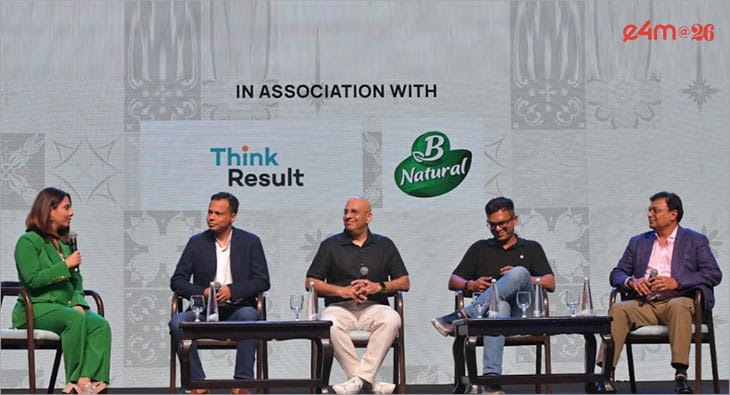

- A panel discussion at GoaFest titled "TV Is Dead. Long Live TV." explored the evolving role of television in the context of digital platforms and changing consumer behavior, featuring leaders from various sectors including broadcasting and marketing.
- Avinash Pandey emphasized that television remains deeply embedded in Indian households, with high penetration rates in several states, and highlighted the growth of connected TV and free-to-air ecosystems.
- The panelists agreed that rather than viewing television and digital as competitors, they should be seen as complementary, with television excelling in brand-building and digital platforms enhancing engagement and targeting younger audiences.
- The discussion concluded with a consensus that while television's dominance may be challenged, its cultural influence and role in storytelling and advertising remain significant, necessitating a shift in measurement and integration strategies for broadcasters.
At a packed GoaFest session titled “TV Is Dead. Long Live TV.”, leaders from Sony Pictures Networks India, Dabur, Ajio, IBDF and NDTV Profit debated whether television is losing relevance or simply evolving into a more participative, multi-screen ecosystem.
The future of television came under sharp focus at GoaFest during a high-energy panel discussion titled “TV Is Dead. Long Live TV. Resetting the Role of Television in the Age of Fragmentation.” The session brought together some of the biggest voices from broadcasting, advertising and marketing to unpack whether TV is truly under threat from digital platforms, influencers and changing consumer behaviour, or whether it is merely entering a new phase of evolution.
The panel featured Akshay Agarwal, Rajiv Dubey, Arpan Biswas and Avinash Pandey, and was moderated by Tamanna Inamdar.
Setting the tone for the debate, Avinash Pandey dismissed the notion that television is dying, arguing that the medium continues to remain deeply entrenched in Indian households. Pointing to the scale of TV consumption in the country, Pandey highlighted that television reaches over a billion people in India and continues to dominate in several regional markets.
He noted that TV penetration in states across southern India, along with markets like West Bengal, Maharashtra, Odisha and Punjab, continues to remain extremely high, with some southern states witnessing penetration levels as high as 90-95 per cent. He also stressed that connected TV and free-to-air ecosystems are expanding rapidly, making television far more dynamic than before.
At the same time, the discussion acknowledged the undeniable shift in advertising spends towards digital ecosystems and influencers. Moderator Tamanna Inamdar pointed to the growing investments by major FMCG players in influencer-led marketing and digital-first campaigns, citing publicly available information from companies like Hindustan Unilever and Nestlé.
Responding to this, Rajiv Dubey explained that the debate should not be framed as television versus digital, but rather as television plus digital. According to him, television still delivers massive scale and broad-based awareness, while digital and influencers help brands access audiences that traditional television sometimes cannot reach effectively, especially younger consumers.
Dubey argued that for many young consumers, the smartphone has become the first screen. As a result, marketers are increasingly layering influencer marketing and social media engagement on top of mass-reach television campaigns. However, he was equally emphatic that digital cannot fully replace the storytelling power of television.
The conversation then shifted towards television’s role in the marketing funnel. Akshay Agarwal strongly defended TV’s dominance in top-of-the-funnel brand building, positioning television as the medium where “demand creation” happens, while digital often serves as a “demand capture” mechanism focused on last-mile conversion.
Agarwal maintained that television’s scale, trust and credibility remain unmatched, but acknowledged that broadcasters need to evolve in a fragmented media environment. He argued that the next phase of television growth will depend on turning passive viewing into participative engagement.
Using Sony’s flagship reality properties as examples, Agarwal explained how viewers today want to participate in content ecosystems rather than merely consume programming. Whether it is voting for contestants on singing reality shows or engaging with second-screen experiences linked to television programming, the audience now expects interactivity.
“TV and digital are not competing ecosystems anymore. The real opportunity lies in using the second screen to deepen engagement with the first screen,” was the broader sentiment emerging from his remarks.
From the perspective of a digital-first consumer brand, Ajio’s Arpan Biswas offered a nuanced take. While acknowledging that television continues to remain relevant for brand-building exercises and credibility creation, Biswas noted that e-commerce businesses operate under different pressures compared to traditional FMCG companies.
For digital commerce platforms, he argued, the focus is often on immediate performance metrics, conversion efficiency and investor-driven growth expectations. As a result, digital advertising naturally becomes more attractive for short-term sales objectives and measurable return on ad spend. However, Biswas clarified that television still plays a crucial role when brands aim to build long-term salience and emotional resonance, particularly in tier-two and tier-three markets where TV remains highly influential.
One of the most engaging moments of the session came when Tamanna Inamdar asked panelists to recall the last iconic advertisement or tagline they remembered. The responses ranged from “Mauka Mauka” to “Melody Itni Chocolaty Kyun Hai?”, reinforcing the enduring cultural power of long-form advertising storytelling.
The panel collectively agreed that while digital platforms may excel at short bursts of attention, they often struggle to create the kind of enduring cultural memory that television campaigns historically achieved.
Rajiv Dubey observed that social media attention spans today often range between six and nineteen seconds, making it difficult to tell emotionally layered stories in such compressed formats. He described six-second digital bumper ads primarily as reminders rather than storytelling vehicles.
The debate also touched upon the risks associated with influencer-led marketing ecosystems. Tamanna Inamdar raised concerns around brands tying themselves to thousands of micro-influencers whose reputational risks can sometimes spill over onto the brands themselves.
Dubey acknowledged that the risks of cancel culture and influencer controversies are real, but insisted that marketers today need a blended ecosystem of celebrities, influencers, regional creators and traditional advertising to maximise relevance across markets.
Interestingly, Arpan Biswas argued that the risk lies less with the medium itself and more with the choice of communication and content strategy. In his view, television and digital are fundamentally distribution channels, while the actual reputational risk emerges from the personalities or creators brands choose to associate with.
As the discussion approached its conclusion, Akshay Agarwal made a strong case for broadcasters to rethink how they measure value. He argued that television companies can no longer rely solely on GRPs, reach and frequency metrics while engaging with advertisers. Instead, the industry must increasingly focus on outcome-led conversations involving ROI, attribution, customer acquisition and engagement.
He also stressed the importance of integrating brands more organically into content ecosystems, creating moments within shows themselves rather than treating advertising merely as interruptions between programming.
Closing the discussion, Avinash Pandey delivered perhaps the session’s most passionate defence of television. Describing advertising and storytelling as a business built around emotion, dopamine and human connection, Pandey argued that creativity-driven brand building cannot be entirely reduced to algorithms and performance dashboards.
“Television will grow and be alive more than ever before,” he asserted, firmly rejecting the idea that the medium is approaching obsolescence.
By the end of the session, the consensus among panelists appeared clear: television may no longer dominate media consumption in the same uncontested manner it once did, but its role as a large-scale, trust-building and culturally influential medium remains deeply intact. What is changing is not the existence of television, but the way television integrates itself into a fragmented, multi-screen consumer journey.
Read more news about (internet advertising India, internet advertising, advertising India, digital advertising India, media advertising India)
For more updates, be socially connected with us onInstagram, LinkedIn, Twitter, Facebook Youtube & Whatsapp
