Second-Screen Strategy: How multi-screen IPL viewing is changing marketing
IPL viewership stays TV-focused, but brands tap second-screen behaviour to turn match-time excitement into real-time orders, driving sharp spikes in consumption during live games
 by
by
Published: Apr 6, 2026 9:34 AM | 8 min read
 Follow Us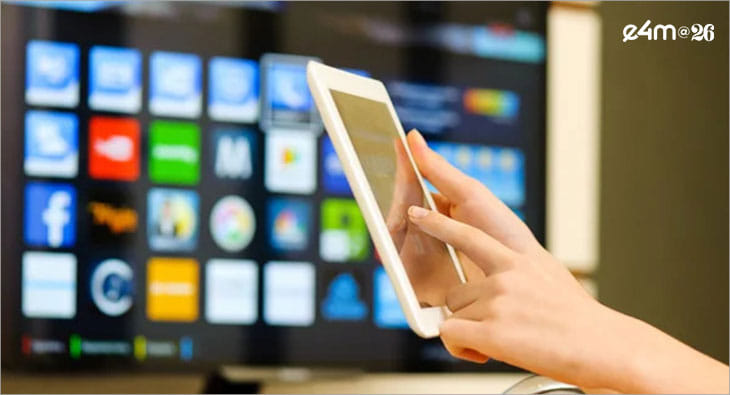

India’s IPL viewing may still be anchored on television, but brands are increasingly converting match-time emotions into real-time transactions through second-screen behaviour, with companies reporting sharp spikes in consumption during live games.
Murali Krishnan, Co-Founder and CMO, Wow! Momo Foods, said “Matches are watched on TV, but decisions are made on the second screen. We’re tapping into those peak emotions, wickets, sixes, timeouts, to convert real-time excitement into instant orders. We feel performance led approach has found its new groundswell; contextual offers, dynamic creatives, and app nudges allow us to convert passive viewership into high-frequency consumption, drive higher average order values during and immediately after the game. This for me is data being dovetailed to pure emotional upswing. I strongly believe in new India cricket creates the hunger, the second screen fulfills it.”
The company’s latest nationwide Indian Momo League campaign, rolled out across Kolkata, Chennai, Mumbai, Delhi, Bengaluru and Hyderabad, is designed around this insight. City-specific variants aim to mirror team loyalties, while bundled IML Combos are being positioned to drive higher ticket sizes during match hours. The brand said food ordering demand has risen threefold during peak match-time windows.
Other food brands are adopting similar playbooks. Curefoods’ Olio Pizza has renewed its partnership with Rajasthan Royals and launched the “Slice Maar” campaign, built around the overlap between cricketing action and food consumption.
Gokul Kandhi, Chief Operating Officer, Curefoods said, “Our partnership with the Rajasthan Royals is a cornerstone of our year, and we’re thrilled to be back for another season. The ‘Slice Maar’ campaign is pure, unadulterated fan energy. It’s the sound of a six being hit and the feeling of grabbing the perfect slice of pizza on match night. With the new Royal Pizza Slice, we’re not just selling a product; we’re serving an essential part of the cricket ritual for every single fan, making the game-day experience more accessible and exciting than ever before.”
The campaign’s hero product, a 24 cm single-serve slice priced from ₹99, is positioned as an affordable match-night indulgence aimed at driving impulse purchases during live games.
Mondelez India is taking a more experiential route. Its Cadbury Dairy Milk campaign, anchored in the “Kuch Meetha Ho Jaaye” platform, introduces #TheKhaasSeat, a dedicated section at Wankhede Stadium for first-time IPL attendees, coupled with access to players and exclusive merchandise through QR-enabled packs.
“Cadbury Dairy Milk has always been at the heart of India’s most cherished cultural moments and cricket is no exception. For a cricket fan, stepping into a stadium for a live match for the first time is a truly khaas moment. But so is every cheer, every chant, and every shared connection in the stands. Through this campaign we celebrate all these moments, because every celebration deserves something meetha,” said Nitin Saini, Vice President, Marketing, Mondelez India.
Meanwhile, platform players say this shift is being driven by a fundamental change in how fans consume cricket.
Shekar Khosla, Vice President, Marketing, Google India, said, “We’ve seen firsthand the depth of India’s passion for cricket. The IPL has consistently dominated Google Search trending topics since 2020. With the latest advances in AI, we are seeing that experience continue to fundamentally transform. AI is enabling a much deeper exploration of information; globally, queries in AI Mode are three times longer than traditional searches, and sessions have become significantly more conversational.”
He added that Google has collaborated with the BCCI to enable a more conversational search experience, where fans can explore everything from historical matches to real-time tactical insights. “For the very first time, we are integrating these AI-powered insights directly into the live broadcast, fundamentally changing how fans engage with the game as it happens,” he said.
YouTube points to a parallel shift in consumption patterns, where second-screen usage and non-live formats are reshaping the scale of the sport.
“When we think of cricket today, second-screening is a defining phenomenon, with nearly 90% of fans using their smartphones during live sports. With 60% of cricket consumption now happening in non-live formats, the sport’s scale is increasingly driven by daily digital engagement,” said Shubha Pai, Head of Sales, YouTube.
She added that cricket views on YouTube surged from 50 billion in mid-2024 to 190 billion in 2025, while Connected TV has emerged as the fastest-growing surface with a 65% year-on-year increase in views. Pai also noted that brands need to move beyond traditional advertising, leveraging creator-led campaigns, particularly by partnering with hyper-local and regional creators, or “Crictubers,” to tap into deeper fan communities.
Snapchat, too, is positioning itself as a “parallel screen” during live matches, particularly for Gen Z users.
“Gen Z in India isn’t just watching cricket, they are engaging with and experiencing the game in real time with their circle. Today, 55% of Snapchatters are watching cricket on TV, 54% streaming it, and over 90% are actively using a second screen,” said Yagnesh Ravi, Lead Ad Solutions, Snap Inc.
He added that eight out of ten users are actively messaging during matches, making the platform a real-time engagement layer around live sports. Snapchat’s cricket strategy includes AR fan zones, branded lenses, live sports integrations and in-stadium activations, including a recent collaboration that engaged over 25,000 fans. According to the company’s Attention Advantage Report 2025, adding Snapchat to a media mix can increase attention levels by 22 percent.
Industry data further underlines the scale of this shift. According to TGI ICUBE 2023-24, India has an estimated 500 million cricket fans. Research commissioned by Google indicates that 90% of fans use a second screen during live matches, while 60% of total cricket content consumption now happens in non-live formats.
On YouTube, while official highlights of India’s ICC Women’s Cricket World Cup victory garnered 14 million views, fan-driven content across celebrations and behind-the-scenes moments generated nearly 20 times more views, reflecting the growing influence of the creator ecosystem.
This trend is already visible in IPL 2026’s opening match, where social media activity surged sharply. Data from KlugKlug shows that between March 28 and March 30, around 23,860 influencers created 36,970 posts around the Royal Challengers Bengaluru versus Sunrisers Hyderabad match, generating 448 million views, 55.47 million likes, 447,500 comments and 4.63 million shares. The overall engagement rate stood at 1.59%, with an engagement-to-views ratio of 7.67%.
The conversation was driven by player performances. From Sunrisers Hyderabad, Ishan Kishan, Travis Head, Abhishek Sharma, Liam Livingstone and Heinrich Klaasen led discussions. From Royal Challengers Bengaluru, Virat Kohli, Jacob Bethell, Rajat Patidar, Venkatesh Iyer and Phil Salt dominated the buzz.
Among them, Rajat Patidar emerged as one of the most engaging players, with around 1.32 million average likes, 4 million average views and an engagement rate of 45.12%, alongside a sustained engagement of 14.8% over the past month. Ishan Kishan followed with around 1.9 million average likes and 10 million views, while Jacob Bethell recorded an engagement rate of 33.84%.
Platform roles also remain distinct. Instagram continues to dominate real-time reactions through memes and short-form content, while YouTube drives deeper, long-form engagement through analysis, interviews and storytelling.
KlugKlug’s data also shows that IPL buzz now begins well before the first match. While conversations remained steady between December 2025 and February 2026, a sharp spike began on March 19, ten days before the tournament, with chatter around the opening match starting as early as March 9. On match days, franchise-led content played a key role, with Royal Challengers Bengaluru alone publishing 51 posts between March 28 and March 30, generating close to 40 million views.
Influencer marketing around the Indian Premier League (IPL) is allegedly expected to reach nearly ₹700 crore in 2026, according to a new analysis released by creator intelligence and collaboration platform Qoruz. The report tracks creator activity, engagement patterns, and brand spending across IPL seasons between 2023 and 2025.
The study shows that spending on influencer collaborations during the IPL has expanded from an estimated ₹250 crore in 2023 to around ₹550 crore in 2025, with projections suggesting the market could cross ₹700 crore during the upcoming season. This reflects an average annual growth rate of about 40 percent over the four-year period.
The report also indicates that total IPL digital advertising spends stood in the range of ₹3,200–₹3,800 crore in 2025, based on industry benchmarks and media planning patterns, and is expected to grow to ₹3,800–₹4,400 crore in 2026. Within this, influencer marketing is projected to account for approximately 16 to 18 percent of total digital ad spending next season.
The data also highlights that a significant portion of IPL-related content remains organic rather than sponsored, suggesting that while brands are beginning to tap into second-screen behaviour, much of the cultural conversation is still being driven by fans and creators in real time.
Read more news about IPL 2024 News, Internet Advertising, Marketing India, PR and Corporate Communication, Television Media
For more updates, be socially connected with us onInstagram, LinkedIn, Twitter, Facebook YouTube & Google News
