Publicis CEO sparks debate. Are ad agencies cutting talent too fast for AI?
Arthur Sadoun recently said clients want partners investing in talent—not just trimming costs. As AI reshapes advertising, ad majors seek to balance technology bets with sweeping restructurings
 by
by
Published: Jul 31, 2026 8:58 AM | 6 min read
 Follow Us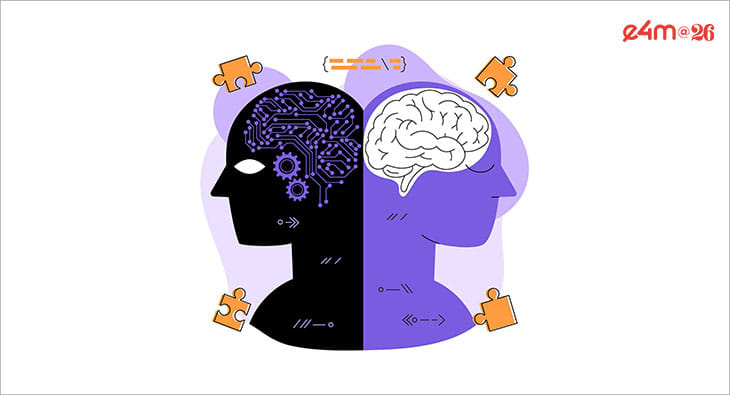

- Publicis Groupe CEO Arthur Sadoun emphasized the importance of investing in talent and technology over layoffs and cost-cutting, highlighting a shift in client expectations within the advertising industry.
- His remarks come amid significant restructuring efforts at rival agencies WPP and Omnicom, which are focusing on integrating AI and achieving cost synergies while facing pressure to improve profitability.
- The advertising industry is increasingly investing in AI, with Publicis committing over $1 billion, while WPP and Omnicom also allocate substantial resources to AI development, raising questions about balancing cost efficiency with talent investment.
- Industry experts warn that prioritizing short-term cost-cutting could undermine long-term competitiveness, suggesting that agencies need to enhance capabilities and strategic thinking alongside AI integration to meet client needs effectively.
Arthur Sadoun rarely names competitors, but a fortnight ago the Publicis Groupe CEO came close. While announcing stronger-than-expected quarterly results and raising the company's annual guidance, Sadoun argued that agencies focused on layoffs, share buybacks and cost-cutting risk sending the wrong message to clients.
"Our clients are not looking for partners that are cutting jobs," he said, adding that they are looking for agencies investing in talent, technology and AI.
The remarks came at a defining moment for the global advertising industry. WPP is undergoing a major restructuring under new CEO Cindy Rose following weak financial performance. Omnicom, meanwhile, is integrating Interpublic Group (IPG) after its acquisition, targeting $750 million in annual cost synergies over the coming years. Across the industry, holding companies are racing to reinvent themselves as generative AI begins reshaping every aspect of advertising—from media planning and creative production to client servicing and commerce.
For decades, agency holding companies grew through acquisitions, geographic expansion and scale. AI is now redefining those competitive advantages. Every major network is investing hundreds of millions of dollars in AI while simultaneously under pressure to improve profitability. The tension lies in balancing shareholder expectations for efficiency with clients' growing demand for strategic thinking, creativity and specialist talent.
Sadoun has brought that contradiction into sharp focus. The bigger question is no longer whether AI will transform agencies, but whether the winners will be those that reduce costs fastest or those willing to continue investing in talent and capabilities despite short-term pressure.
His comment is also being viewed as a veiled attack on rival agencies WPP and Omnicom who have undergone multiple restructuring and layoff initiatives across markets as they double down on technology and consolidate agencies. “Publicis, in contrast, has largely positioned AI as a productivity multiplier rather than a workforce reduction exercise,” says an industry leader.
exchange4media reached out to WPP, Omnicom and Havas seeking their reaction on Sadoun’s statements and their strategy with regard to AI. Their responses were awaited at the time of publishing.
AI Spending the New Battleground
If layoffs have dominated headlines, AI investments have quietly become equally significant. Sadoun's comments have reignited the debate: Can agencies build AI-first businesses while simultaneously shrinking the very talent base that clients pay for?
Publicis has committed over $1 billion towards AI, data and technology over the past few years through acquisitions, CoreAI development and platform capabilities. Earlier this year, the company also announced an AI acceleration programme to train and AI-enable its nearly 100,000 employees globally.
WPP is investing £300 million every year in AI, data and technology, with its AI-powered marketing platform WPP Open at the centre of the strategy. Omnicom too has invested heavily in Omni AI, integrating generative AI capabilities across media, creative and commerce. Both agencies have forged partnerships with tech giants like OpenAI and Google Cloud to embed generative AI across creative, media and production businesses.
‘Capability, Not Cost, the Real Differentiator’
“The industry risks prioritising short-term efficiencies over long-term competitiveness. Most agencies are focused on cutting costs rather than investing in people and capability,” says Ashish Bhasin, Founder, Bhasin Consulting and former CEO, dentsu Asia Pacific. According to Bhasin, agencies today compete as much with technology companies as they do with one another, making talent quality the biggest differentiator.
He cautions against excessive restructuring in what remains fundamentally a people-driven business. "With nearly 70% of agency costs linked to talent, many are cutting muscle, not fat," he says. While investments in culture and employee wellbeing are welcome, they cannot replace sustained investments in high-quality talent and technology. "Without that, agencies risk being perceived as a sunset industry."
That view is echoed by Shrenik Gandhi, Co-founder and CEO, White Rivers Media, who believes cost optimisation has become table stakes. "Cost optimization will always remain a part of the business, but it takes you only so far. The bigger question is how well you weave AI into the way your teams actually work every day," Gandhi says.
"The tools themselves are available to everyone now. What sets an agency apart is people who know how to pair AI with sharp strategic thinking and genuine creativity. That mix is difficult to replicate, and clients notice the difference."
Looking ahead, Gandhi believes capability—not efficiency alone—will determine market leaders. "Both matter, but capability will decide the winners. Any agency can trim costs, so a lean structure stops being an advantage the moment everyone has one."
His own company's investment priorities reflect that thinking. "We are hiring people who are comfortable working alongside AI, continuously upskilling teams and embedding AI into planning, content and client servicing. Over the next three years, the biggest returns will come from making AI part of everyday workflows."
Nimesh Shah, Head Maven, Wind Chimes Communications, believes Sadoun's remarks should be interpreted more broadly. "The larger point that Mr Sadoun made was that agencies will need to always equip and train their teams on the latest set of tech, tools and consumer behaviour. AI investment is simply a manifestation of current times. The context is about providing value to the client, as always."
According to Shah, clients are ultimately indifferent to agency cost structures. "Clients don't care about the agency's cost structures. They are more concerned about how the agency is solving, or working with them to solve, their problem innovatively and impactfully."
He says AI is already changing how agencies allocate investments. Wind Chimes is increasingly using AI to reduce production costs for routine content creation, generate multiple creative variations for campaigns and produce AI-enabled brand films that were previously considered commercially unviable because of production budgets.
Rajni Daswani, Chief Growth Officer – People & Business, SoCheers, opines agencies are asking the wrong question altogether. “The real question is what happens to the people while that investment is underway," she says. According to her, AI may accelerate execution, but judgment remains uniquely human.
"Anyone can generate content faster and cheaper. But fewer people can decide what's actually worth putting out into the world. If you ask me what wins over the next three years, it will be the agencies that become more strategic without outsourcing their judgment,” Daswani noted.
Whether competitors ultimately prioritise workforce rationalisation, capability building or a combination of both, the next phase of competition may not be decided by which holding company deploys AI first—but by which one convinces clients that technology enhances human expertise rather than replaces it.
Read more news about Internet Advertising India, Marketing News, PR and Corporate Communication News, Digital Media News, Television Media News
For more updates, be socially connected with us onInstagram, LinkedIn, Twitter, Facebook YouTube & Google News