Has the scaling of quick home services opened a new frontier for marketers?
According to an estimate, India’s online home services market is projected to grow at a CAGR of 18–22% to reach ₹8,500–8,800 crore by FY30
 by
by
Published: Mar 12, 2026 9:00 AM | 6 min read
 Follow Us

Just a few years ago, the rise of quick commerce reshaped how urban consumers buy groceries, medicines and everyday essentials. The idea of compressing delivery timelines from days to minutes fundamentally altered consumer expectations around convenience. Interestingly, a similar shift now appears to be unfolding in an entirely different category: household services.
From cleaning and dishwashing to electrical fixes and laundry support, a new set of startups is attempting to bring the 10-minute economy into the home itself, promising on-demand human help at the tap of a button. Platforms are moving beyond the earlier model of scheduled bookings for specialised services, such as salon-at-home, appliance repair or deep cleaning, and are instead positioning instant, everyday household assistance as a core consumer proposition.
What makes this category particularly eye-catching is that, despite being in its early stages, it has gained significant traction over the past couple of years. The growth is being driven by factors such as time-starved urban households, the rise of dual-income families, and increasing comfort with app-based service aggregation.
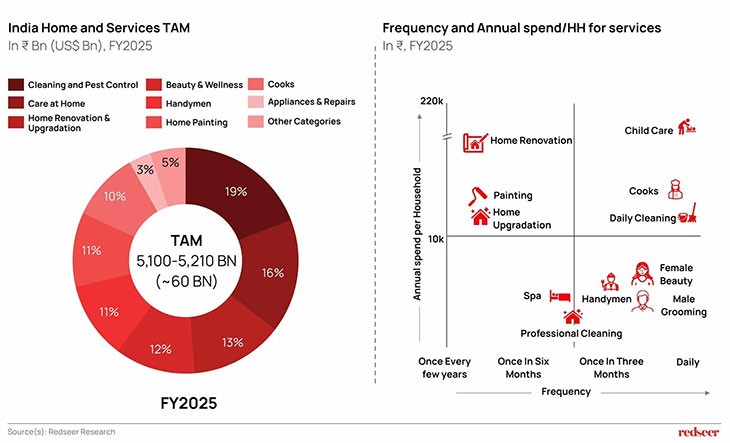
According to Redseer, India’s online home services market is projected to grow at a CAGR of 18–22% to reach ₹8,500–8,800 crore by FY30. The firm notes that the broader home services market is already massive, estimated at ₹5,10,000-5,21,000 crore ($57-59 billion) in FY25, but remains largely unorganised, with online platforms accounting for less than 1% of the total transaction value. At present, the online segment itself is valued at around ₹4,100–4,300 crore ($464-487 million) and is expanding rapidly as urban consumers increasingly prioritise convenience, reliability and accountability in household services.
The report has identified instant home services as the next major digital opportunity, drawing parallels with how quick commerce accelerated demand for instant gratification.
Gurpreet Singh, Head of Performance, WPP Media India, stated, “Quick home services are quickly becoming the next customer acquisition battlefield, similar to what quick commerce went through. Competition across search and social has intensified, and CACs are steadily rising as more platforms chase the same high-intent users. But unlike groceries or food delivery, home services depend heavily on trust. Messaging around professional verification, ratings, and service quality plays a big role in conversion.”
The most recent case in point is how quickly consumer adoption is accelerating. For instance, Urban Company’s InstaHelp, its home-assistance offering, reportedly crossed 50,000 daily bookings in February 2026, signalling strong demand for quick-turnaround services such as dishwashing, cleaning and kitchen help. New-age startups are witnessing similarly sharp growth curves. Snabbit’s order volumes surged to 6,30,000 in December 2025, up from 1,00,000 in August 2025, while Pronto reported that orders climbed from 30,000 to 1,50,000 within a few months. Other players such as Broomees are also experimenting with tech-enabled domestic workforce aggregation to address similar gaps.
The speed of this growth has begun raising a key question within the advertising and marketing ecosystem: is quick home services emerging as a new advertising category?
Much like quick commerce in its early years, the segment sits at the intersection of convenience, immediacy and habit formation, making it attractive for performance-led marketing strategies. Industry observers say that as more players enter the segment and expand their service offerings, marketing strategies are also becoming more structured.
Sini Magon, COO and Global Partner at Grapes Worldwide, noted that quick home services are gradually shaping up as a distinct advertising category, with brands moving beyond reliance on app ecosystems to build broader brand recall through sustained advertising. According to her, discovery-led channels such as search, social media and app-install campaigns continue to account for a large share of marketing spends, as they capture users actively looking for services. At the same time, platforms are also investing in performance optimisation and ranking within their own apps, ensuring greater visibility for services once users enter the ecosystem.
From a broader media planning lens, experts say the sector is still in its market-creation phase, where awareness, trial and habit formation remain the immediate focus.
Yash Dabi, VP & Head, Bangalore at 22feet, says the category is increasingly attracting advertiser attention because of the strong intent signals it generates. “The category benefits from urgent problem-solving searches and sticky app-based behaviour. As more organised platforms scale supply and standardise service quality, advertisers will start viewing them as performance-led platforms with a high LTV (Lifetime Value) potential and increasing competition for customer acquisition.”
Rishi Sen, Founder & Chief Brand Architect at The Sixth Sen, says the category is already emerging as a distinct advertising segment in dense urban markets where convenience-led demand is strongest. Sen estimates that around 60–70% of marketing spends are currently directed toward discovery-led channels such as search, app installs, paid social, hyperlocal society activations, referral programmes and introductory trial offers. The remaining 30–40% is being channelled into optimisation, including app-store optimisation (ASO), conversion-rate improvements, remarketing campaigns and geo-level supply density targeting. He notes that these percentages are informed estimates based on visible campaign behaviour, since most platforms do not publicly disclose channel-wise media allocations.
Also read: Django wins digital mandate for Snabbit
What will it take for quick commerce to win Bharat?
56% surge: Why e-commerce is winning the ad race
Most quick home service platforms are currently skewing heavily toward performance marketing. Discovery channels like search, app installs and social discovery drive most of the acquisition because they capture high intent demand. At the same time, a significant portion of spend goes into optimisation through app store ranking, retargeting and CRM-led repeat usage. “The focus right now is less on large brand spends and more on efficient demand capture and lifecycle growth,” added Dabi.
Experts told e4m that in categories like this, media efficiency is tightly linked to fulfillment quality, service reliability and local supply density. If that experience breaks, performance marketing becomes expensive very quickly. So, this may begin as a CAC battle, but it will ultimately be won on LTV, repeat rate and operational consistency.
As the category matures, marketers are also beginning to look beyond pure performance acquisition toward brand-building efforts.
Singh of WPP Media noted, “As the category matures, we’re also seeing marketers invest more in brands. Brand building helps create familiarity and trust, which matters when you’re inviting someone into your home. It also helps expand the category by reminding people to use services proactively, like preventive appliance servicing or periodic deep cleaning. Performance marketing will continue to drive growth, but the brand is increasingly becoming the layer that improves recall, conversion, and long-term customer value.”
These shifts indicate that while quick home services are currently being built on performance marketing and demand capture, the next phase of growth could see the sector evolve into a full-fledged advertising category.
Read more news about Marketing News, Advertising News, PR and Corporate Communication News, Digital News, People Movement News
For more updates, be socially connected with us onInstagram, LinkedIn, Twitter, Facebook, YouTube & Google News