Real test of a marketing idea is its ability to spark conversations: Kunal Sharma, KRBL
Kunal Sharma, Vice President Marketing and Organised Trade at KRBL Limited, spoke about the insight behind their Women’s Day campaign #NotYourBiryani
 by
by
Published: Mar 12, 2026 9:15 AM | 6 min read
 Follow Us

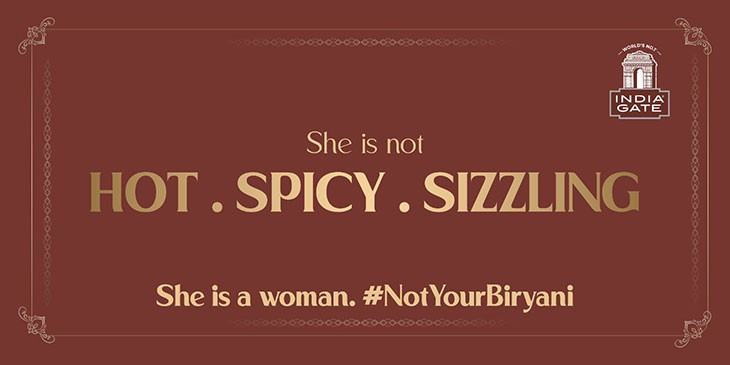
As brands increasingly attempt to align marketing with social conversations, rice brand India Gate’s latest campaign, #NotYourBiryani, focuses on the casual use of food-related adjectives when referring to women in everyday language.
The campaign centres on reclaiming words such as “Hot,” “Spicy,” and “Masaledaar,” placing them back in their culinary context. A menu-card styled visual anchors the creative, reframing these descriptors as food attributes and prompting audiences to reflect on how such language is used in daily conversations.
In an interaction with e4m’s Principal Correspondent Chehneet Kaur, Kunal Sharma, Vice President Marketing and Organised Trade at KRBL Limited, spoke about the insight behind the campaign, the role legacy brands can play in shaping social narratives, and how companies are attempting to move beyond symbolic messaging during occasions such as International Women’s Day.
From Brand Communication to Cultural Commentary
According to Sharma, the campaign emerged from a broader communication platform the brand began building last year around Indian values.
“This journey started with our campaign around the values of India. As a legacy brand present in the country for over two decades, we felt we could be custodians of certain Indian values,” Sharma said.
As part of that exercise, the company examined themes it believed resonate across generations. Respect for women emerged as one such value.
Instead of approaching the subject through a serious or instructional tone, the campaign uses humour and everyday observations to spark reflection.
“We didn’t want to be preachy. We wanted to make it conversational. That’s where we found an interesting entry point in how certain words are casually associated with women in daily language,” Sharma said.
A Gender-Agnostic Message for a Wider Audience
While the campaign references respect for women, Sharma said the idea was positioned as a broader cultural conversation rather than a message directed at a specific gender.
“When we arrived at this idea, we didn’t see it as a woman-forward or men-forward campaign. Anyone who hears the message can relate to it and interpret it from their own perspective,” he said.
Even though women remain a significant consumer group for household food purchases, Sharma noted that conversations around social values should not be restricted to one demographic.
“While our product choices may lean more towards women consumers, the conversations we create as a brand should be agnostic of gender,” he said.
Avoiding the ‘Pinkwashing’ Trap
The campaign was released around International Women’s Day, a time when many brands launch gender-focused messaging. Sharma acknowledged that ensuring authenticity during such moments remains a challenge.
“Almost every brand communicates around Women’s Day today. The challenge is to make sure the message does not feel superficial or like pinkwashing,” he said.
To broaden the conversation, the campaign used vox pop formats featuring people from different genders and backgrounds rather than focusing solely on women’s perspectives.
“We live in a conversation economy today. If an idea can organically drive conversations, that is the real litmus test of its authenticity,” Sharma said.
Influencers as the Core Campaign Medium
Influencer marketing served as the central distribution channel for the campaign, with creators such as Ayesha Khan, Nayyab Midha and Harshita Gupta contributing to the storytelling.
According to Sharma, the brand prioritises authenticity while selecting creators.
“The first thing we look at is how organically the message can emerge from the influencer we choose. That makes the content far more relevant and relatable,” he said.
The campaign also avoided overt brand messaging within influencer content.
“We try not to be too brand-forward. Instead, we keep the conversation consumer and insight forward so that it feels natural,” Sharma added.
One creator video reached around 30 million people within two days and generated more than four lakh shares, according to the company.
The campaign also extended into outdoor advertising, where hoardings carried the same wordplay featured in the digital content.
“People clicked photos of the hoardings and shared them online, which extended the conversation digitally,” Sharma said.
Competing Beyond the Organised Market
For packaged basmati rice brands such as India Gate, Sharma said the biggest competition often comes from loose rice sold in the unorganised market rather than other branded players.
“In India, the real competition for packaged rice brands is consumers who buy loose rice,” he said.
The company allocates around 60 percent of its marketing investments towards brand-building initiatives and about 40 percent towards business objectives such as distribution and sales.
Unlike categories where quality concerns push consumers towards packaged products, rice consumption is often influenced by habit and emotional associations.
“Food is deeply emotional in India. Our communication focuses on relationships, lifestyle aspirations and the role food plays in bringing people together,” Sharma said.
Organised retail, e-commerce and quick commerce are also contributing to the shift towards branded products. According to Sharma, about 40 to 45 percent of the company’s consumer pack revenue now comes from these channels.
Navigating Revenue Fluctuations
KRBL recently reported a 12.8 percent decline in revenue from operations in the December quarter compared to the same period last year. Sharma attributed the slowdown largely to external factors affecting exports.
“Our business has two components, exports and India operations. The export segment has been impacted by the global landscape and geopolitical disruptions,” he said.
The domestic market, however, continues to show steady growth.
“Our India business recorded around 10 percent growth in the first half of the year and continues to grow ahead of the FMCG industry average,” Sharma said.
For topical campaigns such as #NotYourBiryani, the immediate performance metric is the level of engagement generated within a short window.
“Most topical campaigns have a life of about seven to ten days. During that period, resonance and conversations are what we monitor closely,” he said.
Purpose Beyond the Product
Beyond marketing campaigns, the brand has also been investing in social initiatives such as “Grains of Hope,” a programme aimed at addressing hunger among children in partnership with the Akshaya Patra Foundation.
Through a kitchen run at its plant, the initiative provides meals to around 15,000 children every day.
Sharma said initiatives like these are also shaped by changing consumer expectations.
“The consumer who will become our core audience ten years from now is someone who values purpose-driven brands. We need to understand what matters to them and communicate in ways that feel relevant,” he said.
As media consumption becomes increasingly fragmented, Sharma believes brands will need to continually adapt how they communicate long-standing cultural themes.
“When you talk about Indian values to a 50-year-old consumer, the tone may be different. But when you talk to a younger audience, the same values have to be expressed in a more contemporary way,” he said.
Read more news about Marketing News, Advertising News, PR and Corporate Communication News, Digital News, People Movement News
For more updates, be socially connected with us onInstagram, LinkedIn, Twitter, Facebook, YouTube & Google News