As clicks disappear, India’s SEO agencies rethink what they sell
SEO agencies are building capabilities around AI citation tracking, structured content, digital PR, reputation management and monitoring how brands are described across different answer engines
 by
by
Published: Jul 28, 2026 8:37 AM | 8 min read
 Follow Us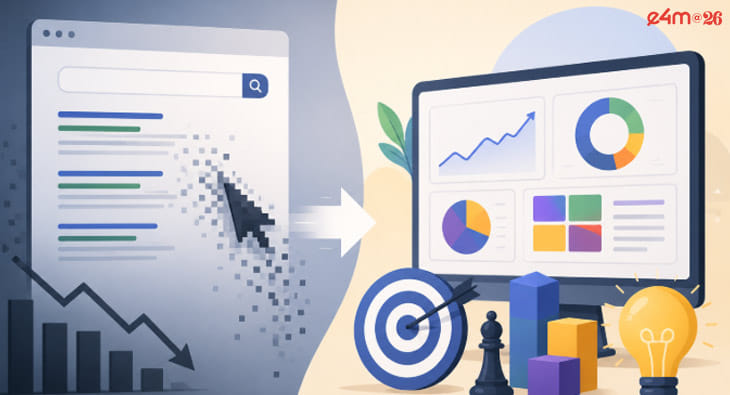

- Publisher ad-request volumes experienced a significant decline of up to 41% year-on-year in Q2 2026, with reductions of 32-37% in the US and 39-41% in the UK, attributed to fewer users reaching publisher pages and the rise of AI-generated answers.
- The average click-through rate for top-ranking search results has dropped dramatically, from around 5% in December 2024 to below 1% by February 2026, as AI Overviews increasingly provide answers directly in search results.
- SEO agencies are adapting to this shift by expanding their focus beyond traditional ranking optimization to include AI citation tracking, structured content, and digital PR, as brands seek to be discoverable and credible across AI platforms.
- The evolving landscape is prompting agencies to redefine success metrics, moving from traffic-based KPIs to measures of citation share and brand visibility within AI-generated answers, while also facing challenges in establishing stable performance metrics.
Publisher ad-request volumes fell by as much as 41% year-on-year in the second quarter of 2026 across a group of premium US and UK publishers tracked by advertising platform Ozone. The data, covering approximately 20 billion impressions, found declines of around 32% to 37% in the US and 39% to 41% in the UK. With fewer users reaching publisher pages, there were fewer advertising opportunities available for those publishers to sell.
The findings are not India-specific, and some publishers were also deliberately reducing low-value ad requests. They nevertheless illustrate how the spread of AI answers and zero-click discovery can travel down the commercial chain: fewer outbound clicks mean fewer page views, less open-web inventory and, eventually, less revenue.
For one large recipe platform tracked by WPP Media India, the average click-through rate for a result ranked first on Google fell from around 5% in December 2024 to below 1% by February 2026. Over the same period, the share of tracked queries triggering an AI Overview rose from around 1% to 40%.
The platform had not suddenly become less relevant. The interface had changed. Google was increasingly providing the answer before users reached the link.
Read more on Google’s gameplan in earlier e4m report
“The task for brands is no longer only to be searchable, but to be retrievable, citable, credible and recommendable across AI-led discovery surfaces,” said Subhashis Guha, Principal Leader, Performance and SEO, WPP Media India.
Publishers have been among the most visible casualties of this shift. But the same disruption is now reaching the agencies whose business was built around improving search rankings and turning those rankings into organic traffic.
As the relationship between ranking, clicking and conversion weakens, India’s SEO agencies are being forced to rethink what they sell, how they measure success and whether the traditional SEO mandate is still large enough to contain the work clients now expect.
The disruption is unfolding even as advertiser investment in search continues to grow. According to the dentsu-e4m Digital Advertising Report 2026, digital advertising accounted for ₹71,621 crore, or 59%, of India’s ₹1,21,339-crore advertising market in 2025. Paid search represented 23% of digital advertising expenditure, translating into spending of ₹16,581 crore.
These figures refer to paid search rather than spending on SEO services. They nevertheless underline the size of the commercial ecosystem being reshaped. Brands are not abandoning search. They are investing more in it even as AI-generated answers weaken the familiar relationship between visibility, website traffic and conversion.
The pressure is no longer theoretical. An Ahrefs analysis published in February 2026 found that the presence of an AI Overview reduced the click-through rate for the top-ranking organic result by 58%, based on data from December 2025. Its earlier study, published in April 2025, had estimated the decline at 34.5%, suggesting that the effect had become more pronounced as AI Overviews expanded.
For SEO agencies, however, the disruption is not simply about losing clicks.
Technical SEO, site architecture, crawlability, structured data and keyword optimisation remain important. But as the relationship between ranking and traffic weakens, agencies are being asked to help brands appear within answers generated by Google AI Overviews, ChatGPT, Gemini, Perplexity and other AI-led discovery platforms.
Read more on ad model behind AI wars
“Traditional SEO isn’t disappearing, but its role is expanding,” said Tejas Thakkar, Senior Vice President, SEO and Content, LS Digital. “Over the next 12–18 months, success won’t be defined only by where a webpage ranks, but by whether a brand becomes discoverable, credible and retrievable across AI-powered search experiences.”
Agencies are consequently building capabilities around AI citation tracking, entity optimisation, structured content, digital PR, reputation management and monitoring how brands are described across different answer engines.
They are also having to look beyond a brand’s own website. AI systems can draw on publisher articles, product reviews, online communities, forums, creator content and social platforms when deciding which companies, products and sources to cite or recommend.
Jacob Joseph, Vice President, Data Science, CleverTap, said the modern search agency was beginning to resemble a combination of SEO, content strategy, digital PR and search intelligence. “Technical SEO and keyword optimization still provide the foundation, but the next phase is about helping AI understand a business well enough to recommend it with confidence,” he said.
This required original content, topical authority, expert validation, structured information and credible references outside a company’s owned platforms. Brands would increasingly want to know how often they were cited or recommended across AI platforms, alongside the rankings and organic traffic they traditionally monitored, he added.
The change is also altering the kind of content agencies recommend.
Madan Mohare, Chief Data and Innovation Officer, Younion Brand Experiences, described the shift as one from winning a position in search to becoming part of the answer.
“The focus will increasingly be on creating content that AI platforms can trust and reference, supported by expert perspectives, original research, proprietary data and clear product information,” he said.
This does not necessarily mean that money is moving neatly from SEO into a separately defined Answer Engine Optimisation or Generative Engine Optimisation budget.
Instead, agency mandates are spreading across content, digital PR, reviews, publisher partnerships, online communities, product information, structured data and new measurement tools. A client may continue to call the mandate SEO even when the work extends considerably beyond optimising its website.
This means that the SEO business would expand, but agencies defining it purely as ranking optimisation would find their scope narrowing. Investment would instead spread across answer-ready content, digital PR, publisher partnerships, review ecosystems, product feeds, commerce readiness and AI-search measurement.
This creates an opportunity for agencies to offer a broader discoverability proposition. It also creates the risk that they will be expected to deliver substantially more within existing search mandates before the market has settled on standard ways to price or evaluate the work.
Market-ing movement: Read more here
Measurement, however, may be the more immediate problem. Rankings, clicks, sessions and conversions were imperfect, but they gave marketers and agencies a relatively legible performance chain. AI visibility is harder to establish. Answers can vary by platform, prompt, geography, user context and the time at which a query is made.
That makes measures such as citation frequency, prompt coverage and “share of answer” considerably less stable than a conventional ranking.
AI referral traffic is also not yet large enough in most cases to compensate for the decline in conventional organic visits, according to Guha. The larger near-term effect may be the influence AI answers exert before a user reaches a website.
There are early indications that the smaller volume of traffic may sometimes arrive with stronger intent.
In one automobile-sector engagement tracked by WPP Media India, the click-through rate for the top-ranked result fell by 58%, while organic traffic declined by 37%. AI Overviews appeared for around 60% of the targeted keywords and occupied close to 48% of the mobile screen.
Despite the traffic decline, organic leads increased by 15%, alongside an improvement in the brand’s AI visibility. “This shows why lower traffic does not always mean lower business impact,” Guha said.
The shift is also unlikely to be uniform across industries. Jasbir Singh, Branding and Digital Marketing Head at E3 Group, said categories such as “healthcare, financial services and B2B were adapting faster because their consumers conducted more information-intensive searches.” Retail and ecommerce remained more dependent on conventional SEO and conversion optimisation.
For marketers, the challenge is to distinguish meaningful discovery from another layer of visibility metrics. For agencies, it is to prove that a wider combination of content, PR, structured data, reputation and AI monitoring produces something more valuable than an impressive-looking dashboard.
SEO agencies will therefore have to do more than rename existing services as AEO or GEO. They will need to show how visibility inside an AI-generated answer connects with branded searches, qualified visits, leads, revenue or assisted conversions.
The agencies that once promised to place a brand at the top of a page must now help it become one of the sources an AI system considers trustworthy enough to cite, describe and recommend. The scope of SEO is expanding. Proving the value of that expansion may be the harder business.
Read more news about Digital Media, Internet Advertising, Marketing News, Television Media, Radio Media
For more updates, be socially connected with us onInstagram, LinkedIn, Twitter, Facebook, YouTube & Google News