AI is rewriting Indian marketing's OS. Is the industry ready?
Brands that will lead in the AI era are those treating AI as the operating system, say industry heads; AI is now visible in performance optimisation, consumer insights, and creative adaptation
 by
by
Published: May 15, 2026 8:49 AM | 7 min read
 Follow Us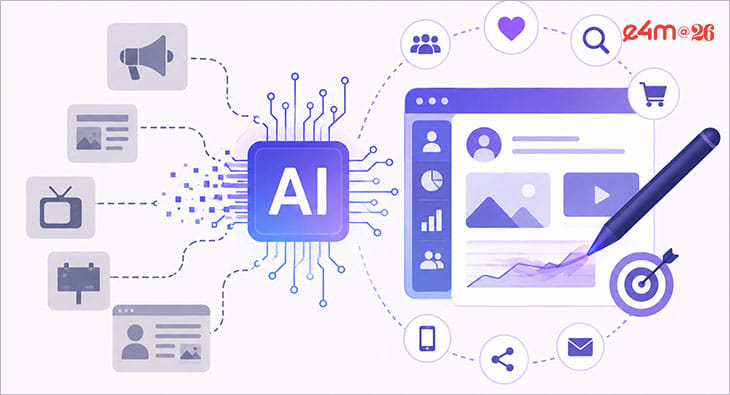

- Indian marketing is undergoing a significant transformation as AI becomes integrated into operational processes, moving from traditional campaign cycles to always-on systems that require rapid responsiveness.
- Marketing teams are leveraging AI for performance optimization, consumer insights, and real-time decision-making, enabling them to process larger volumes of behavioral data and adjust campaigns mid-execution.
- While generative AI tools are gaining attention, marketers emphasize that the true value lies in AI's ability to enhance predictive capabilities, improve targeting, and reduce friction for consumers.
- Despite the rise of AI, many marketers stress the importance of maintaining human connection in branding, indicating a balance between automation and personal engagement remains crucial for building trust.
For a while, Indian marketing’s relationship with AI looked a bit like a teenager (or millennial journalist) discovering Photoshop for the first time. Every second LinkedIn post suddenly featured AI-generated creatives, AI-generated strategy decks, AI-generated thought leadership, and enough references to “hyper-personalisation” to qualify as a drinking game. But beneath the noise and the AI-washing, something far more consequential is beginning to happen inside marketing organisations themselves.
The thing is, India’s marketing teams once worked in neat, predictable cycles. Consumer research would feed into campaign planning, which would move into creative production, media buying, measurement, and eventually optimisation. Weekly reviews and monthly dashboards governed most decision-making.
That structure is now beginning to collapse under the weight of AI.
As digital advertising crosses 60% of India’s Rs 1.55 lakh crore advertising market, according to Pitch Madison Advertising Report 2026 estimates, marketing organisations are no longer dealing with manageable campaign cycles, but always-on systems, and are increasingly being forced to operate at a speed and level of responsiveness that traditional workflows were never designed for.
The shift is no longer confined to generative AI experiments or faster creative production. AI is increasingly becoming part of the operational layer itself, shaping how brands process signals, optimise campaigns, personalise communication, and make decisions in near real time.
According to Anuradha Aggarwal, Director and CMO at Amazon India, the transformation happens when AI becomes “an invisible operating layer,” seamlessly powering discovery, personalisation, creativity, and measurement in parallel. Aggarwal said brands that will lead in the AI era are the ones treating AI “not as a campaign tactic but as the operating system behind how they think, create and connect.”
Aggarwal added that AI is increasingly embedded across the customer and brand experience itself, enabling faster optimisation, more contextual communication, and deeper understanding of customer behaviour. But she cautioned that technology alone cannot build brands, arguing that the companies seeing the strongest impact are the ones using AI to meaningfully reduce friction for consumers while balancing automation with human judgment.
And while agencies and brands are rushing to slap “AI-powered” onto every deck and capability statement in existence (something we will be breaking down further in an upcoming article), the more meaningful transformation may be happening elsewhere: inside the invisible systems that govern marketing operations.
“The biggest real-world impact is currently visible in performance optimisation, consumer insights, and creative adaptation,” said Prasun Kumar, CMO at Magicbricks. “AI is helping marketing teams process significantly larger volumes of behavioural data in real time, which improves targeting, audience segmentation, and campaign responsiveness.”
Kumar believes the larger shift is not merely about automation, but about compressed decision-making cycles. “AI is reducing the time between insight and action, which is fundamentally changing the pace at which marketing teams operate,” he said.
The feedback loop shrinks
That compression of decision cycles appears to be emerging as one of the defining characteristics of AI-led marketing systems.
At Medusa Beverages, VP-Marketing Gaurav Sehgal said AI has transformed the way the company tracks cultural shifts and responds to them. “We are in a space where culture does not wait. A moment opens, and the brands that are ready are the ones who already saw it coming,” Sehgal said.
He added that AI-driven optimisation systems have given the company “early visibility into consumption shifts, regional preferences, and category conversations in near real-time.” The impact, according to Sehgal, is operational as much as creative. “Decisions that used to sit in a weekly review are now happening mid-campaign, while there is still time to act on them.”
Notably, most marketers interviewed for this story did not identify content generation as the biggest long-term shift. Instead, they repeatedly pointed toward optimisation, retention, predictive systems, and behavioural intelligence as the areas where AI is fundamentally altering marketing operations.
Sudesh Shetty, CMO and Founding Member, Fibe, said the three areas seeing the strongest impact are creative production, performance optimisation, and retention. But even there, the operational implications matter more than the tooling itself.
“Performance optimisation has shifted from something you review once a month to something that adjusts in real time,” Shetty said. “Brands aren’t necessarily spending more. They’re just wasting less.”
Retention systems, meanwhile, are becoming increasingly predictive. “AI can spot early signs that a customer is about to leave, before they’ve even made that decision, and trigger the right message at the right time,” Shetty said. “That kind of precision at scale just wasn’t possible before.”
The implications of those systems extend well beyond advertising.
Beyond content
Retail media, one of India’s fastest-growing advertising segments, is expected to cross Rs 30,000 crore by 2026, according to industry estimates. That ecosystem increasingly relies on AI-driven optimisation, recommendation systems, inventory-linked advertising, attribution modelling, and automated experimentation to function effectively at scale. Similarly, the rapid growth of programmatic and connected TV advertising is creating an ecosystem where continuous optimisation is becoming structurally necessary rather than optional.
At Campus Activewear, CMO Gaurav Sharma said the company initially adopted AI within performance marketing optimisation before gradually expanding its use cases. “We built our own dashboards not only for descriptive analytics but even for diagnostic and prescriptive analytics,” Sharma said.
The use cases have since expanded into retention marketing, voice-led customer support, and creative optimisation. “Most of our product-first assets are getting created with AI,” Sharma said. “We have managed to bring the costs down and improved the speed to market.”
Yet even as creative AI dominates public discourse, several marketers suggested that the larger value lies elsewhere.
Sehgal cautioned against mistaking faster content production for transformation itself. “AI has made us a sharper marketing team, not a faster content machine,” he said.
That sentiment surfaced repeatedly across sectors.
“Most teams already know how to generate more content or more variants,” said Shagun Walia, Marketing Communications, Avery Dennison – South Asia & SSA. “The harder part is understanding what actually lands, what builds trust, and what drives action.”
According to Walia, AI’s biggest impact currently lies in consumer insights, measurement, and performance optimisation because it allows brands to process fragmented behavioural signals faster and more effectively. “What I find most interesting is that AI is slowly changing marketing from a reactive function into a more predictive one,” she said.
Still, despite the accelerating operational integration of AI, most marketers remain wary of reducing branding itself into a purely automated process.
At Anahata Organic, CMO Kruti Soni said AI has become a valuable support system for analytics, reporting, and operational efficiency, but argued that emotional connection still depends heavily on human interaction. “Most of our communication is intentionally personal and conversational — almost like a real conversation between a mother and daughter,” Soni said.
“Our founder still prefers interacting live with customers during our Thursday Lives and Pranayam classes because genuine human connection builds far stronger trust than automated communication ever can,” she added.
That tension may ultimately define the next phase of India’s AI marketing transition.
TL;DR
For all the excitement around generative tools and AI-native workflows, the real transformation in India appears less about replacing marketers and more about redesigning how marketing organisations function. The brands seeing the strongest impact are not necessarily the ones producing the most AI-generated content, but the ones using AI to shorten feedback loops, process signals faster, personalise at scale, and move from periodic campaign management toward continuous optimisation systems.
As India’s advertising market becomes increasingly digital, those operational advantages may become harder to ignore. The challenge for agencies and brands alike is that AI is no longer behaving like a bolt-on productivity tool. It is beginning to resemble infrastructure.
Read more news about Digital Media, Internet Advertising, Marketing News, Television Media, Radio Media
For more updates, be socially connected with us onInstagram, LinkedIn, Twitter, Facebook, YouTube & Google News