SEO Is Changing, but Birlasoft CMO Says Trust Will Still Decide Who Gets Discovered
Birlasoft’s Satinder Juneja discusses composable MarTech stacks, agentic AI, synthetic profiles and why brand trust will remain central to AI-led discoverability.
 by
by
Published: Aug 20, 2026 12:57 PM | 11 min read
 Follow Us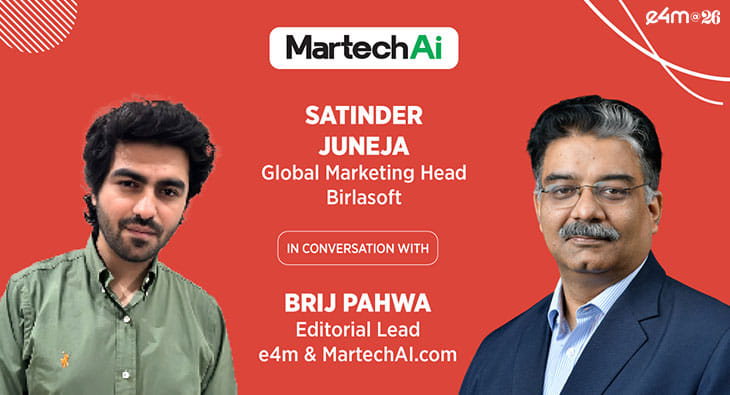

- In a recent interview, Satinder Juneja from Birlasoft emphasized the need for flexibility in modern MarTech stacks, advocating for a composable approach to accommodate evolving demands and the integration of AI technologies.
- Juneja highlighted the importance of balancing automation with human judgment, asserting that while AI can enhance marketing operations, human insight and creativity remain crucial for effective decision-making and strategy.
- The conversation touched on the role of synthetic profiles in B2B marketing, showcasing how AI can help understand buying centers, but underscored the necessity of human validation in utilizing these profiles effectively.
- Juneja also discussed emerging concepts such as context engineering and neuroadaptive experiences, suggesting that as AI advances, marketers will need to adapt their strategies to leverage emotional signals and improve customer engagement.
This interview was originally published on MartechAI.com.
As artificial intelligence moves deeper into marketing stacks, search, data, content and operations, the pressure on marketers is no longer simply to adopt technology. It is to decide what to adopt, how much to automate and, increasingly, what deliberately not to lock in.
In a virtual interview with Brij Pahwa, Editor Lead, MartechAI.com & exchange4media, Satinder Juneja, Global Marketing Head, Birlasoft, spoke about why he believes modern MarTech stacks need built-in flexibility, how agentic AI is beginning to enter real marketing workflows, why the “pathways to expertise are collapsing”, and what marketers need to get right as discoverability shifts from traditional search towards AI platforms.
The conversation also went deeper into B2B marketing, including the use of synthetic profiles to understand buying centres, the role of human judgement alongside automation, and emerging concepts such as context engineering and neuroadaptive experiences.
With the MarTech ecosystem becoming increasingly complex, how should CMOs think about building their technology stacks today? Integrated or composable?
Picking the stack, deciding what the ideal stack is and figuring out how to create it is probably a daily worry for a CMO or marketing leader. And it is only getting more complex.
My view is that it has to be composable because new demands keep coming in. If we were having this conversation in 2019 or 2021, we were talking about things such as intent signals, intent data and some predictive analytics. We were not talking about AI and agents in the way we are today.
If somebody had built a stack then that wasn't composable, integrating AI into it today would have been extremely difficult.
One lesson I have learned personally after AI came in with such force is: don't create a 100% stack, ever.
Create probably 85%, 89% or 90%. Leave 10% room. Where exactly do you leave that 10%? I don't know. It could be the content layer, identification layer, CDP layer or somewhere else. The point is not to leave your stack incomplete. It is to build in roughly 10% flexibility so that you can quickly change direction when the business or audience requires it.
Your stack needs to respond to your audience, and the marketer responsible for putting that stack together needs to be able to respond as well.
There is another important part of this. Putting together a complicated technology stack can actually be the easier part. Running it is equally difficult. That is where marketing operations becomes extremely important.
We can get swayed by the glamour of shiny MarTech tools, but for those tools to work properly, your operations have to be in order. That is also where humans and agents can start working beautifully together.
As automation increases, what skills become more important for marketers?
Twenty-five or thirty years ago, marketing was much more about art, creativity and design. Then technology started seeping in and the conversation became whether marketing was an art or a science.
Today, a marketer has to be a mix of both.
In 2026, a marketer who doesn't understand technology will not be a successful marketer. Understanding technology is now par for the course. It is almost like knowing the language of the business.
But human insight, the ability to assess things and the ability to observe become even more important. Human observability is becoming more important. Curiosity matters. Your ability to assimilate diverse signals quickly matters.
Look at how quickly the AI conversation itself has changed. Not very long ago, everybody was talking about prompts and prompt engineering. Today we are talking about autonomous agents, and tomorrow the conversation could be something else.
The pace of the narrative and the pace of requirements are changing very fast.
There is another important point: the pathways to expertise are collapsing.
Earlier, there was a hierarchy. You spent three years here, five years there, seven years somewhere else, accumulated knowledge and eventually reached a certain position. Today, access to a lot of that knowledge can happen in days rather than years.
But what you don't necessarily get is observability. Someone can ask ChatGPT, Claude or Kimi about the role of a CMO and get an answer immediately. But the cycles of failing and succeeding, and what those experiences do to your judgement, cannot simply be replaced. At least so far, AI cannot give you that.
That is why continuous learning is no longer something only younger marketers need to think about. The biggest need for a marketer is to stay relevant. You continuously need to learn, experiment, fail, pick up new things and move ahead.
What does a marketing organisation look like when humans and AI agents begin working together?
The first question is: who is creating these agents?
You are. You are creating them for your need and your context.
Agents and humans will coexist. Once your marketing operations are in order, you need to identify which parts can be automated with reasonable predictability and lower risk. Those are the things you automate first.
Then, as your confidence in the technology and its behaviour increases, you start moving towards more complex and riskier tasks.
What an agent needs to do will also differ from one organisation to another. Marketing teams will need to imagine where they need an agent, what frequency it should operate at and how much autonomy it should have.
How much agentic AI is actually being deployed in marketing today, beyond the hype?
From what I am observing within my industry and outside it, there are several practical areas already emerging.
Reporting, summarisation, follow-ups, checks and record keeping are getting agentified. There are also opportunities around things such as duplication checks. For example, if a marketer licenses a stock image, how do you know that a competitor has not used the same image? An internal agent could potentially crawl external websites and flag that.
Some more evolved marketing teams are also experimenting with automation around SEO, bidding and media-buying signals.
People are learning how to create end-to-end agents that can potentially go from the brief to the campaign. Have I personally seen a successful implementation of that end-to-end model? I have not.
But is work happening towards it? Absolutely. It is around the corner.
I am also seeing some insight intelligence getting automated and coming to marketers more frequently. So AI agents are already beginning to play a role in operations and planning.
AI platforms are changing how people discover companies and products. Does this fundamentally change the rules of discoverability for marketers?
Take the technology aside for a moment. Whether it is AI or the traditional internet, the need to get discovered and ranked ahead of others remains the same.
Technology is the vehicle. The marketer's ability to understand that technology and manoeuvre through it is what matters.
Years ago, marketers were trying to understand how Google ranked content. Then came different SEO techniques and constant algorithm changes. The same thing is happening with AI.
I have had pitches from vendors and spoken to experts, but nobody has been able to give me a firm answer that if you do these three, four, five or thirty things, you will start ranking in AI or GEO.
But one thing remains constant: brand trust and credibility.
The basics still matter. Crawlability matters. Your sitemap and site structure matter. What may be changing is that AI systems can connect what is on your website with what exists on platforms, forums and other external sources.
You may have to make sure you are present wherever those systems are looking, but trust, credibility and differentiation become even more important.
We have already seen an example of this in B2B. Someone asked an AI platform for the top companies in a particular technology area and our name appeared. That eventually led to a relevant conversation.
Interestingly, the content that helped surface us had been written roughly three and a half years earlier, but it remained highly relevant.
In our industry, you first have to enter the longlist, then the shortlist, and then fight to win. If you are not appearing in that AI-generated shortlist in the first place, you don't get that fighting chance.
Data remains one of marketing's biggest problems. Where do AI and data start becoming genuinely useful together?
You need to stack and prepare your data properly. That preparation is important before you plan different activities.
One strong use case we have seen is around synthetic data and synthetic profiles.
In B2B and IT services, buying cycles can be long and you are often marketing to a buying centre rather than one person. Getting direct access to all those prospects and understanding exactly how each person might react to your marketing can be extremely difficult.
We used externally observable signals to understand how a typical role within a buying centre behaves, what information that person responds to and what kinds of signals are externally visible.
With the help of AI, we picked up roughly one-and-a-half to two dozen signals for a particular profile and used those to create synthetic profiles representing different roles in a buying centre.
But the important part was human validation.
Our marketers work with these profiles every day, so they first validated whether these synthetic profiles appeared realistic. Once the marketers felt we were around 60% to 70% there, we took them to the salespeople who interact with these buying-centre roles on the ground.
Once we reached roughly a 70% confidence threshold, we started using these profiles to pressure-test campaigns and likely reactions.
The model can then keep learning as more signals and observations are fed into it. For us, the synthetic data project has been an eye-opener in terms of what the combination of AI and data can potentially do. We are now looking at bigger and bolder experiments around it.
What will define the best B2B technology marketing organisations going forward?
Learning has to happen across industries. In fact, I am sometimes more interested in what a D2C or B2C brand is doing and whether something from there can be brought into B2B technology marketing.
One thing that will become very important is balancing automation with human creativity.
Automation gives you signals. Technology gives you dots. But somebody still has to connect those disparate dots and create a different shape altogether.
That is where human creativity and perspective matter.
My creativity lies in connecting disparate dots. Technology might give four people the same four dots, but one person might connect them into one shape while somebody else sees a fifth dot and creates something completely different.
That human creativity isn't going anywhere.
You also mentioned context engineering. What does that mean for marketing?
You have to teach AI about context.
It is still a learning area for us, but think about the possible situation of a client where you are not physically present.
One context could be that the client is at a trade show. Another context could be that the same client is reading your email.
The objective in both situations remains the same. You want to be the favourable brand. But the contexts are different, so how you act should also be different.
When you bring AI into that, the question becomes: how do you engineer the context around different client situations so that your ability to target or engage that client improves?
I think context engineering can take us beyond some of the typical generative AI applications we are seeing in marketing today.
Beyond hyper-personalisation, what could the next frontier of AI-led customer experience look like?
One area I am reading about, and I want to be clear that I am putting a wager on this rather than saying this is definitively where things will go, is neuroadaptive design or neuroadaptive experience.
As AI and digital capabilities advance, our ability to connect different data points and bring them into the experience layer increases.
Today, personalisation might mean understanding that somebody repeatedly buys a particular product at a particular time. But what comes after that?
If this idea of neuroadaptive experience fructifies, AI could potentially become capable of reading emotional signals in real time and adapting an experience accordingly.
Technology keeps giving marketers superpowers. The question is what we imagine and build with those capabilities.
That has always been the evolution of marketing. The technology changes, the available surfaces change, and marketers find new ways to use them. The opportunity now is to go beyond what is visible today.
Read more news about Marketing News, Advertising News, PR and Corporate Communication News, Digital News, People Movement News
For more updates, be socially connected with us onInstagram, LinkedIn, Twitter, Facebook, YouTube & Google News
