Can India turn audience scale into screen revenue?
India’s screen economy faces a monetisation challenge. Extending IP, building paying audiences and demonstrating advertising effectiveness will be critical to unlocking growth, say experts
 by
Published: Oct 19, 2026 8:54 AM | 12 min read
 Follow Us


- India has a large screen audience but faces a significant gap in revenue generation compared to countries like South Korea, the U.S., and China, primarily due to low subscription prices and a culture of free content access.
- The OTT market in India developed with heavily subsidized and free content, hindering the establishment of a paying habit among users, which contrasts with Western markets where payment for content is more common.
- Industry experts suggest that to improve monetization, platforms should offer differentiated content, enhance advertising value, and extend the commercial life of intellectual property through various revenue streams.
- The online video market in India is projected to grow significantly, with opportunities for content owners and advertisers, but the challenge remains in translating high consumption rates into substantial revenue.
India has built one of the world’s largest screen audiences, but not a comparable screen economy. The gap between reach and revenue is now the industry’s central challenge.
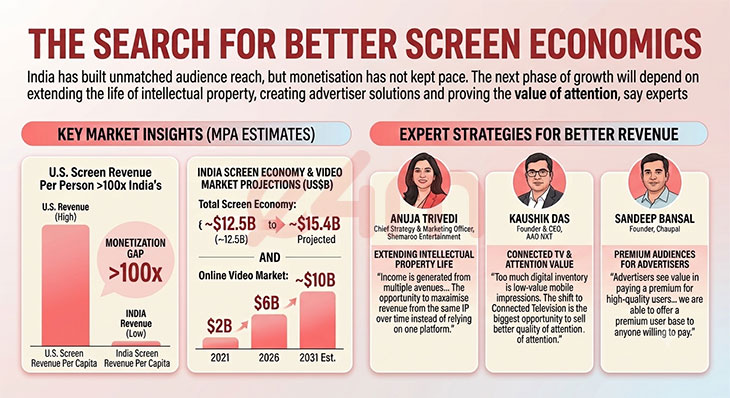
South Korea generates nearly 30 times India’s screen revenue per person; the United States, more than 100 times. Even China generates over seven times India’s figure, according to Media Partners Asia (MPA). These comparisons are not measures of individual entertainment spending. They reflect advertising yields, subscription economics, purchasing power, content exports and industry structure. But they raise an uncomfortable question: if audience scale is India’s defining advantage, why does it translate into so little revenue per person?
One reason lies in the economics of access. Much of the content available on India’s leading digital platforms is free, while monthly subscriptions across several services cost around ₹100 or less. Some platforms also offer episode- or series-level payments for just a few rupees. These low prices help widen access and encourage consumption, but they also constrain revenue per user unless platforms can drive repeat purchases, build paying audiences at scale or persuade viewers to pay more for differentiated content.
Also Read: India has the video audience, but is the monetisation catching up?
Clearly, content distribution has expanded faster than monetisation. A television show can find a new audience on YouTube; an old song can resurface through an Instagram Reel and lead viewers back to the original; an OTT title can travel across markets. Yet the commercial value of these audiences depends on who owns the rights, how content is packaged and whether viewers or advertisers are willing to pay.
Sandeep Bansal, Founder of Chaupal, an OTT platform focused on Punjabi, Haryanavi and Bhojpuri content, acknowledges the gap but points to the size of India's market.
“India is a significantly larger economy than South Korea or most other economies, and hence, even at a lower ARPU, the market remains lucrative enough for many players. Having said that, there is still a gap in the amount that Indian screens earn versus those overseas,” he says.
According to Bansal, the roots of this gap lie partly in how the OTT market developed. “India started its wave of OTT adoption on the back of heavily subsidised and, in many cases, free content. Therefore, early on, users never got a chance to form a paying habit. In the West, the transaction is clear: you want content, you pay for it. That mindset is developing very slowly in India, and it is only after the larger OTT players started charging for subscriptions that the pace has picked up.”
The gap is not a failure but a consequence of a long-standing industry priority, says Kaushik Das, Founder & CEO of AAO NXT, an Odia Streaming Platform. “It is the result of a deliberate choice India made over two decades: to build reach first and worry about revenue later. That is the structural problem, and it is cultural as much as it is commercial.”
Das identifies three priorities for changing the equation. First, platforms must make subscriptions worth paying for through clear pricing, differentiated tiers and content that cannot be accessed free elsewhere. The opportunity is already visible: according to the FICCI-EY Media and Entertainment Report 2026, digital subscription revenues grew 60% in 2025 to ₹16,300 crore, with 216 million paid video subscriptions across 143 million households.
“Indians will pay. They just will not overpay,” Das says, adding, “Second, advertising yields must move from volume to value. “Too much of India’s digital inventory is low-value mobile impressions sold by the thousand. The shift to connected television, where the same report counts around 40 million units now against 30 million a year earlier, is the single biggest opportunity to sell a better quality of attention at a better price.”
The third priority is to extend the commercial life of content. “A show or a film in India earns from one window and then disappears. Korea built its per capita numbers on exporting formats and extending IP across music, merchandise, games and remakes. We have the stories and the languages to do the same, and we have barely started,” Das adds.
The revenue mix is changing. MPA estimates India’s online video market grew from about $2 billion in 2021 to $6 billion in 2026, while television revenue declined from $7 billion to $4.8 billion. Online video is projected to reach about $10 billion by 2031, with the overall screen economy expanding from roughly $12.5 billion to $15.4 billion.
That growth creates opportunities for content owners, platforms and advertisers, but the economics remain unsettled. Can a content library generate multiple revenue streams over its lifetime? Can an OTT property support brand partnerships without damaging the viewing experience? And can media businesses prove enough commercial value for advertisers to pay more than they would for conventional inventory?
Anuja Trivedi, Chief Strategy and Marketing Officer at Shemaroo Entertainment, believes the challenge is not a lack of demand but the industry's ability to translate consumption into revenue.
“India has never had a problem with content consumption. We have audiences watching content across multiple screens, discovering new formats and revisiting older content. But the amount of content people consume and what the industry earns from it are two different things,” she says.
Distribution has expanded faster than monetisation. A television show can find a new audience on YouTube; an old song can resurface through an Instagram Reel and lead viewers back to the original; an OTT title can travel across markets. Yet the commercial value of these audiences depends on who owns the rights, how content is packaged and whether viewers or advertisers are willing to pay, she points out.
Pep Figueiredo, COO of PTPL India and a former SonyLIV executive, believes these revenue streams will define the market’s next phase. Citing South Korea’s success in exporting intellectual property, he sees $15 billion as a realistic five-year target for India’s screen economy, driven by retail media and international distribution.
Das, however, cautions against measuring India against markets with vastly different income levels. “If India can double its screen revenue per capita in five years, from roughly eight dollars to fifteen or sixteen, that would be a structural shift, not just growth. It would mean we have moved from being a market of viewers to a market of paying audiences, and that is the only milestone that matters,” he says.
Extending the life of IP
For content owners, one of the most immediate opportunities lies in extending the commercial life of existing intellectual property. Content no longer needs to depend on its original release, platform or audience to remain relevant.
Shemaroo has seen content find new audiences well beyond its first release. Anuja Trivedi noted that the opportunity lies in maximising IP across platforms and aligning advertising measurement with campaign objectives.
“There are many more ways for content to reach people today, and we need to make better use of those opportunities,” Trivedi says. The task is not simply to distribute content everywhere, but to build a revenue strategy around how audiences discover, consume and revisit it.
“For a brand like ours, income is generated from multiple avenues like broadcast, digital advertising, subscriptions, licensing and syndication. The opportunity is to maximise revenue from the same IP over time instead of relying on one platform,” she adds.
That makes rights ownership and distribution strategy central to content economics. A property that continues to find audiences can generate licensing and syndication income alongside advertising and subscription revenue. But returns depend on the rights available, distribution terms and the commercial value of each audience.
It also requires understanding what each platform does best. “Be it broadcast, OTT or connected TV, each platform plays a different role depending on the audience a brand wants to reach and what it wants to achieve,” Trivedi says.
Bansal places this evolution within a broader progression in the subscription market. “For any economy, the pattern is always that first, you get those with the highest paying capacity to pay for subscription-based premium services. Then, you move on to capture users with a lower capacity to pay through cheaper ad-supported plans, and the last leg is captured through free, completely ad-supported plans. India is currently somewhere between phases one and two, so it will take time for its potential to be realised to the level that it can be.”
Subscriptions need a reason
In a market where free content competes with paid entertainment, subscriptions depend on whether viewers perceive distinct value. Trivedi points to ShemarooMe, the company’s Gujarati OTT platform, as an example of building around a specific linguistic and cultural audience.
“People will pay for content when they see value in it, but that value has to be clear,” she says. A strong library that viewers want to return to will be central to subscription growth.
Subscriptions cannot be treated simply as a function of adding titles. Content must give viewers a reason to return, while the platform must offer a differentiated experience that justifies payment.
Making attention measurable
Advertising presents a second test. Reach and impressions remain important, but they do not establish whether advertising changed behaviour or generated sales.
For platforms seeking premium rates, the case increasingly rests on proving the value of the attention they sell. That requires measurement frameworks linking exposure to business outcomes while accounting for other factors influencing sales.
“When ad campaigns convert to incremental sales for the brands, this will motivate brands to reinvest,” Figueiredo says.
Trivedi argues that metrics should reflect campaign objectives. “We can deliver millions of impressions, but if people don’t remember the brand or have no interest in what they have seen, reach alone doesn’t tell us very much,” she says.
Measures range from viewing duration and completed ad views to brand recall, awareness, consideration and purchase intent. For sales-led campaigns, conversions, cost per acquisition and return on advertising spend matter; incremental sales can provide further evidence where credibly measured.
“The measures of success ultimately depend on whether the brand is looking to build awareness or drive sales,” Trivedi says. Reach and attention are complementary: reach puts a message in front of an audience, while outcome measures show what happened next.
The opportunity is expanding. MPA estimates India’s connected-TV advertising opportunity at about $850 million, while retail media has grown from roughly $300 million in 2020 to $3.1 billion in 2026, according to industry estimates reported in September. CTV brings advertising to television screens; retail media links advertising with shopping environments and transaction data. The latter may offer a clearer route to commercial impact, but measurement must still distinguish correlation from causation.
Beyond ad slots
Ravikant Sabnavis, partner at Daily Roti LLP and former CEO of Arha Media & Broadcast which runs Aha, a Tamil and Telugu focussed streaming platform, believes content businesses must look beyond the conventional choice between advertising slots and subscriptions.
“Content owners must find new and disruptive ways of monetisation, rather than try and flog the conventional options like subscriptions and ad slots,” he says.
One route is to integrate brands into shows during or after production, rather than treating advertising as an interruption. Another is to create a path from content to commerce.
Sabnavis cites Aha’s brand integrations on OTT and its experimentation with long-form content as alternatives to conventional web-series economics. “Long-form content on OTT is another innovation, also pioneered by Aha way back in 2022-23, rather than a web-series format which is difficult to monetise both from a subscription and brand-integration perspective,” he says.
Formats running across 30–50 episodes can create more monetisation opportunities while building viewer stickiness. A longer run gives brands more chances to associate with a property and allows viewers to develop a sustained relationship with its characters and storylines.
But longer content is not automatically more profitable. Its economics depend on continued viewing, meaningful brand participation and whether additional production investment can be recovered. More episodes create potential; they do not guarantee demand.
Integrations must also fit the content and audience. An intrusive or disconnected placement can undermine the viewing experience, while a relevant association can engage consumers more naturally.
“Rather than be fixated with a number or target, content owners should focus on creating these opportunities and let higher ARPUs be the outcome,” Sabnavis says.
Bansal points to the value of a paying audience as another way to differentiate an OTT platform. “Advertisers already do see value in paying a premium for high-quality users. Chaupal, since day one, has always been a subscription-based OTT platform, with a 50% iOS user base indicating high-value users. As such, we are able to offer a premium user base to anyone who is willing to pay,” he says.
From inventory to solutions
The shift is also changing conversations with advertisers. In Sabnavis’s experience at Aha, many advertisers wanted meaningful consumer engagement rather than a conventional slot.
“Whilst heading Aha, I found that the overarching metric for a large number of advertisers has moved to ‘how do I engage meaningfully with my consumers’, thus rendering the traditional ad-slot model irrelevant for this cohort,” he says.
The distinction is between supplying inventory and solving a marketing problem. A conventional slot offers placement and exposure. A tailored solution starts with the advertiser’s objective and considers how content, brand association and measurement work together.
“For content owners to win a premium from advertisers, they must try and tailor a measurable solution for the advertiser’s problem, rather than offer an off-the-rack solution,” Sabnavis says.
The same principle applies to subscriptions. Both advertisers and viewers need a reason to pay: advertisers need solutions to marketing problems, while viewers need value beyond what is freely available.
This places greater demands on media businesses. They must understand the advertiser’s objective, identify the right content and audience, design an appropriate campaign and define success. Describing an opportunity as immersive or outcome-led is not enough; commercial value must be demonstrated.
Read more news about Digital Media, Internet Advertising, Marketing News, Television Media, Radio Media
For more updates, be socially connected with us onInstagram, LinkedIn, Twitter, Facebook, YouTube & Google News